How to Turn Book Notes Into Reusable Knowledge
Move from chapter summaries to source-traceable claims, questions, connections, retrieval prompts, decisions, and project outputs.
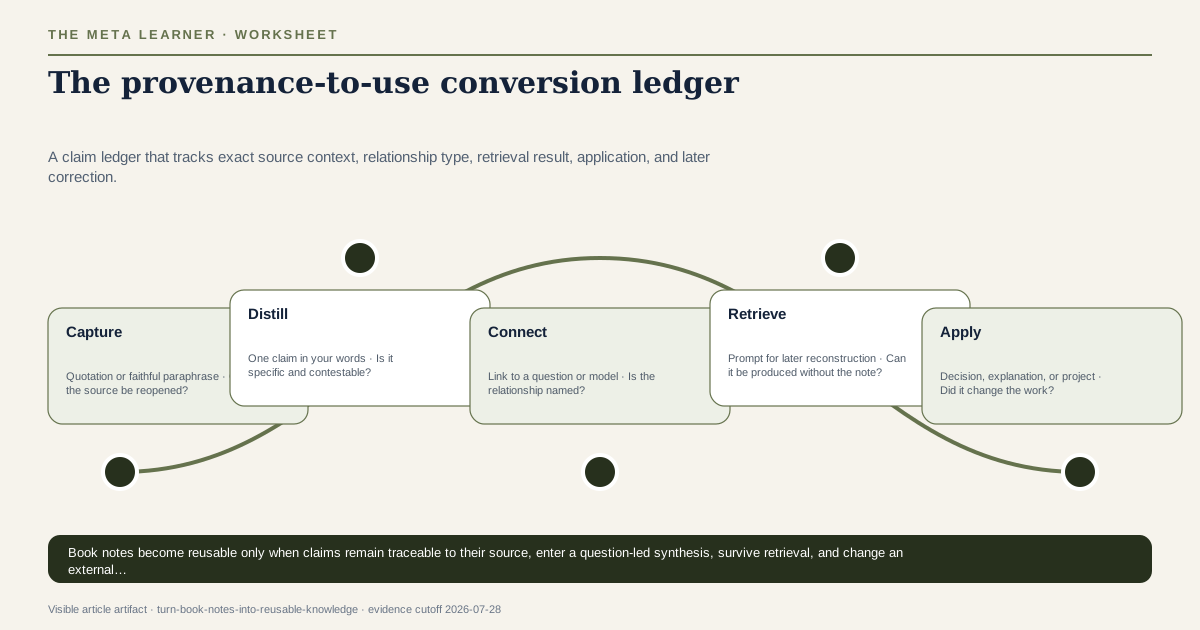
Turn book notes into reusable knowledge by extracting source-traceable claims, rewriting them in your own model, connecting them to active questions, retrieving them after a delay, and applying them in a decision or artifact. A note becomes reusable when it has both provenance and a route to use. Decomposition can damage literary, historical, or argumentative context; consequential interpretation still requires returning to the whole source.
Reuse begins where chapter order ends
This guide is for readers who want ideas from books to survive beyond the reading session and contribute to later decisions or writing. It covers claim extraction, source boundaries, synthesis, retrieval, application, and revision. It is not atomizing every sentence, replacing the book with notes, or building an archive without use. Reopen one note a month later and ask whether it still leads to the passage, preserves the author’s boundary, and helps with a new question. Reusability is demonstrated at retrieval, not at capture.
Chapter summaries preserve the book’s order, not necessarily the structure of your future problem. Reuse requires a second transformation: from “what the book said next” to “what claim belongs in which question, with what evidence and boundary.”
The six transitions a reusable note must survive
| Stage | Artifact | Quality test | |---|---|---| | Capture | Quotation or faithful paraphrase | Can the source be reopened? | | Distill | One claim in your words | Is it specific and contestable? | | Connect | Link to a question or model | Is the relationship named? | | Retrieve | Prompt for later reconstruction | Can it be produced without the note? | | Apply | Decision, explanation, or project | Did it change the work? | | Revise | Updated claim and history | Are corrections visible? |
The pipeline can live in any medium. Clear fields matter more than software.
The non-negotiable source anchor
For every substantive source note, retain author, title, edition or date, page or location, and a stable link when available. Distinguish direct quotation, close paraphrase, and your inference. If an AI helped transform the note, keep the original passage and verify the transformation.
Provenance is not administrative decoration. It allows you to recover context, audit an overconfident summary, and cite responsibly years later.
Make the edge carry meaning
Do not merely link two notes. Name why:
- supports;
- contradicts;
- qualifies;
- supplies an example;
- transfers to;
- raises a question about.
A typed relationship makes later synthesis faster because the interpretive work is visible.
Synthesis case: twenty chapter summaries, no answer
A reader has chapter summaries from twenty books but cannot assemble a defensible answer to a new question.
The reader changes the unit of organization from chapters to contestable claims. Each claim keeps its source context and a typed relationship to the live question:
| Observed signal | What it may mean | Next response | |---|---|---| | Summary by chapter | Structure follows the book, not future use | Reorganize around claims or questions | | Permanent note | Revision history may disappear | Keep source, date, and confidence | | Many links | Association is not synthesis | Write the relation: supports, conflicts, qualifies |
The reader builds a small claim table across three books, identifies disagreement, writes a synthesis paragraph, and tests it in an actual essay. Reuse creates the organization.
The claim table solves a synthesis problem for a small nonfiction set. It is not a demand to fragment literature, erase an author’s architecture, or keep every passing idea.
Why reuse needs retrieval and application
Learning research emphasizes retrieval, integration with prior knowledge, and application across contexts. These principles imply that rereading an archive is a weak endpoint. Reconstructing a claim, comparing it with another source, and using it in a novel task provide stronger evidence of accessible knowledge.
1, 2The unfamiliar-question test
Choose a question the original book did not answer directly. Retrieve three relevant claims, reopen their passages, and write a synthesis that preserves where they agree and conflict. Then ask what assumption connects the claims to the new question. Reuse has occurred only if the result is both generative and traceable; friction that sends you back to the whole book may be a valuable safeguard.
Process five notes into one live decision
Process five notes from a recently finished book:
- Choose notes relevant to one live question.
- Rewrite each as a standalone claim.
- Attach exact source context.
- Add a limitation or condition.
- Connect each to one other source or experience and name the relation.
- Create two retrieval prompts that span multiple notes.
- Use at least one claim in a memo, lesson, decision, or experiment this week.
After a month, reopen the project output before the original notes. Observe which ideas proved useful, which were distorted, and which never needed permanent storage.
Continue with How to Synthesize 20 Sources, expose the reasoning through The Evidence Map, and test record durability in How to Build a Personal Knowledge Base That Survives Tool Changes.
Let claims change without rewriting provenance
Do not treat “permanent note” as “unchangeable belief.” Retain the original claim, source location, confidence, and date; append later qualifications, counterevidence, and uses. Separate a changed interpretation from a changed source. This history makes correction possible without severing provenance and shows whether a once-promising idea ever earned repeated use.
Failure modes of the knowledge warehouse
- Importing highlights and declaring the book processed.
- Keeping claims tied to chapter order.
- Removing nuance to make notes “atomic.”
- Linking everything without naming the relationship.
- Generating a summary without checking the source.
- Saving knowledge with no active question or future route.
What should resist atomization
Not all reading should become a database. Literature, exploratory reading, and tacit professional knowledge can resist decomposition. Reuse also risks decontextualizing an author’s argument. Return to the whole source when interpretation or stakes require it.
Reusable knowledge is not an ever-growing warehouse. It is a maintained network of claims you can trace, retrieve, challenge, and put to work.
Named sources
Evidence and further reading
Published July 29, 2026. Substantively updated July 29, 2026. Evidence last verified July 28, 2026.
- : Rebuilt as a provenance-preserving claim pipeline with retrieval and synthesis tests.