How to Build a Personal Learning System
Build a lightweight personal learning system that connects questions, sources, practice, evidence, projects, and review without becoming a second job.
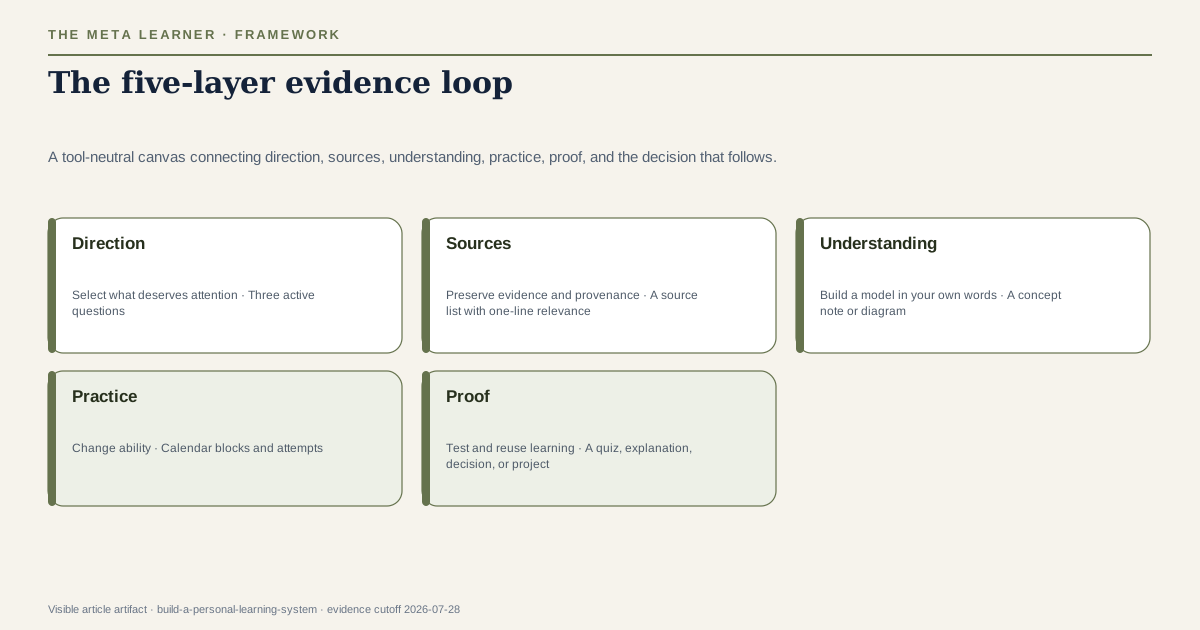
A personal learning system is a small set of repeatable places and routines that move a question toward understanding and usable capability. The minimum viable system needs an active-question list, trusted sources, scheduled practice, performance evidence, and a review that changes what happens next. The evidence supports learning mechanisms, not one application, taxonomy, review cadence, or universal workflow.
Start with flow, not a tool stack
This guide is for adults managing several learning goals who need continuity without turning learning into administration. It covers a lightweight system for active projects, evidence, review, and reuse. It is not a prescribed app stack, an exhaustive personal archive, or a second-brain ideology. Run the system on one live learning project first. Its value appears when the project survives interruption, produces an honest test, and leaves a trail you can reuse—not when the dashboard looks complete.
It does not require a sophisticated app. In fact, a system that demands constant tagging and migration can consume the time it was meant to protect. Start with the flow of work; choose tools only after the flow is clear.
A five-layer learning architecture
| Layer | Purpose | Smallest useful artifact | |---|---|---| | Direction | Select what deserves attention | Three active questions | | Sources | Preserve evidence and provenance | A source list with one-line relevance | | Understanding | Build a model in your own words | A concept note or diagram | | Practice | Change ability | Calendar blocks and attempts | | Proof | Test and reuse learning | A quiz, explanation, decision, or project |
An archive is not a system if nothing travels through it. Each layer should lead to the next: a source changes a model; the model suggests a practice; the practice produces evidence; the evidence alters priorities.
The architecture is deliberately tool-neutral because the evidentiary boundary is narrower than any app recommendation:
Specify proof before choosing containers
Begin with a twelve-week horizon and one capability that matters. Define the proof you would trust: an interview in the new language, a published analysis, a reproducible program, or a decision memo that survives critique. Break that proof into smaller performances.
Create only four working views:
- Now: no more than three active learning questions.
- Sources: items selected for a reason, with author, link, date, and relevance.
- Practice: the next scheduled attempt, not a wish list.
- Evidence: dated artifacts, feedback, errors, and decisions.
Notes belong to a question or project whenever possible. This gives them a retrieval route and a reason to be revised.
Put AI behind a provenance boundary
AI can help turn a goal into possible components, generate contrasting examples, question an explanation, or format a practice set. Keep the original source beside any generated synthesis. Label uncertain output. For important claims, record the evidence you opened rather than the citations a model merely suggested.
Treat prompts as disposable unless they encode a valuable procedure. The durable asset is not a library of clever phrases; it is a workflow whose inputs, checkpoints, and outcomes you understand.
Failure diagnosis: the consultant with five inboxes
A consultant saves articles about negotiation, AI, and writing across five tools. When a project begins, the material is hard to find and none of it is connected to a decision.
Diagnose the broken transition rather than redesigning the whole system. The consultant distinguishes capture, interpretation, practice, and proof, then asks where material stops moving:
| Observed signal | What it may mean | Next response | |---|---|---| | Large inbox | Capture exceeds processing | Stop collecting and choose an active question | | Many folders | Taxonomy may precede use | Organize around current projects | | No review evidence | The system stores but does not teach | Schedule retrieval or application |
She keeps one project page with the question, three source notes, one attempted output, and an error log. At review, inactive material is archived; reusable claims are linked to the deliverable that tested them.
The case does not show that one project page is universally sufficient. It shows an observable correction to a specific failure: stored material was not entering retrieval, performance, or decisions.
The only test that matters: can the model travel?
Choose one concept the system appears to have taught. Explain it without opening the notes, apply it to a new case, and then inspect the source record for distortion. A useful system should help recover the model, reveal uncertainty, and route errors back to their evidence. If only the folder location is remembered, storage improved but learning did not.
Build version 0.1, then close the loop
Build version 0.1 in thirty minutes:
- Write one twelve-week outcome and one test.
- Choose three current questions.
- Add no more than five sources for the first question.
- Schedule two attempts and one delayed test.
- Create an evidence log with columns for date, task, result, error, and next change.
At the end of each week, delete or defer inactive questions, inspect the evidence, and plan the next three attempts. Do not reorganize the whole archive.
Then connect the capture layer to Note-Making vs Note-Taking, compare the design with The Retrieval-First Knowledge Base, and use What Should You Memorize When AI Can Retrieve Almost Anything? to decide what must remain internal.
The learner’s weekly operating loop
Review only the active questions, scheduled attempts, and new evidence. For each question, decide: continue, narrow, defer, or stop. Record the error that changed the decision and the next performance that could test it. Do not create a recurring review obligation for the published article; this is a learner-controlled operating loop inside the method.
Six ways the system turns into clerical work
- Collecting before choosing a question.
- Designing a universal taxonomy before producing any work.
- Saving AI output without source boundaries.
- Reviewing notes without retrieval.
- Tracking minutes while ignoring performance.
- Allowing more active projects than the calendar can support.
Where a personal system stops
A lightweight system will not encode all the nuance of complex research or professional practice. Some fields require specialized labs, supervisors, software, or formal records. The system should connect to those environments rather than pretend to replace them.
The test of a personal learning system is simple: does it help you choose better practice and produce better evidence of capability? If not, simplify it until it does.
Named sources
Evidence and further reading
Published July 29, 2026. Substantively updated July 29, 2026. Evidence last verified July 28, 2026.
- : Rebuilt around a tool-neutral evidence loop and an inspectable minimum viable learning system.