The Meta Learner Method: Map, Practice, Test, Adapt
A four-stage method for turning a vague learning ambition into a tested cycle of diagnosis, deliberate practice, evidence, and revision.
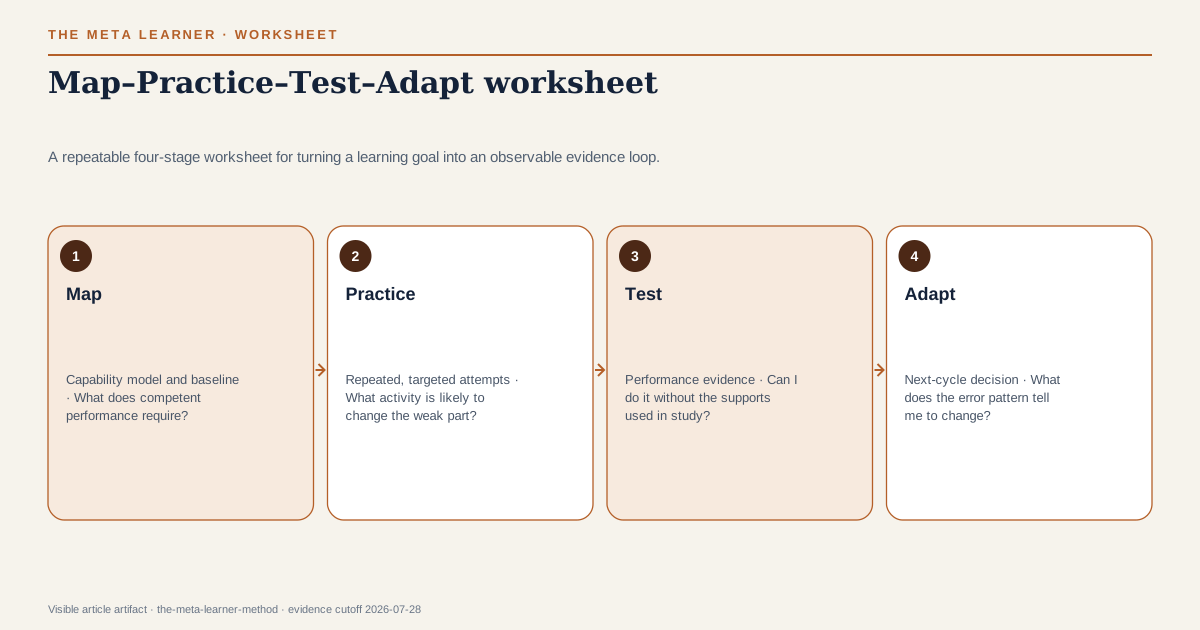
The Meta Learner Method is a repeating four-part cycle: map the capability, practice the component that needs to change, test it under honest conditions, and adapt from the result. It converts learning from content consumption into a sequence of evidence-producing decisions. Some goals are hard to decompose, some feedback is delayed, and short cycles can favor what is easily measured.
When the cycle is worth running
This guide is for adult self-learners who need a repeatable method for new, ambiguous, or changing learning goals. It covers the full Map–Practice–Test–Adapt cycle and the evidence required to move between its stages. Use this when the desired capability can be demonstrated, a representative attempt can be saved, and the learner can change at least one feature of practice. Do not use it as a rigid four-step schedule, as a guarantee that every domain can be learned alone, or when a high-stakes task requires licensed supervision. Judge the cycle by whether the target capability survives delay and changed conditions, not by the neatness of the map or the industriousness of the practice log.
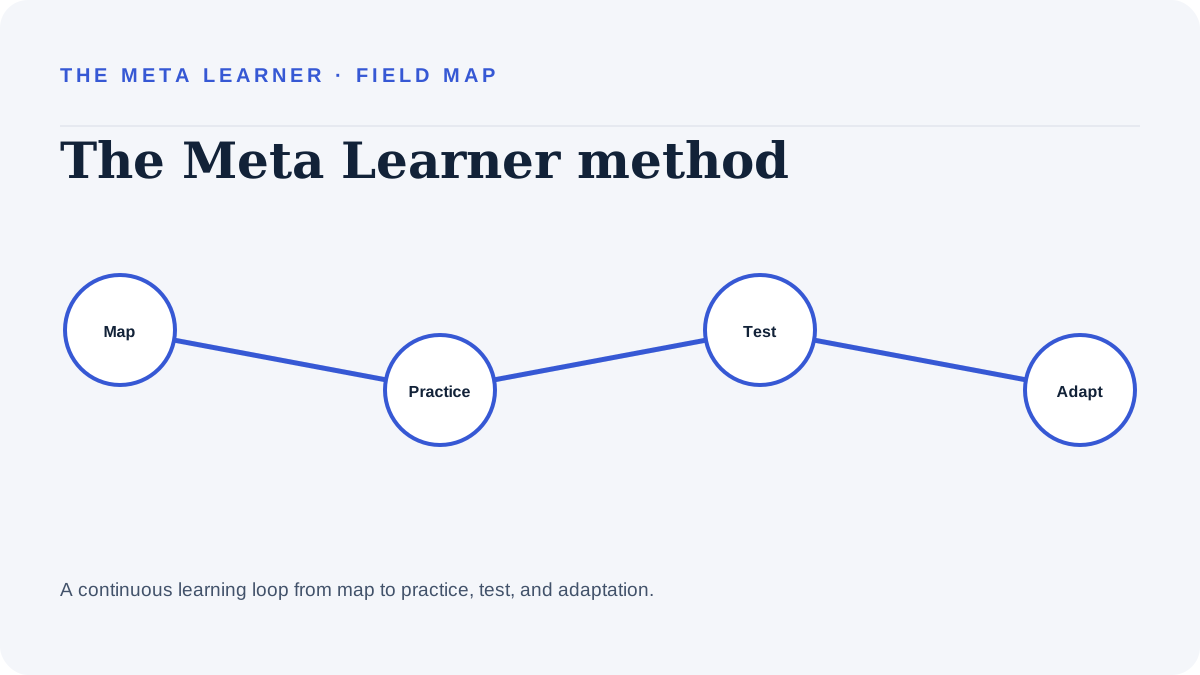
The method is deliberately small. It can organize a two-hour session, a twelve-week project, or the maintenance of an expert skill. Its purpose is not to prescribe one study technique but to make the learner’s choices and evidence explicit.
The cycle at a glance
| Stage | Output | Diagnostic question | |---|---|---| | Map | Capability model and baseline | What does competent performance require? | | Practice | Repeated, targeted attempts | What activity is likely to change the weak part? | | Test | Performance evidence | Can I do it without the supports used in study? | | Adapt | Next-cycle decision | What does the error pattern tell me to change? |
Research principles behind the cycle
The method synthesizes established findings rather than claiming a new scientific theory. Prior knowledge shapes new learning; retrieval and practice conditions affect retention; feedback is most useful when it helps close a defined performance gap; and metacognitive monitoring helps learners regulate strategy. No single technique replaces alignment among goal, practice, and test.
1, 2, 3Map
Rewrite the ambition as a performance. “Learn data analysis” is too broad. “Given an unfamiliar customer dataset, I can clean it, choose an appropriate comparison, explain uncertainty, and produce a reproducible chart” exposes component skills.
Then establish a baseline by attempting a representative task. Do not study first. The attempt reveals missing concepts, brittle procedures, and false confidence. Ask a knowledgeable person or a reliable rubric what good performance contains.
Practice
Select an activity that targets the current bottleneck. If the gap is recall, retrieve. If it is perceptual discrimination, compare examples. If it is execution, perform the procedure. If it is judgment, classify cases and explain choices.
Keep assistance adjustable. A worked example may be useful early; later, fade prompts and references. AI can generate variations or simulate a partner, but it should not conceal which part you performed.
Test
Testing is not punishment at the end. It is information for the next decision. Match the test to the target:
- Explain the concept without notes.
- Solve a new case rather than the rehearsed example.
- Hold a live conversation with an unfamiliar partner.
- Ship a small artifact to a real standard.
- Revisit the task after a delay.
Record accuracy and the type of error. “Failed” contains little guidance; “recognized the concept but could not select it under time pressure” suggests a more useful next practice.
Adapt
Change one important variable: representation, difficulty, feedback source, spacing, or task type. Keep what worked long enough to observe a pattern. Adaptation is disciplined hypothesis revision, not endless method shopping.
Worked cycle: evaluating an AI product claim
An entrepreneur wants to evaluate AI product claims. A broad goal such as “learn AI” cannot determine what to read or how to know when the learning is sufficient.
The method becomes useful only when each stage leaves evidence for the next. Convert the situation into a specific mapping, practice, testing, or adaptation problem:
| Observed signal | What it may mean | Next response | |---|---|---| | Map has only topics | Performance is undefined | Add decisions or outputs the learner must make | | Practice resembles consumption | Target process is absent | Make the learner retrieve, choose, or produce | | Test repeats examples | Near familiarity may dominate | Use a new case with the same underlying structure |
The goal becomes: compare two model evaluations, identify unsupported conclusions, and write a recommendation with uncertainty. Practice uses flawed examples; the test uses a new vendor report; adaptation follows the observed error categories.
The worked loop is intentionally small. It demonstrates how evidence moves through the four stages; it does not prescribe the same practice schedule or test for every domain.
Transfer beyond Map–Practice–Test–Adapt worksheet
Take the four-stage record into a new context without the original worked example. Preserve the sequence, but change the target evidence, practice, and test so they resemble the new performance. The unaided test passes only when the learner can justify those replacements, complete the new task without hidden scaffolding, and use the resulting error pattern to choose the next adaptation. A polished answer produced with the old template is not transfer.
Why the stages loop
Map, Practice, Test, and Adapt are functions, not fixed phases. A real session may loop from testing back to mapping when a hidden prerequisite appears. It may move from practice to adaptation when feedback shows that the exercise rewards the wrong behavior. What makes the method coherent is the evidence at each transition. The map names the desired performance; practice produces attempts; testing removes supports or changes context; adaptation responds to an observed pattern rather than mood.
When the result disappoints, revise the stage that produced the weak evidence. Do not redesign the whole loop unless failures recur across tasks and stages.
Run a seven-day evidence cycle
Run a seven-day minimum cycle:
- Choose one capability and one authentic test.
- Attempt the test now; save the baseline.
- Identify the highest-leverage gap.
- Schedule three short practices that target it.
- Repeat a comparable test without assistance.
- Compare the artifacts and classify errors.
- Write one sentence: “Next cycle, I will change ___ because ___.”
Preserve the transition evidence
Before changing the learning process, record five fields: the target performance, the present evidence, the change you will make, the result you predict, and the date of review. For this topic, “map has only topics” is a signal to investigate, not a conclusion. State why the chosen practice should change the mapped capability and name the result that would make you abandon that explanation. After the review, retain the original entry and append the outcome. The preserved prediction gives adaptation teeth: success can confirm only what was actually forecast, and failure cannot be edited into inevitability.
Breakdowns between map practice test and adapt
- Mapping an entire discipline instead of the next useful capability.
- Practising what feels comfortable rather than the bottleneck.
- Testing with the same cues used during study.
- Changing several variables, making results uninterpretable.
- Treating a score as a verdict on identity rather than data about a method.
Add a criterion-bearing reviewer
Use a reviewer at the test stage to identify errors the learner cannot see. Ask the reviewer to point to a criterion and a concrete revision, then run that revision through another map–practice–test cycle.
Carry the cycle into adjacent problems
Place this article in a larger learning path: use What Is Meta-Learning? A Human Guide to Learning How to Learn for prerequisite context, compare its boundary with Meta-Learning vs Productivity: The Difference That Matters, and continue into Build Your First Useful AI Workflow: Agents, Automation, and Human Checkpoints when you are ready to test the idea in another decision.
What the cycle permits you to claim
The evidence in this article supports a bounded design choice, not a rigid four-step schedule or a guarantee that every domain can be learned alone. The four moves are stable, but their contents are not: a novice may need worked guidance, while an experienced practitioner may need adversarial cases and delayed transfer. Carry the map, prediction, attempt, result, and revision together; otherwise adaptation becomes a story told after the outcome rather than a response to evidence. For consequential capabilities, the cycle needs external standards, qualified feedback, and an accountable evaluator—not only the learner’s private judgment.
What the cycle cannot resolve
Some goals are hard to decompose, some feedback is delayed, and short cycles can favor what is easily measured. Creative judgment and professional expertise require richer contexts than a checklist can capture. Use the method to guide inquiry, not to reduce every form of learning to a number.
The cycle ends only provisionally. When the context changes, yesterday’s competence becomes a new map.
Named sources
Evidence and further reading
Published July 29, 2026. Substantively updated July 29, 2026. Evidence last verified July 28, 2026.
- : Added entry and non-use conditions, executable evidence gates, adaptations, failure modes, and an unaided transfer test.