Meta-Learning vs Productivity: The Difference That Matters
Productivity helps you complete work; meta-learning changes what you can understand and do. Learn where they overlap and how to measure each honestly.
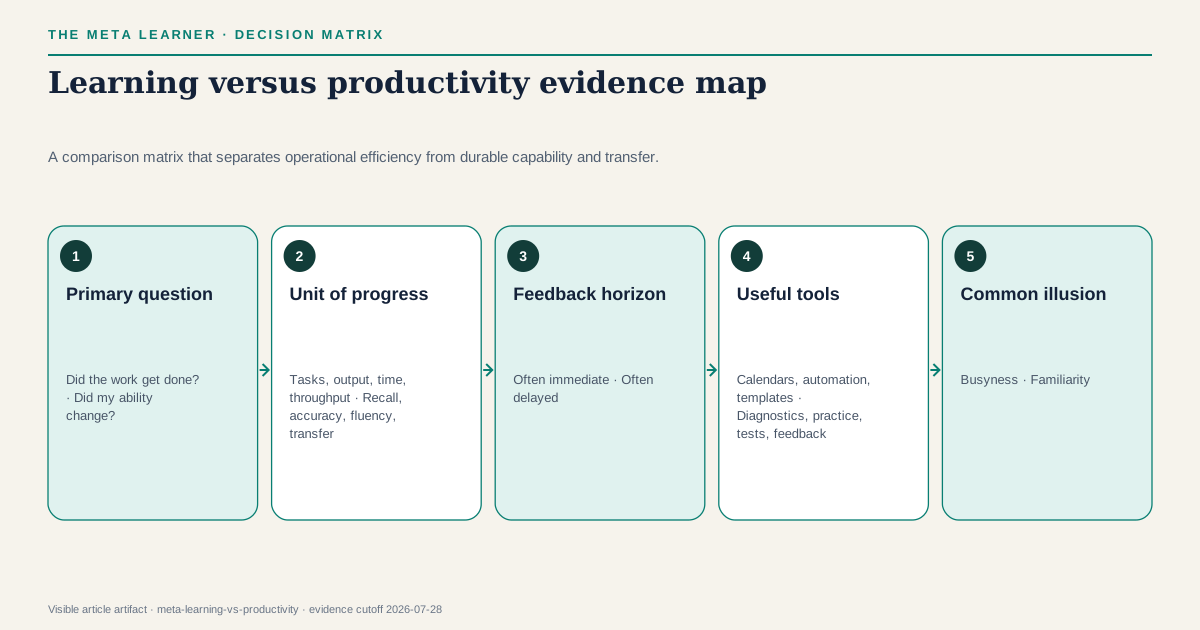
Productivity is about producing desired outputs with limited time and resources; meta-learning is about improving the process by which your capabilities change. A productive session may generate many notes or pages, while an effective learning session may produce little visible output but stronger retrieval, judgment, or transfer. The boundary is not always clean.
The category error
A full study dashboard can coexist with a static capability. The problem is not necessarily discipline; it is a category error. Productivity measures whether desired work is produced with limited resources. Meta-learning measures whether the learner’s future performance changes.
This distinction does not make calendars, task lists, or friction reduction unimportant. It prevents their visible outputs from becoming counterfeit evidence of recall, judgment, or transfer.
The two are allies when the system protects good practice. They become enemies when efficiency removes the cognitive activity that learning requires. An AI-generated summary, for example, may be a productive way to scan a document but a poor substitute for reconstructing its argument from memory.
Output and capability on separate axes
| Dimension | Productivity | Meta-learning | |---|---|---| | Primary question | Did the work get done? | Did my ability change? | | Unit of progress | Tasks, output, time, throughput | Recall, accuracy, fluency, transfer | | Feedback horizon | Often immediate | Often delayed | | Useful tools | Calendars, automation, templates | Diagnostics, practice, tests, feedback | | Common illusion | Busyness | Familiarity | | Failure signal | Missed outcome or excess cost | Inability to perform without support |
Neither column is superior in every situation. If you already possess the skill, automation may be sensible. If the objective is to acquire the skill, automating the essential performance can defeat the purpose.
Learning versus productivity evidence map: evidence and boundary
Reviews of learning techniques find that practice testing and distributed practice generally produce more durable learning than familiar activities such as rereading and highlighting. One reason the weaker activities persist is that fluency during study feels like progress. Productivity systems can amplify this illusion by rewarding visible completion rather than delayed performance.
1, 2This distinction clarifies many debates about AI. If the goal is to ship a routine internal memo, assisted drafting can reduce time. If the goal is to become a persuasive writer, the learner still needs to generate, diagnose, revise, and compare language. The same tool use can be appropriate for one objective and counterproductive for the other.
The substitution test
Before making a workflow faster, ask:
- What capability is this activity supposed to exercise?
- Which part of the activity creates that change?
- Does the shortcut preserve, strengthen, or remove that part?
- How will I test the capability without the shortcut?
Suppose you are learning Spanish conversation. Automatically translating every sentence improves message completion but may remove lexical retrieval and repair practice. A better design might allow one unaided attempt, then a hint, then feedback after speaking.
Case: every coding lesson completed, no feature built
A designer completes every scheduled coding lesson and keeps immaculate notes, yet cannot build a small feature without following the instructor line by line.
The hidden inference is whether faster activity produced stronger capability. Separate workflow signals from learning evidence before deciding that an optimized system is working:
| Observed signal | What it may mean | Next response | |---|---|---| | Plan completed | Activity target was met | Test an unprompted performance | | More notes | Information was captured | Ask what can now be produced | | Faster workflow | Friction fell | Check whether errors or transfer improved |
The calendar remains useful, but the weekly review changes from hours completed to one independent build, its error pattern, and the next practice target. Productivity supports the learning loop; it no longer stands in for the result.
The comparison does not make productivity irrelevant. It shows why efficiency measures and learning measures must be kept separate enough to reveal when they diverge.
The capability-without-support test
Apply the same distinction to a second project. Keep one productivity metric and one delayed performance metric. A useful method should improve the work process without making independent recall, judgment, or transfer weaker.
Find where efficiency removed practice
Audit one week of learning activity in two columns. In the first, record throughput signals such as pages processed, notes captured, tasks completed, or prompts sent. In the second, record capability signals such as an explanation produced without support, an unfamiliar problem solved, an error corrected, or a decision defended. Look for cases where throughput rose but capability did not. Choose one of those cases and remove an optimization that may be hiding the target operation. Replace it with a short test that resembles the real outcome. The purpose is not to make work deliberately inefficient; it is to prevent smooth activity from becoming the only evidence available.
Build two ledgers for one week
Audit one week of “learning” tasks. Next to each task, record its true output:
- Operational output: a file, decision, message, or completed obligation.
- Learning output: a fact recalled, distinction recognized, procedure performed, or judgment transferred.
- Both: a real project deliberately designed to stretch capability with feedback.
Choose one task wrongly optimized for throughput. Replace its completion metric with a performance check. Instead of “read three chapters,” use “reconstruct the author’s argument, identify two assumptions, and apply one idea to a new case tomorrow.”
Pair leading and lagging evidence
A useful review keeps both kinds of measurement without confusing them. A leading measure tells you whether the conditions for learning occurred: three spaced practice sessions, two unaided attempts, or one round of external feedback. A lagging measure asks whether capability survived: recall after a delay, performance on an unfamiliar case, or a real decision made with fewer errors. Research on practice testing and distributed practice supports using later performance rather than immediate fluency as the stronger learning signal. 1, 2
The pair also prevents overcorrection. A poor delayed result does not mean schedules and tools are worthless; it means the activity needs diagnosis. Keep the operational system if it reliably creates practice opportunities, but change it when its rewards encourage collecting, polishing, or completing instead of retrieving and applying. The correct productivity system is the smallest one that protects the learning behavior and makes its result reviewable.
Preserve the divergence
When throughput rises but capability does not, freeze both observations before changing the system. Record which optimization may have removed the target operation, what you will restore, and the delayed result you expect. A completed plan is evidence about execution; it becomes learning evidence only when later performance changes.
When throughput impersonates learning
- Adding a complex note system when the missing ingredient is practice.
- Counting saved articles as knowledge.
- Automating a novice’s core work before they can inspect the result.
- Refusing all efficiency tools even after the capability is stable.
- Measuring only immediate performance and missing later forgetting.
Choose the missing loop
Place this article in a larger learning path: use What Is Meta-Learning? A Human Guide to Learning How to Learn for prerequisite context, compare its boundary with Learning How to Learn in the AI Era, and continue into The Meta Learner Method: Map, Practice, Test, Adapt when you are ready to test the idea in another decision.
Limitations
The boundary is not always clean. Writing an authentic report can both produce value and develop skill; organizing materials can reduce cognitive load and enable better practice. The important question is causal: which parts of the workflow are expected to change ability, and what evidence would show that they did?
Use productivity to make room for learning. Do not let its visible metrics replace the less visible work of becoming capable.
Named sources
Evidence and further reading
Published July 29, 2026. Substantively updated July 29, 2026. Evidence last verified July 28, 2026.
- : Reframed the comparison around durable capability, delayed testing, transfer, and inspectable workflow evidence.