Learning How to Learn in the AI Era
AI changes which parts of learning are abundant and which human capabilities become more valuable. This map shows how to adapt without becoming passive.
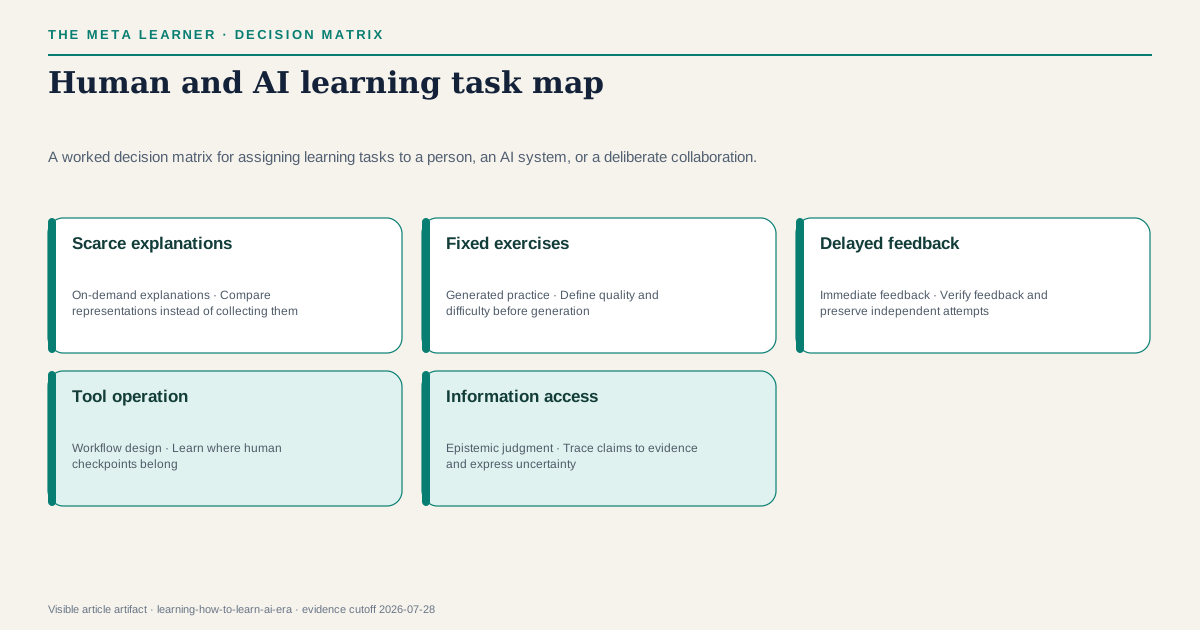
Learning in the AI era requires a deliberate division of labor: use AI to expand access, variation, feedback, and simulation, while keeping goal-setting, verification, retrieval, judgment, and responsibility with the learner. The central risk is not using AI; it is outsourcing the mental work that the intended capability requires. AI systems change quickly, and access, language quality, privacy protections, and error rates vary.
The new learning bargain
When explanations, examples, and drafts become abundant, the scarce resource is no longer first access. It is the learner’s capacity to frame, verify, retrieve, discriminate, and remain accountable without the system. This article is for self-learners deciding which operations AI may accelerate and which must remain part of the capability being built.
It covers access, feedback, practice design, verification, and the evidence used to claim competence. It is not a forecast of every model capability or a claim that every learning task should include AI.
Before generative AI, explanations and worked examples were often scarce. Now a learner can request ten analogies, a custom dialogue, a critique, or a practice set in seconds. But abundance does not settle whether the material is correct, appropriately difficult, remembered, or transferable to real work.
Five shifts that matter
| From | Toward | Learner response | |---|---|---| | Scarce explanations | On-demand explanations | Compare representations instead of collecting them | | Fixed exercises | Generated practice | Define quality and difficulty before generation | | Delayed feedback | Immediate feedback | Verify feedback and preserve independent attempts | | Tool operation | Workflow design | Learn where human checkpoints belong | | Information access | Epistemic judgment | Trace claims to evidence and express uncertainty |
These shifts do not make foundational knowledge obsolete. Judgment depends on knowledge: a person cannot reliably notice a missing premise, implausible number, or misleading analogy in a domain they do not understand. AI literacy and domain literacy therefore develop together.
Human and AI learning task map: evidence and boundary
Learning research consistently emphasizes the active construction of knowledge, retrieval, feedback, and transfer. UNESCO’s generative-AI guidance adds human agency, inclusion, privacy, and age-appropriate use as design constraints. These sources support a supervised partnership model, not a universal claim that AI improves learning by itself.
1, 2, 3, 4Current evidence is uneven because “using AI” covers many different interventions. A tutor that asks a learner to predict, attempt, explain, and revise is not equivalent to a chatbot that immediately supplies a polished answer. Outcomes depend on the learner, task, prompt, interface, feedback quality, and assessment.
Research synthesis on learning techniques also warns against equating fluent study performance with durable learning. For a novice, AI may need to expose worked structure and vocabulary; a learner with prior knowledge can accept less guidance and more adversarial practice. In both cases, delayed retention and an unaided transfer task—not satisfaction with the session—define whether the division of labor built the intended capability.
A human–AI learning protocol
Use this sequence for a concept, skill, or problem:
- Frame: Define the outcome and what a valid performance looks like.
- Attempt: Work unaided long enough to reveal your current model.
- Ask: Request a hint, critique, contrast, example, or question—not automatically the final output.
- Verify: Check important claims against primary or authoritative sources.
- Retrieve: Close the tool and reconstruct the explanation or procedure.
- Transfer: Apply it in a different example or real task.
- Reflect: Record the error pattern and next practice choice.
The order matters. An independent attempt creates diagnostic information. Retrieval reveals whether the explanation became yours. Transfer distinguishes local success from flexible understanding.
Case: ratios explained but not selected
A manager asks an AI system to explain accounting ratios and receives an elegant tutorial. The next day, she cannot choose which ratio matters in an unfamiliar case.
The key inference is whether AI removed irrelevant friction or removed the mental operation the learner needed to practise. Read each signal through that distinction:
| Observed signal | What it may mean | Next response | |---|---|---| | Fast answer | Access improved, not necessarily learning | Add a no-assistance retrieval step | | Personalized example | Relevance may improve | Check the example against a trusted source | | Confident output | Confidence is not provenance | Trace material claims before reuse |
She changes the workflow: first attempts the case, then requests a hint, then explains the ratio in her own words, and finally checks a published accounting source. AI supplies variation and feedback; the learner retains the work of selection, verification, and transfer.
This allocation is a design hypothesis. Different tasks and stakes require different boundaries, so the learner must retest independent performance after changing the division of work.
The unaided performance gate
Run the workflow once with AI support and once with the key support withheld. Change the subject but preserve the target operation. If performance survives, the support may be scaffolding; if it collapses, move that operation back into deliberate human practice.
Cheap output, expensive capability
AI changes the economics of learning unevenly. It makes first explanations and surface transformations cheap, but it does not make attention, memory change, judgment, or accountability cheap. That creates a temptation to optimize the abundant layer while neglecting the scarce one. A useful design therefore asks which cognitive act the learner must still perform. If the target is judgment, the system should expose contrasting cases and consequences rather than merely produce a polished conclusion.
Change one boundary at a time. Preserve enough of the workflow to identify whether the result came from better assistance, better practice, or simply more time.
When to add or remove AI
Before adding an AI step, write down the operation that should still belong to the learner: framing the question, retrieving a principle, checking a source, choosing between options, or defending a conclusion. Then predict what independent performance should look like after three assisted sessions. Remove the AI on the fourth attempt and compare the result with that prediction. If the learner cannot reconstruct the reasoning, the workflow created output without durable capability. If the learner can explain, adapt, and verify the result, the support probably reduced friction without replacing the target skill. This test is more informative than counting prompts or minutes because it measures what remains when assistance disappears.
Run the assisted-to-independent cycle
Take a task you regularly give to AI. Divide it into three columns:
- Delegate: low-consequence transformations you can inspect quickly.
- Collaborate: analysis, practice, and drafting where your judgment must stay active.
- Retain: goal choice, sensitive decisions, final verification, and accountability.
Then redesign one session. Ask the model to withhold its answer until you attempt the task, request source links for factual claims, and finish with three questions you answer without assistance. Compare your next-day recall with a session in which you only read the generated result.
Keep the assistance ledger
For each AI-supported session, record the target operation, the support exposed to the learner, the operation retained by the learner, the predicted unaided result, and what happened when assistance was removed. “Fast answer” belongs in the access column, not the learning column. Preserve failed removals: they reveal where collaboration became dependence.
Failure modes of AI-assisted learning
- Confusing a personalized tone with a trustworthy tutor.
- Asking for summaries before deciding why the source matters.
- Accepting citations without opening them.
- Generating endless examples without retrieving any.
- Using AI during assessment when the target is unaided performance.
- Treating tool fluency as durable domain competence.
Choose the next control
Place this article in a larger learning path: use What Is Meta-Learning? A Human Guide to Learning How to Learn for prerequisite context, compare its boundary with AI Literacy for Adult Learners: Capabilities, Limits, and Mental Models, and continue into Build Your First Useful AI Workflow: Agents, Automation, and Human Checkpoints when you are ready to test the idea in another decision.
Limitations
AI systems change quickly, and access, language quality, privacy protections, and error rates vary. Some learners need more human structure; some high-stakes domains require qualified supervision. The protocol is a general safeguard, not evidence that every AI-supported activity is beneficial.
The durable opportunity is larger than prompt technique. It is the ability to design a learning relationship with machines while preserving the human capacities that make their output useful.
Named sources
Evidence and further reading
Published July 29, 2026. Substantively updated July 29, 2026. Evidence last verified July 28, 2026.
- : Added learning-science evidence, expertise boundaries, and a draft-held human–AI capability allocation model.