What Is Meta-Learning? A Human Guide to Learning How to Learn
Meta-learning is the skill of improving how you acquire, retain, evaluate, and apply knowledge across changing goals and environments.
Meta-learning means becoming better at learning itself. A meta learner can diagnose a task, choose a suitable strategy, test whether learning is actually happening, and adapt when the evidence says it is not. Some outcomes appear only after long delays, and performance can depend on context. External feedback and transfer tests remain necessary.
The calibration problem
Adults who repeatedly enter new domains face a problem beneath the subject matter: the learning process produces seductive but incomplete signals. A familiar page, an elegant explanation, or a week of disciplined activity can coexist with weak recall and brittle judgment. Meta-learning is the practice of calibrating method against later capability.
It covers diagnosis, strategy choice, honest testing, and adaptation across intellectual and practical skills. It is not a universal recipe, a personality type, or a substitute for teachers and domain expertise.
It is not a shortcut for acquiring expertise without effort. It is a control system for directing effort toward the right representations, practice conditions, feedback, and applications. That makes it especially valuable for adults, whose goals, prior knowledge, time constraints, and learning environments vary widely.
The four jobs of a meta learner
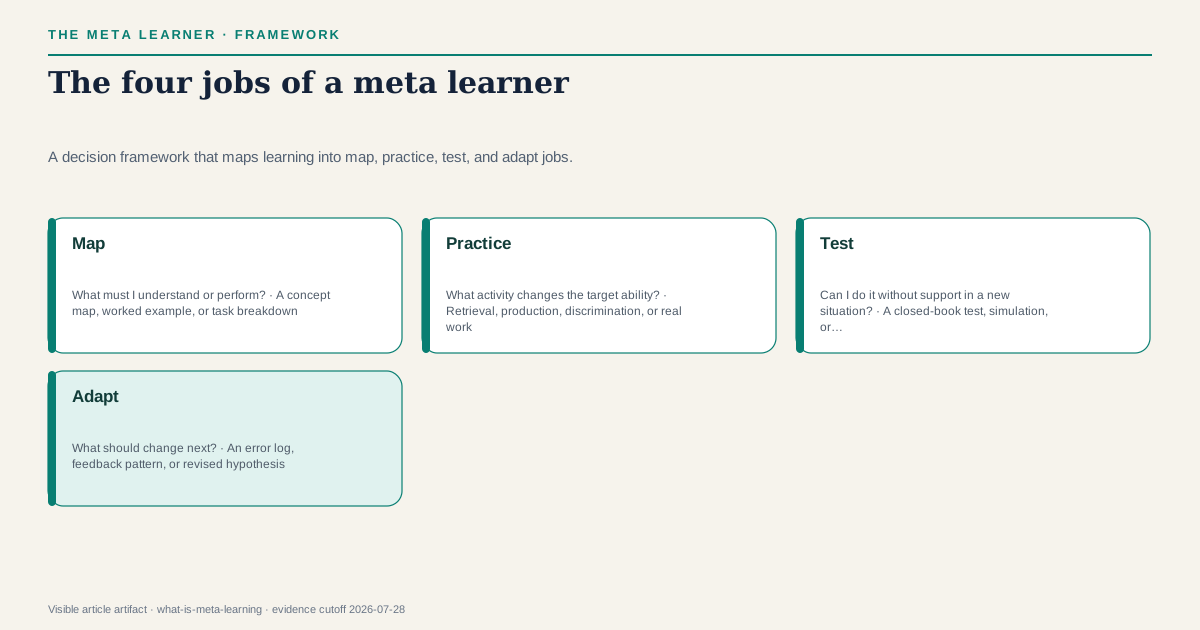
Learning becomes more manageable when it is separated into four recurring jobs:
| Job | Question | Useful evidence | |---|---|---| | Map | What must I understand or perform? | A concept map, worked example, or task breakdown | | Practice | What activity changes the target ability? | Retrieval, production, discrimination, or real work | | Test | Can I do it without support in a new situation? | A closed-book test, simulation, or external result | | Adapt | What should change next? | An error log, feedback pattern, or revised hypothesis |
This loop distinguishes meta-learning from simply consuming information. Reading, watching, highlighting, and asking an AI for explanations may support learning, but none proves that a capability has changed.
What the evidence establishes for the four jobs of a meta learner
Research on metacognition separates knowledge about cognition from the monitoring and regulation of cognition. Reviews of learning techniques also show that learners’ intuitions can be unreliable: familiar or fluent material can feel learned even when it cannot later be retrieved. Practice tests and distributed practice have much stronger general utility than rereading or highlighting alone.
1, 2, 3The practical implication is not that one technique always wins. It is that a learner should define the outcome and select evidence that matches it. Vocabulary recall needs retrieval over time. Pronunciation needs perception, production, and intelligibility feedback. Evaluating an AI answer needs source tracing and comparison, not memorization.
What meta-learning is not
Meta-learning is not productivity with academic vocabulary. A faster inbox or a perfect notes app can reduce friction, but neither guarantees understanding or transfer. It is not a fixed “learning style,” because preferences do not establish which method produces stronger learning. It is also not unlimited self-reliance. Teachers, peers, editors, and tools often provide the feedback that self-observation cannot.
AI gives this distinction new urgency. It can make explanations, summaries, and examples abundant. That lowers the cost of access while increasing the risk of mistaking generated fluency for personal competence. The learner’s scarce work shifts toward framing, verification, retrieval, judgment, and transfer.
Case: learning to challenge a forecast
A policy analyst must learn enough statistics to challenge a vendor’s forecast. Collecting tutorials feels productive, but it does not reveal whether she can detect a misleading chart.
For meta-learning, the hidden decision is which part of the learning loop failed—not whether effort occurred. Translate the situation into an observable signal before changing the method:
| Observed signal | What it may mean | Next response | |---|---|---| | Fluent explanation | Possible familiarity without recall | Close the source and reconstruct the idea | | Repeated error | The representation or practice may be wrong | Classify the error before adding time | | Success only in one example | Transfer has not been shown | Change the context and test again |
She maps the target as three observable judgments, practises on paired examples, tests on an unseen chart, and records why each error occurred. The result is not a prettier study system; it is evidence about which part of the loop needs revision.
The analyst scenario demonstrates diagnosis, not a universal sequence. Its value lies in making the target, test, and revision visible enough for another learner to challenge.
The cross-domain transfer criterion
Move the same four-job loop into a second domain with a different output. If it began with chart interpretation, try a spoken explanation or written decision. Keep the map–practice–test–adapt logic, change the evidence, and note which part still transfers without prompting.
Three levels of correction
The method operates at three levels. At the task level, the learner chooses the next action. At the strategy level, the learner compares ways of practising. At the system level, the learner notices patterns that recur across projects. A weak result at one level should not trigger indiscriminate change at all three. If a single retrieval prompt is ambiguous, repair the prompt. If an entire week of practice fails to improve transfer, reconsider the strategy. If the same planning error appears across domains, change the learning system.
Repair the layer named by the evidence. A confusing prompt needs a prompt change; repeated failure across varied tasks may justify changing the strategy; a recurring planning error across projects may justify changing the system.
Build one weekly calibration loop
Choose one real learning goal and write a one-page learning contract:
- State the capability as an observable action: “I can explain,” “I can decide,” or “I can produce.”
- Record what you already know and one diagnostic task you cannot yet complete.
- Choose one practice activity that resembles the desired performance.
- Schedule a test without notes or AI assistance.
- Decide in advance what result would make you change the method.
Run the loop for seven days. Keep the record small: date, practice, result, next adjustment. The point is not exhaustive tracking; it is making the connection between action and evidence visible.
The learning experiment ledger
Before changing a method, preserve the target performance, present evidence, proposed change, predicted result, and falsifying observation. “Fluent explanation” is a diagnostic clue, not a verdict. Append the observed result without rewriting the original prediction. The ledger lets a learner see whether adaptation follows evidence or merely follows mood.
False signals of meta-learning
- Optimizing a system before defining the capability.
- Measuring time spent instead of what can be recalled or performed.
- Changing methods after one uncomfortable session rather than a meaningful pattern.
- Treating confidence as proof.
- Asking AI to remove every difficulty, including the desirable difficulty that practice requires.
Where another mind enters
Ask an external reviewer to inspect the target performance, not the neatness of the learning system. Their job is to identify a missed criterion or recurring error; the learner’s job is to test the proposed correction in a new case.
Choose the next system layer
Place this article in a larger learning path: use Learning How to Learn in the AI Era for prerequisite context, compare its boundary with Meta-Learning vs Productivity: The Difference That Matters, and continue into The Meta Learner Method: Map, Practice, Test, Adapt when you are ready to test the idea in another decision.
What this loop can establish
The evidence in this article supports a bounded design choice, not a universal recipe, a personality type, or a substitute for teachers and domain expertise. A strategy that improves immediate performance for a novice may do little for an expert or for transfer a week later; the criterion must match the capability being built. The example matters because it exposes the learner’s reasoning: what was tried, what changed, what evidence counted, and what alternative explanation remains. Meta-learning does not confer domain authority. Where errors carry serious consequences, strategy choice must sit inside qualified supervision and domain-specific standards.
Limitations
Metacognitive judgment is itself fallible, especially in unfamiliar domains. Some outcomes appear only after long delays, and performance can depend on context. Use external feedback and real tasks where possible, and do not turn constant self-monitoring into anxiety or administrative overhead.
The definition after the test
A meta learner builds a model of the target, performs the work that changes ability, checks results under honest conditions, and revises the process. The loop is simple. Learning to run it well is a lifelong practice.
Named sources
Evidence and further reading
Published July 29, 2026. Substantively updated July 29, 2026. Evidence last verified July 28, 2026.
- : Reworked for the finite corpus with explicit evidence boundaries, structured assets, and draft-held publication control.