The State of AI-Assisted Learning in 2026: What Changed and What Matters
A dated, falsifiable interpretation of richer AI learning workflows, persistent outcome gaps, learner rights, assessment, and human responsibility.
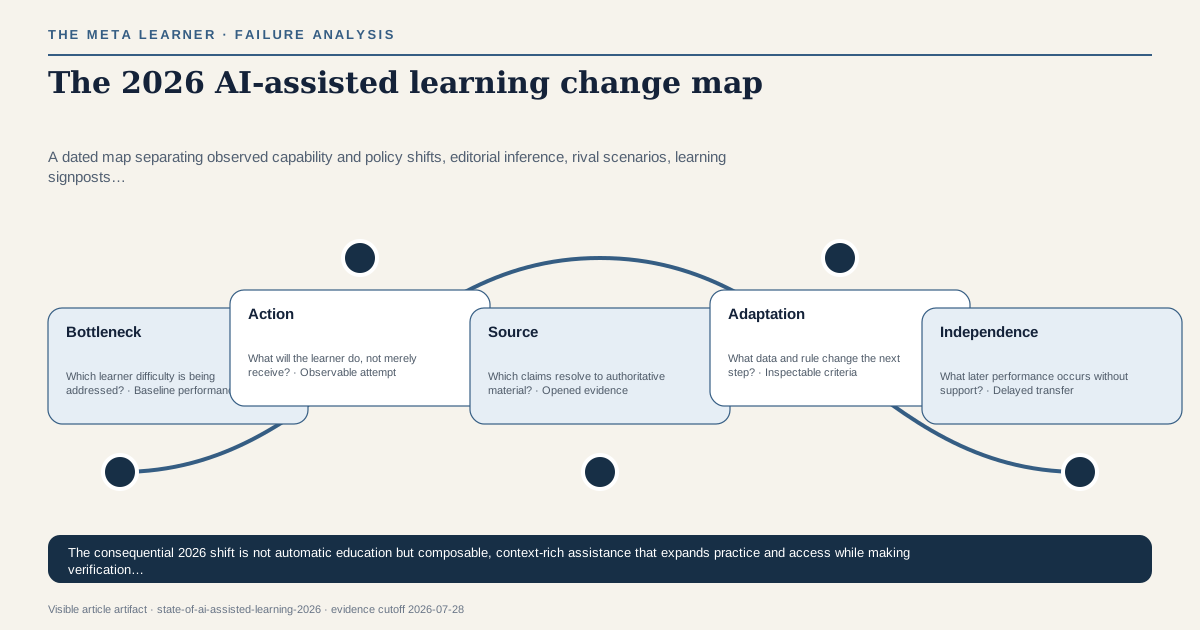
By July 2026, AI-assisted learning was becoming more composable: text, voice, vision, source retrieval, persistent context, generation, and tool use could be combined inside one workflow. That expanded what learners and educators could attempt. It did not establish automatic learning gains. The decisive questions became whether assistance produces retrieval, transfer, source judgment, privacy, accessibility, and capability that survives beyond the interface.
Observed facts at the 2026 cutoff
UNESCO guidance frames generative AI in education as a human-centered design and governance problem involving validation, privacy, age, equity, and pedagogical purpose.unesco-guidance, unesco-competency, oecd-education, nasem-learning Its student competency framework extends beyond interface use to human-centered mindset, ethics, techniques, applications, and system design.unesco-competency
The OECD’s 2026 outlook examines a digital-education ecosystem in which AI can support teaching, learning, assessment, administration, and institutional transformation while requiring governance and capacity.oecd-education How People Learn II provides the durable counterweight: learning depends on prior knowledge, motivation, context, practice, feedback, and transfer, not access to an explanation alone.nasem-learning
The source base supports expanded AI learning functions and sustained institutional concern about pedagogy, rights, competence, and governance. It does not provide one comparable causal estimate for “AI-assisted learning” as a whole.
Claim sources: unesco-guidance, unesco-competency, oecd-education, nasem-learning
Five changes that deserve attention
1. Assistance became multimodal
Learners can move among speech, text, images, diagrams, screens, and files inside one interaction. This can improve access and create richer practice. It can also capture more sensitive data and make a wrong explanation more persuasive because several modalities agree.
2. Context became persistent
Systems can work across source collections and retain information about a learner or project. Continuity reduces setup cost. It also creates memory, privacy, correction, and portability questions.
3. Generation became an environment
The system can create explanations, examples, quizzes, simulations, code, and feedback in sequence. The educational opportunity is variation. The risk is a closed loop in which the system produces both the task and the evidence that the task was completed.
4. Tool use connected answers to action
AI can retrieve, transform, organize, and sometimes act through external tools. Evaluation must therefore move from one response to the end-to-end learning workflow.
5. Assessment lost a familiar shortcut
A polished take-home artifact became weaker standalone evidence of what a learner knows. Institutions need clearer distinctions among independent capability, authorized orchestration, and system contribution.
These observations describe affordances and institutional pressure, not universal adoption.
Our inference: composability is the structural shift
The most important change is not a single tutoring feature. It is the ability to compose several functions around a learning objective.
A well-designed sequence could ask a learner to attempt a problem, retrieve a relevant source, generate a contrasting case, receive targeted feedback, and complete a delayed transfer task. A badly designed sequence could generate the problem, solve it, summarize it, grade it, and record “mastery” without meaningful learner reconstruction.
The same components produce opposite educational systems. Pedagogy is therefore not downstream decoration. It is the architecture that determines which cognitive work remains visible.
The learning-value test
Before adopting a capability, answer six questions:
| Layer | Decision question | Evidence | |---|---|---| | Bottleneck | Which learner difficulty is being addressed? | Baseline performance | | Action | What will the learner do, not merely receive? | Observable attempt | | Source | Which claims resolve to authoritative material? | Opened evidence | | Adaptation | What data and rule change the next step? | Inspectable criteria | | Independence | What later performance occurs without support? | Delayed transfer | | Rights | What is collected, inferred, retained, and appealable? | Data and governance record |
Engagement and satisfaction can matter, but they are not substitutes for capability evidence.
Bounded case: an adult statistics learner
A learner understands definitions while reading but fails to choose an appropriate analysis for unfamiliar data. An AI tutor first requires a prediction and rationale. It then provides two contrasting datasets, asks the learner to select a method, and reveals one hint after the attempt. Claims about assumptions link to the course text.
One week later, the learner receives a new dataset without the tutor and explains the choice. The intervention is kept only if method selection and explanation improve without a severe rise in false confidence.
The case does not prove that this tutor works. It shows how a composable system can preserve the learning action and test transfer.
What did not change
Learners still need internal knowledge to notice anomalies and formulate questions. Retrieval remains different from recognition. Feedback requires a quality model. Transfer remains conditional. Motivation and belonging shape sustained effort. Human relationships can supply trust, challenge, identity, and situated feedback that an interface cannot simply declare.
AI can change how these requirements are supported. It does not repeal them.
Scenarios and signposts
Scenario 1 — capability acceleration. AI supplies varied practice, immediate feedback, accessibility, and useful source support. Signposts: improved delayed transfer, broader participation, lower instructor preparation burden, and stable learner agency.
Scenario 2 — performance without learning. Assisted output rises while independent capability stagnates. Signposts: high task completion, weak reconstruction, dependence on generated structure, and poor performance after a changed context.
Scenario 3 — institutional redesign. Assessment, privacy, curriculum, and teacher work adapt together. Signposts: explicit tool boundaries, varied assessment conditions, data rights, source provenance, and educator participation in procurement.
Scenario 4 — unequal assistance. Benefits concentrate in languages, schools, and learners with better infrastructure and evaluation capacity. Signposts: pair-specific quality gaps, premium access, weak support for disability or low-resource settings, and unequal ability to contest errors.
Use When Synthetic Content Becomes the Default Input for the source layer, Education After the Take-Home Essay for assessment, and The New AI Divide for agency.
Signposts that distinguish learning from activity
Watch delayed recall, transfer to changed cases, error detection, source judgment, independent explanation, teacher workload, accessibility, language-specific performance, privacy incidents, and appeal outcomes. Pair product-use data with at least one learning result and one rights boundary.
Do not infer learning from chat length, completion rate, time in an interface, or learner preference alone. Do not infer failure from lower time-on-task if performance improves. The signpost must match the educational claim.
Invalidation signals for the 2026 AI-assisted learning change map
The central thesis would weaken if robust longitudinal evidence showed that broadly defined AI assistance reliably improved retention, transfer, equity, and learner agency regardless of pedagogy, source design, or assessment. It would also weaken if composability remained a niche affordance with no meaningful effect on learning workflows.
For a specific use, reverse or redesign when unaided performance declines, source errors escape review, adaptation cannot be explained, sensitive data exceed consent, or the system’s accessibility burden outweighs its gain.
Evidence that would change the conclusion should be intervention-specific: learner population, subject, baseline, assistance level, comparator, delay, outcome, and failure distribution.
Limits of the 2026 view
“AI-assisted learning” covers heterogeneous systems and interventions. Public evidence can be provider-led, short-term, selective, or weak on transfer and distribution. Capabilities, pricing, policy, and access change quickly. The article does not certify a product, compare vendors, or establish population-wide effects. Its scenarios are dated interpretations rather than predictions.
The 2026 shift expanded the space of possible learning systems. Whether that becomes deeper learning depends on what the system requires the learner to do—and what evidence survives after the help is gone.
Named sources
Evidence and further reading
Published July 29, 2026. Substantively updated July 29, 2026. Evidence last verified July 28, 2026.
- : Rebuilt as a falsifiable Window with observed facts, scenarios, signposts, and invalidation conditions.