Education After the Take-Home Essay: What Assessment Must Now Prove
A structural redesign of assessment around reconstruction, process, performance, transfer, tool judgment, and proportionate evidence of learning.
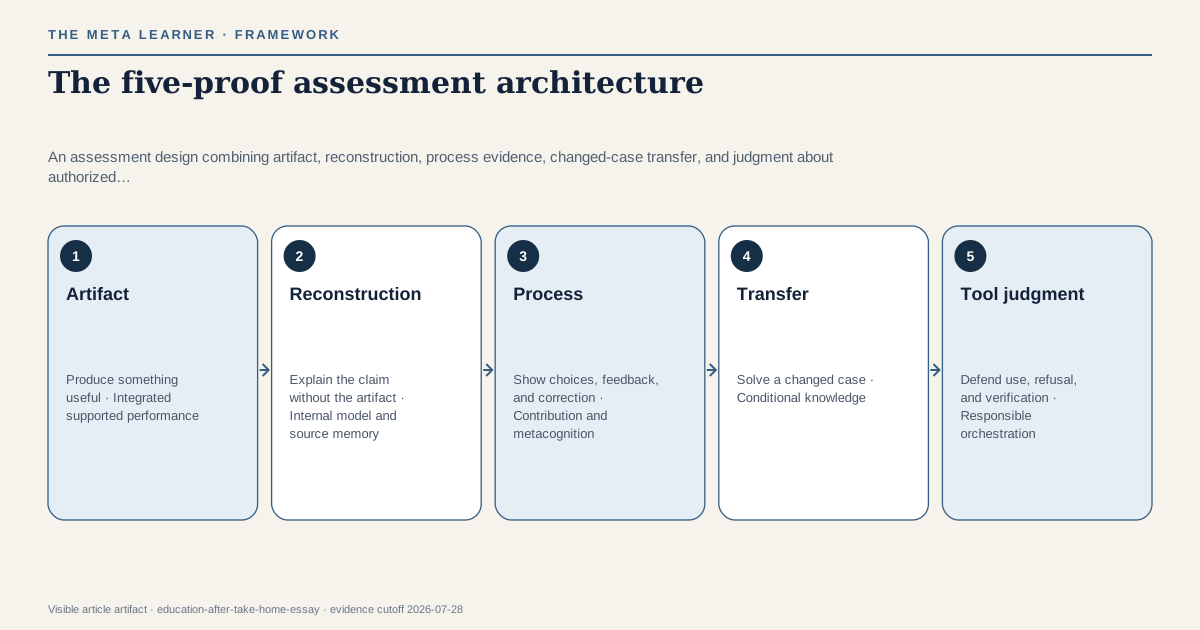
After generative AI, a take-home essay can remain a valuable learning artifact, but it cannot by itself prove who formed the argument or what the learner can do next. Assessment should triangulate the artifact with reconstruction, process evidence, performance on a changed case, and judgment about when and how tools were used. It should do so proportionately, without treating surveillance as validity.
What assessment can no longer assume
Observed facts are limited but sufficient to reject one shortcut: generative systems can materially contribute to a finished essay, while learning remains a claim about the learner that requires valid evidence.
UNESCO’s guidance treats generative AI as a pedagogical, ethical, privacy, and policy challenge requiring human-centered validation rather than simple adoption or prohibition.unesco-genai-education, unesco-rights, nasem-learning, opm-work-samples Its rights-based report emphasizes equity, privacy, safety, and governance as education digitalizes.unesco-rights
Learning science distinguishes short-term performance from durable learning and emphasizes prior knowledge, practice, feedback, and transfer.nasem-learning Work-sample guidance offers a parallel from employment assessment: representative performance can provide evidence tied to the target task.opm-work-samples
The evidence supports human-centered AI policy, rights safeguards, and performance- and transfer-aware learning design. It does not validate one universal post-AI assessment format.
Claim sources: unesco-genai-education, unesco-rights, nasem-learning, opm-work-samples
The artifact–capability break
A take-home essay historically blended many signals: reading, planning, argument, writing, persistence, source use, and revision. It was never a pure measure; tutoring, editing, prior access, disability, language, and unequal time already shaped it.
Generative AI makes the bundle easier to separate. A learner can outsource structure, prose, examples, counterarguments, or citations in ways the final text may not reveal. The answer is not to declare the artifact worthless. It is to stop asking one artifact to prove everything.
An assessment needs a claim: which capability should this evidence support? If the goal is a publishable group report with appropriate tool use, collaboration matters. If the goal is individual argument reconstruction, the design must observe that performance.
Our inference: valid assessment becomes a portfolio of conditions
The strongest evidence will come from variation:
- the learner submits an artifact;
- reconstructs the reasoning in another mode;
- shows material decisions and corrections;
- responds to a changed case;
- and explains the authorized role of tools.
No single condition is definitive. Together, they make false attribution harder and reveal more useful learning information.
This is assessment as triangulation, not detection. AI detectors cannot establish authorship or learning reliably enough to carry the decision alone, and surveillance can undermine rights, accessibility, and trust.
The five-proof architecture
| Proof | Prompt | What it can reveal | |---|---|---| | Artifact | Produce something useful | Integrated supported performance | | Reconstruction | Explain the claim without the artifact | Internal model and source memory | | Process | Show choices, feedback, and correction | Contribution and metacognition | | Transfer | Solve a changed case | Conditional knowledge | | Tool judgment | Defend use, refusal, and verification | Responsible orchestration |
Weights depend on purpose. A writing course may inspect prose decisions; a statistics course may prioritize model choice and interpretation; a design studio may value iterative critique.
Bounded case: an undergraduate policy essay
Students write a policy argument with declared AI assistance permitted for brainstorming and language feedback. They retain a source ledger and three decision notes: one rejected frame, one corrected claim, and one limitation.
In a short conversation, each student reconstructs the central argument and receives a new piece of counterevidence. They have ten minutes to explain what changes. The instructor grades the original artifact, evidence use, response to counterevidence, and transparency under a published rubric.
The design does not prove authorship with certainty. It produces richer evidence of reasoning while keeping the tool boundary explicit. What Happens to Expertise When Novices Can Produce Expert-Looking Work? supplies the appearance–capability diagnostic.
Accessibility and multilingual validity
Removing take-home work can disadvantage learners who need time, assistive technology, or a second language. Live oral assessment can introduce anxiety, accent bias, and cultural assumptions. Process logs can expose sensitive information.
Provide equivalent ways to demonstrate the construct: oral, written, visual, signed, synchronous, or asynchronous where valid. Assess subject knowledge separately from language proficiency unless language is the target. State which accessibility and translation tools are authorized.
Rights are not an afterthought to validity. An assessment that measures surveillance tolerance instead of learning is badly designed.
Assessment scenarios and signposts
Authentic triangulation. Institutions combine artifacts, performance, process, and transfer. Signposts: explicit construct maps, varied evidence, transparent rubrics, and fewer accusations based on style alone.
Surveillance escalation. Institutions try to restore old signals through monitoring. Signposts: invasive proctoring, detector-led sanctions, inaccessible live exams, and weak appeal.
Credential ambiguity. Artifacts remain unchanged while interpretation fragments. Signposts: employers adding tests, students optimizing for detection, and declining trust in grades.
AI-integrated competence. Programs assess responsible orchestration as part of the discipline. Signposts: tool judgment, evaluation tasks, contribution records, and independent fallback where consequential.
Design signposts
Watch whether assessments name the construct, vary conditions, test transfer, reveal contribution, support accessibility, and use appeal routes. Synthetic Content as the Default Input explains why source contact matters; The 30-Day Capability Sprint shows how baseline and changed-case evidence can be preserved.
Invalidation signals for the five-proof assessment architecture
The triangulation thesis would weaken if take-home artifacts remained strong, equitable predictors of later independent performance despite unrestricted generative assistance. It would also weaken if reliable, rights-preserving authorship and contribution verification emerged and made additional conditions unnecessary.
Reverse a local redesign if it reduces validity, accessibility, learner agency, or instructional usefulness. More evidence is not automatically better when it measures the wrong construct.
Boundaries of redesign
Assessment validity is discipline- and purpose-specific. Oral defenses, process records, and work samples can be coached or biased. Additional assessment increases workload, and resource-poor institutions may struggle to implement it. The article does not provide legal advice about student monitoring or misconduct. Its structural interpretation is bounded by evidence available on July 28, 2026.
The post-essay question is not “Did a machine touch this?” It is “What human learning does this decision require us to prove?”
Named sources
Evidence and further reading
Published July 29, 2026. No substantive revision has been recorded. Evidence last verified July 28, 2026.