When Synthetic Content Becomes the Default Input to Human Learning
How abundant generated text, images, and explanations could reshape selection, provenance, reading, assessment, and the learner’s epistemic duties.
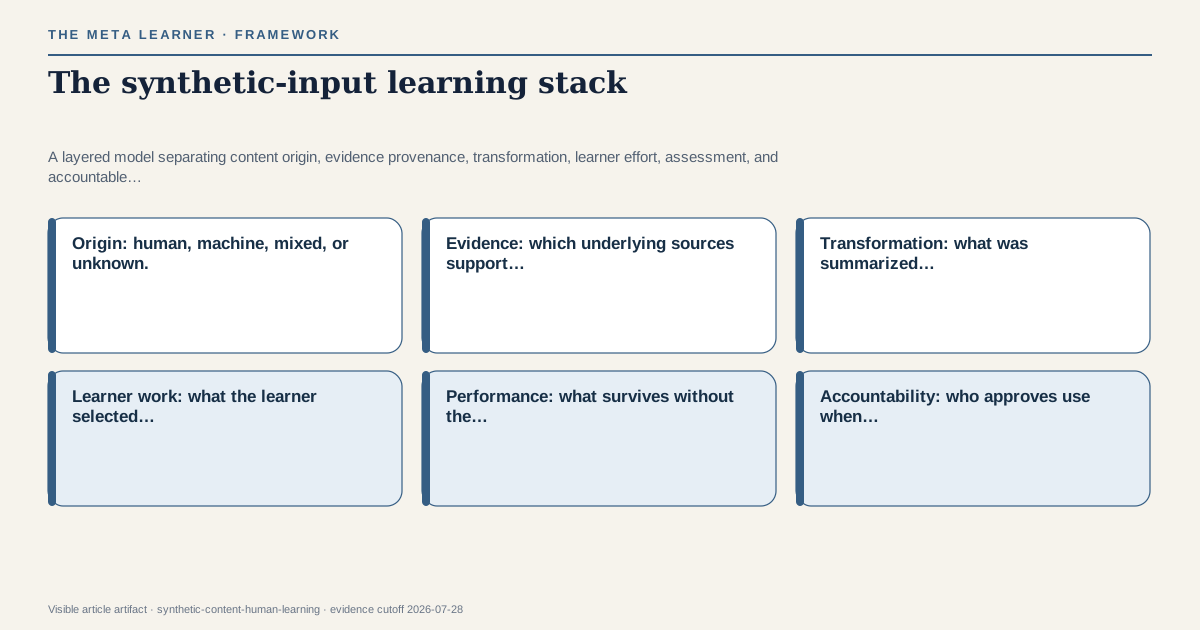
If synthetic content becomes the default input to learning, access to explanations will cease to be the main constraint. Learners and institutions will need stronger ways to preserve provenance, encounter original evidence, reconstruct arguments, practise without generated support, and demonstrate what the learner—not the interface—can understand and do. Long-term causal evidence on synthetic-first learning environments remains limited, and effects will vary by design, age, domain, and access.
Observations at the input layer
NIST defines synthetic content broadly and reviews provenance tracking, labeling, watermarking, detection, testing, and auditing approaches.nist-synthetic, unesco-genai-education, nasem-learning, c2pa-spec The report makes an important distinction: transparency can provide information about origin and history, but it does not guarantee truth or appropriate context.
C2PA specifications offer a technical system for attaching tamper-evident provenance information across content creation and modification.c2pa-spec That can help answer “where did this asset come from?” It cannot settle “is this claim valid?” or “did this student learn?”
UNESCO’s guidance calls for human-centered validation and pedagogical design rather than uncritical product adoption.unesco-genai-education Learning science, meanwhile, treats knowledge construction, prior knowledge, practice, feedback, and transfer as processes, not as properties of an accessible explanation.nasem-learning
The source base establishes growing synthetic-content capacity, emerging provenance infrastructure, and durable learning-design requirements. It does not yet establish the long-term effects of a predominantly synthetic learning diet.
Claim sources: nist-synthetic, unesco-genai-education, nasem-learning, c2pa-spec
Our inference: the curriculum acquires a provenance layer
Traditional learning materials were never automatically true. Textbooks contain errors; lectures simplify; primary sources can mislead. Synthetic generation changes scale and lineage. A learner can receive thousands of fluent variants whose factual ancestry is unclear and whose differences may be stylistic rather than intellectual.
The curriculum therefore needs an additional layer:
- Origin: human, machine, mixed, or unknown.
- Evidence: which underlying sources support material claims.
- Transformation: what was summarized, translated, simulated, or invented.
- Learner work: what the learner selected, reconstructed, tested, and corrected.
- Performance: what survives without the generated scaffold.
- Accountability: who approves use when consequences extend beyond practice.
This layer should not turn every lesson into forensic investigation. It should match stakes. A disposable pronunciation example and a medical decision aid do not need identical controls.
What synthetic-first learning could improve
Generated material can vary examples, reading level, language, modality, and feedback quickly. It can help a learner obtain a counterexample at the moment of confusion, simulate dialogue, or compare explanations. For educators with limited production capacity, it can expand practice inventory.
The opportunity is greatest when generation supplies variation around a stable objective and the learner must still perform. A useful system asks for an attempted answer before a tailored hint, preserves the authoritative source, and checks transfer later.
The danger is a smooth loop in which the system generates the explanation, notes, questions, answer, feedback, and summary. The learner experiences coherence while contributing little reconstruction. Apparent personalization can become automated passivity.
There is also a compounding problem. One generated lesson may summarize another generated explanation that paraphrased a secondary report whose link points to an original source. Every transformation can preserve fluency while dropping scope. Learning design should therefore cap the number of uninspected transformations for consequential claims and restore contact with the underlying record before the learner builds on it.
Bounded case: a history reading packet
An instructor prepares a unit using translated primary documents, two scholarly interpretations, and generated contextual explanations. Each generated passage is labeled and linked to the source material it transforms. Students first annotate one original document, identifying claim, audience, omission, and historical context. AI may then generate rival interpretations, but students must trace which evidence each rival uses.
Assessment includes an unseen source and an oral defense of one inference. The design uses synthetic content to increase comparison, not to replace contact with evidence.
This case does not prove improved learning. It illustrates how to prevent the generated layer from silently becoming the authority. How to Detect Citation Laundering addresses false evidence inheritance, while How to Annotate for Argument protects reconstruction.
Scenarios and practical signposts
Adaptive abundance. Synthetic inputs expand examples and access while source links and performance checks remain intact. Signposts: varied practice, lower access barriers, source reopening, and stable unaided transfer.
Synthetic enclosure. Learners remain inside generated summaries and feedback. Signposts: fewer original sources, high apparent fluency, weak explanation without the tool, and repeated but untraceable claims.
Verified content layer. Institutions combine content credentials, source ledgers, approved collections, and learning analytics. Signposts: provenance standards in authoring tools, visible transformation histories, and assessment that separates assisted from independent capability.
Educational design responses
Preserve at least four moments of friction:
- the learner states an initial model before requesting generation;
- consequential claims resolve to opened sources;
- competing explanations are compared rather than averaged;
- a later task removes or perturbs the scaffold.
Do not use synthetic detectors as a proxy for misconduct or understanding. NIST’s review itself emphasizes technical limits and gaps. Judge evidence of work and learning instead. Education After the Take-Home Essay develops that assessment problem.
Invalidation signals for the synthetic-input learning stack
The thesis would weaken if long-term studies showed that synthetic-first learning reliably produced equal or better retention, transfer, source judgment, and learner autonomy without deliberate provenance or reconstruction. It would also change if generated content carried consistently trustworthy, universally interpretable evidence lineage and robust domain validation.
The thesis would strengthen if original-source contact declined while learners became less able to verify, transfer, or distinguish evidence from explanation.
Limits of the evidence
The available guidance and technical standards do not provide longitudinal population-level evidence about synthetic-first education. Provenance can be absent, stripped, forged, misunderstood, or attached to misleading material. Learning effects depend on subject, age, expertise, language, disability, pedagogy, assessment, and tool access. The scenarios are structural interpretations as of July 28, 2026.
The central educational choice is not human content or synthetic content in the abstract. It is whether the learning environment keeps evidence, effort, and ownership visible when generation becomes invisible.
Named sources
Evidence and further reading
Published July 29, 2026. No substantive revision has been recorded. Evidence last verified July 28, 2026.