How to Detect Citation Laundering in AI-Generated Research
Detect citation laundering by tracing an AI-assisted claim through every intermediary to the source that supposedly observed or established it.
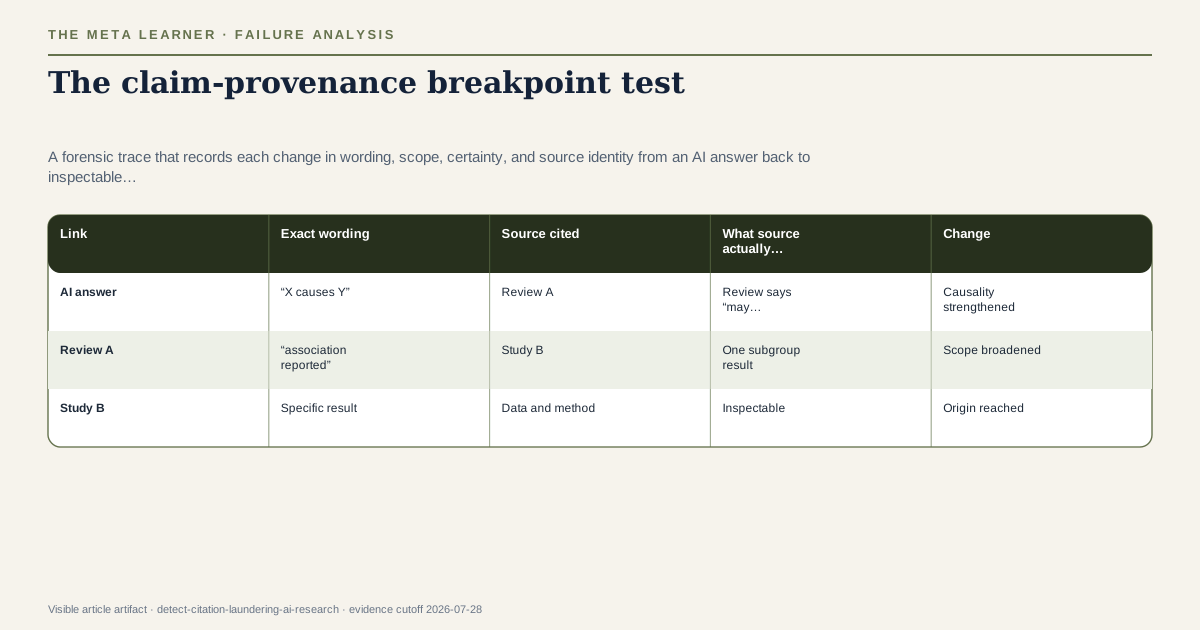
Detect citation laundering by selecting the exact claim, opening the cited source, locating the supporting passage or data, and repeating the process whenever that source cites another. At each link, compare wording, population, outcome, causality, and certainty. If the chain ends in a source that does not support the claim—or never reaches inspectable evidence—the citation has not verified it.
How citations acquire false authority
Citation laundering is not a formal diagnosis for every miscitation. It is a useful name for a recurring failure: a claim passes through summaries, reviews, marketing pages, or AI outputs until the citation signal remains but the evidential support has disappeared.
An AI system may invent a reference. The subtler problem is a real reference attached to the wrong claim. A review cites an earlier paper; a blog simplifies the review; several pages copy the blog; an AI answer synthesizes the pages and supplies the respectable-looking earlier citation. The reader sees convergence where there may be one distorted lineage.
Greenberg’s analysis of a medical citation network documented how citation distortions, amplification, and chains of secondary citation could create unfounded authority around a claim.greenberg-distortion, nist-genai, cochrane-search The study is one domain-specific analysis, not proof that all widely cited claims are wrong. It demonstrates why provenance matters.
Recognize six warning signals
- Many pages use nearly identical unusual wording.
- The same citation appears everywhere, but few writers discuss its design.
- A source is cited for a stronger causal or universal claim than its title suggests.
- The cited item is a review, editorial, abstract, or news story that points elsewhere.
- A precise number travels without denominator, date, or population.
- The AI response provides plausible bibliographic detail but no inspectable support.
These are triggers for tracing, not verdicts.
Build the provenance trace
Create one row for every link:
| Link | Exact wording | Source cited | What source actually says | Change | |---|---|---|---|---| | AI answer | “X causes Y” | Review A | Review says “may be associated” | Causality strengthened | | Review A | “association reported” | Study B | One subgroup result | Scope broadened | | Study B | Specific result | Data and method | Inspectable | Origin reached |
Track five possible mutations:
- verb: associated becomes causes;
- population: one sample becomes people;
- outcome: a proxy becomes the desired construct;
- quantity: relative change loses absolute baseline;
- certainty: possible becomes established.
The breakpoint is the first link where the present wording can no longer be recovered from the source.
Citation-network research demonstrates that distortion and amplification can accumulate through citation chains. NIST identifies confabulation and information-integrity risks for generative AI, while Cochrane search guidance emphasizes study-level records, multiple reports, corrections, and retractions. These sources support traceability; they do not imply that repetition itself falsifies a claim.
Claim sources: greenberg-distortion, nist-genai, cochrane-search
Distinguish three failure classes
Fabrication: the reference, author, title, journal, DOI, or quotation does not exist.
Misattachment: the source exists but does not support the sentence.
Inheritance: the source repeats another source without independent examination, while the chain’s uncertainty vanishes.
Treat each differently. Fabrication requires removal and a search restart. Misattachment requires a narrower sentence or a better source. Inheritance requires tracing until primary evidence, authoritative text, or a transparent synthesis is found.
NIST’s generative-AI profile treats confabulation and information integrity as risks to be managed through evaluation, provenance, and governance rather than through user confidence alone.nist-genai A model’s fluent explanation of its citation is not independent verification.
A worked trace
Claim: “People retain 90 percent of what they teach others.”
The number appears in infographics, training sites, and AI responses. A source chain may point to a “learning pyramid,” then to an institution or researcher who did not publish the claimed experimental basis.
The correct research outcome is not necessarily “teaching others has no learning value.” Retrieval, explanation, and generative activity may be useful under defined conditions. The correction is narrower: this precise universal percentage lacks support from the cited lineage, so it cannot carry the claim.
This distinction prevents debunking from becoming another kind of overclaim.
Check the study family
When the trace reaches a paper, search for its protocol, registration, related reports, correction, retraction, data, and later synthesis. Cochrane notes that several reports can describe one study and that searches should retrieve errata and retraction information.cochrane-search
Do not count multiple reports as independent replications. Do not discard secondary reports automatically; they may contain methods or outcomes absent from the best-known article.
Run the provenance breakpoint test
- Copy one material sentence from AI-assisted research.
- Resolve every identifier and open the full source where possible.
- Find the exact passage, table, or data that supports the sentence.
- Record the five mutation dimensions.
- Follow every indirect citation one step backward.
- Search forward for correction, retraction, replication, or synthesis.
- Label the result verified, narrowed, unresolved, or unsupported.
- Preserve the trace beside the final text.
Begin with Verify AI Explanations and Sources, test the restored claim with Critical Thinking: A Practical System for Claims and Evidence, and reinforce the capability boundary through AI Literacy for Adult Learners.
Verification theater to avoid
- Clicking a link without locating support.
- Asking the same AI system whether its source is correct.
- Treating a valid DOI as a valid claim.
- Counting pages rather than independent evidence.
- Trusting quotation marks without checking the original wording.
- Replacing one unsupported viral claim with an equally sweeping debunk.
- Hiding inaccessible sources behind “research shows.”
What a broken chain means
A broken or distorted citation chain establishes an evidence problem, not necessarily a false proposition or deliberate deception. Primary sources can also be biased, fabricated, or later superseded. Paywalls, language, missing archives, and incomplete reporting can prevent resolution. High-stakes investigations may require librarians, domain experts, research-integrity specialists, or legal review.
The purpose of citation is not decoration. It is to let another reader travel from your sentence back to the evidence without the road changing beneath them.
Named sources
Evidence and further reading
Published July 29, 2026. No substantive revision has been recorded. Evidence last verified July 28, 2026.