How to Verify AI Explanations and Sources
A claim-by-claim verification workflow for checking AI explanations, citations, numbers, uncertainty, and missing context before you rely on them.
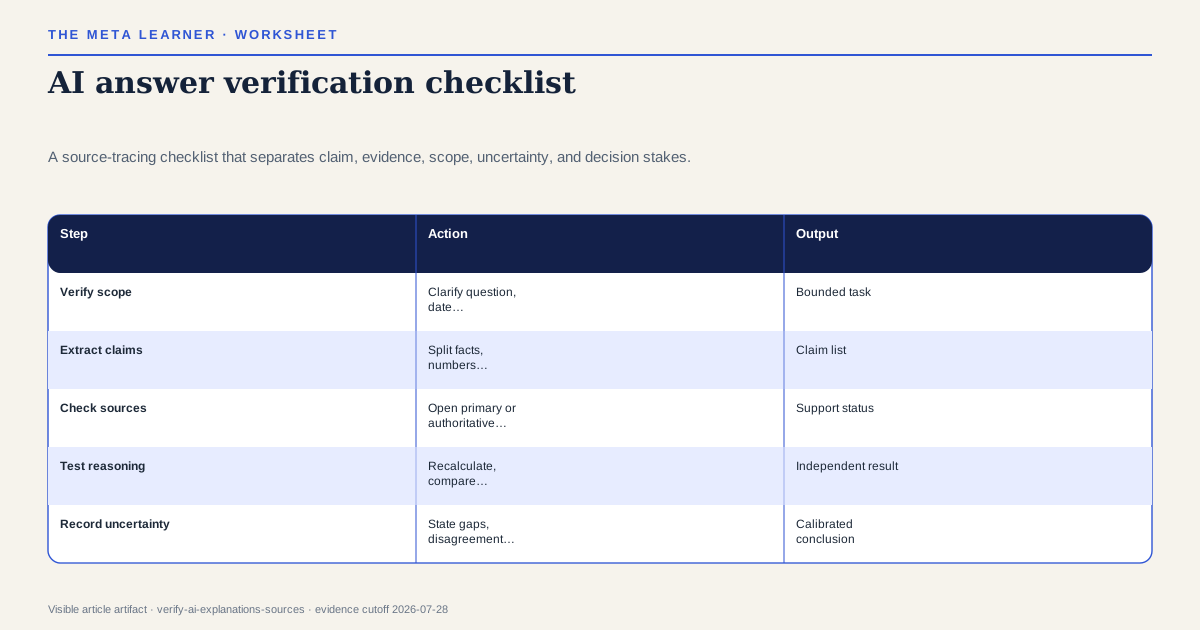
Verify an AI answer by decomposing it into checkable claims, prioritizing claims by consequence and uncertainty, opening the cited sources, and comparing each source with the exact wording. Then test calculations or procedures independently and record what remains unknown. Verification has costs, and some claims cannot be resolved from public evidence.
When an AI answer deserves verification
This guide is for readers who need to reuse AI-generated claims in study, work, or publication. It covers claim extraction, source tracing, triangulation, uncertainty, and stop rules. It is not a guarantee that a cited answer is true or a replacement for professional review in high-stakes domains. Begin with one claim that would matter if wrong. The useful output is not a cleaner answer but a source trail, a bounded conclusion, and a visible remainder of uncertainty.
“Looks right” is not a verification method. Generative systems can combine correct background, an unsupported conclusion, and a nonexistent citation in the same fluent paragraph. Verification works best at claim level because reliability is rarely uniform across an entire answer.
The VECTR workflow
| Step | Action | Output | |---|---|---| | Verify scope | Clarify question, date, place, audience, and stakes | Bounded task | | Extract claims | Split facts, numbers, causal claims, and advice | Claim list | | Check sources | Open primary or authoritative evidence | Support status | | Test reasoning | Recalculate, compare, or reproduce | Independent result | | Record uncertainty | State gaps, disagreement, and review needs | Calibrated conclusion |
Begin with the highest-consequence claim, not the easiest link to open.
Why traceability and evaluation matter
NIST’s AI risk framework emphasizes mapping context, measuring risks, and managing them through governance rather than assuming a model is trustworthy in general. Lateral-reading methods such as SIFT emphasize stopping, investigating the source, finding better coverage, and tracing claims to original context. Together they support a risk-based, source-tracing workflow.
1, 2, 3, 4Inspect the source, not the citation shape
A DOI, journal title, or government-looking URL can still be wrong, irrelevant, or misrepresented. For each important citation ask:
- Does the source exist and identify a real author or institution?
- Is it primary evidence, an authoritative synthesis, or commentary?
- Does it contain the claimed finding?
- Does the population, date, and setting match the answer?
- Are limitations or conflicting results omitted?
Prefer official documents for current policies and product behavior, original papers for specific research claims, and high-quality systematic reviews for broad conclusions.
Check reasoning and numbers
Sources can be genuine while the inference is weak. Recreate calculations with a calculator or deterministic code. Track units, denominators, currency, dates, and whether percentages are absolute or relative. For a causal claim, ask what alternative explanation or selection effect may exist.
For procedures, test a small reversible case. If an AI provides code, run it in a safe environment with known inputs. If it provides a learning plan, verify that the proposed practice resembles the target performance.
Case: a causal claim with three misleading citations
An AI answer cites three papers for a causal claim. One citation does not exist, one is real but irrelevant, and one supports only a narrower association.
Verification starts by separating the answer’s claims from its confident presentation. Turn each uncertainty into a source, scope, or decision-stakes question:
| Observed signal | What it may mean | Next response | |---|---|---| | Specific citation | Potentially checkable claim | Open the source and locate the support | | Several agreeing pages | Possible shared upstream error | Trace independence and origin | | Unclear uncertainty | Scope may be overstated | Rewrite the claim to match the evidence |
The reviewer breaks the paragraph into atomic claims, labels each as verified, contradicted, or unresolved, and removes the causal wording. Verification changes the output rather than decorating it with links.
This procedure reduces avoidable error; it does not certify an AI system or guarantee that available sources are complete. Higher-stakes use still needs accountable domain review.
Verify a claim in a second domain
Repeat the check on a different claim type: a product behavior, a research finding, and a policy statement. Use the relevant primary authority for each. The method transfers when the learner changes sources appropriately without weakening the standard.
Choose verification depth by consequence
Take one AI answer and extract every sentence that could change a decision. Label each sentence as directly supported, inferred from a source, or unsupported. Open the primary source and record whether it states the same claim, for the same population and date. Then rewrite the answer so that the confidence matches the evidence. Finally, decide what evidence would be necessary before acting. This produces a verification record that another person can inspect and prevents a credible citation from being used to support a broader claim than the source actually makes.
Run one VECTR verification pass
Create a verification ledger for one consequential answer:
- Copy each material claim into its own row.
- Label it factual, numerical, causal, interpretive, or recommendation.
- Assign consequence and uncertainty: low, medium, or high.
- Link the strongest evidence you actually opened.
- Mark support as supported, partly supported, contradicted, or unresolved.
- Write the decision you can defend after checking.
Ask the model to identify possible weaknesses only after making your own list. Its self-critique can generate leads, but it is not independent verification.
Match verification depth to the decision
Not every sentence deserves the same investigation. Start by scoring the consequence of error, the reversibility of the action, the uncertainty of the claim, and the independence of the available evidence. A low-stakes brainstorming suggestion may need only a plausibility check. A current rule, safety instruction, financial figure, or claim that affects another person should be traced to the governing or primary source and reviewed by an accountable expert when appropriate. This risk-based approach follows the contextual logic of NIST’s AI risk framework. 1
Set a stopping rule before searching: for example, two independent authoritative sources that agree within the relevant scope, or one controlling official source for a current requirement. Stop with “unresolved” when that rule cannot be met. More searching is not automatically better; repeated secondary pages may share one upstream error. A visible stopping rule turns verification from endless browsing into a proportionate decision process.
Create a verification receipt
For the final answer, preserve the material claim, opened source, supporting passage or calculation, scope, evidence date, unresolved issue, and named decision owner. Add the representative test you ran: a second source, recomputation, counterexample, or governing document. A receipt is deliberately shorter than a research notebook but strong enough for human review. If the decision changes, append the new evidence without erasing the earlier record; the audit trail should reveal why confidence changed.
Verification theater
- Searching the exact generated sentence and treating repetition as proof.
- Counting several articles that all copy one unverified source.
- Checking the source title but not the relevant passage.
- Ignoring dates for changing rules, tools, and prices.
- Assuming uncertainty language guarantees honesty.
- Spending equal effort on trivial and high-consequence claims.
Carry the receipt into related AI decisions
Verification begins with the limits described in AI literacy, but it should also follow the learner into an apparently low-stakes AI tutoring session. The executed workflow experiment shows how a receipt becomes a checkpoint rather than an archival gesture.
Where VECTR cannot carry the decision
Verification has costs, and some claims cannot be resolved from public evidence. Primary sources can be biased or incomplete; scientific findings may not generalize. For medical, legal, financial, safety-critical, or other high-stakes decisions, use qualified professionals and the current governing sources.
The goal is not certainty about everything. It is an audit trail that makes the evidence, inference, and remaining uncertainty visible before action.
Named sources
Evidence and further reading
Published July 29, 2026. Substantively updated July 29, 2026. Evidence last verified July 28, 2026.
- : Revised for the finite 200-article evidence-led corpus and unpublished release gate.