AI Literacy for Adult Learners: Capabilities, Limits, and Mental Models
A practical map of what modern AI can do, where it fails, and the mental models adults need to use it with agency and informed judgment.
AI literacy is the ability to understand what an AI system is doing, use it for an appropriate purpose, evaluate its output, and remain accountable for the result. It combines operational fluency with domain knowledge, risk awareness, and the judgment to know when not to delegate. Capabilities, products, policies, and interfaces change rapidly.
AI literacy as accountable action
This guide is for non-specialists who must use, evaluate, buy, manage, or learn with contemporary AI systems. It covers capabilities, failure modes, context, evaluation, data boundaries, and accountable use. It is not a mathematical machine-learning course or a catalog of rapidly changing product features. Test your literacy on one consequential AI-assisted task: can you explain the system’s role, detect a weak output, protect the data boundary, and name who owns the result?
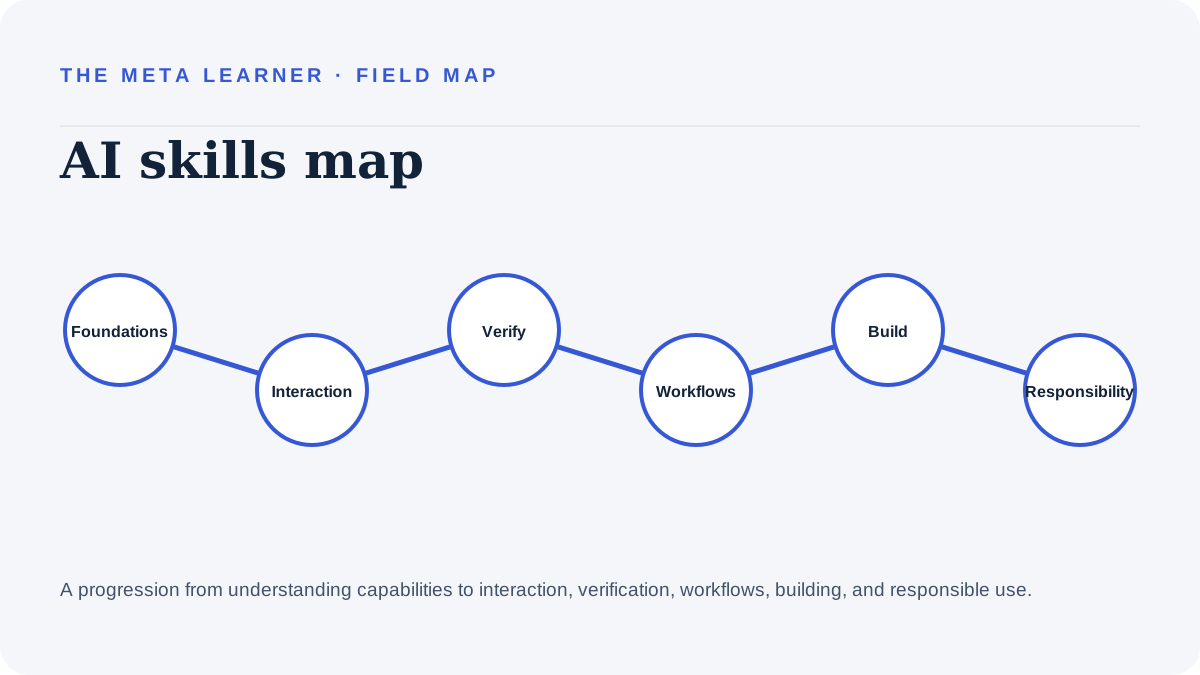
Knowing how to open a chatbot or write a prompt is only the interface layer. A literate user can distinguish prediction from truth, a plausible answer from verified evidence, and an impressive demonstration from a dependable workflow.
Seven mental models
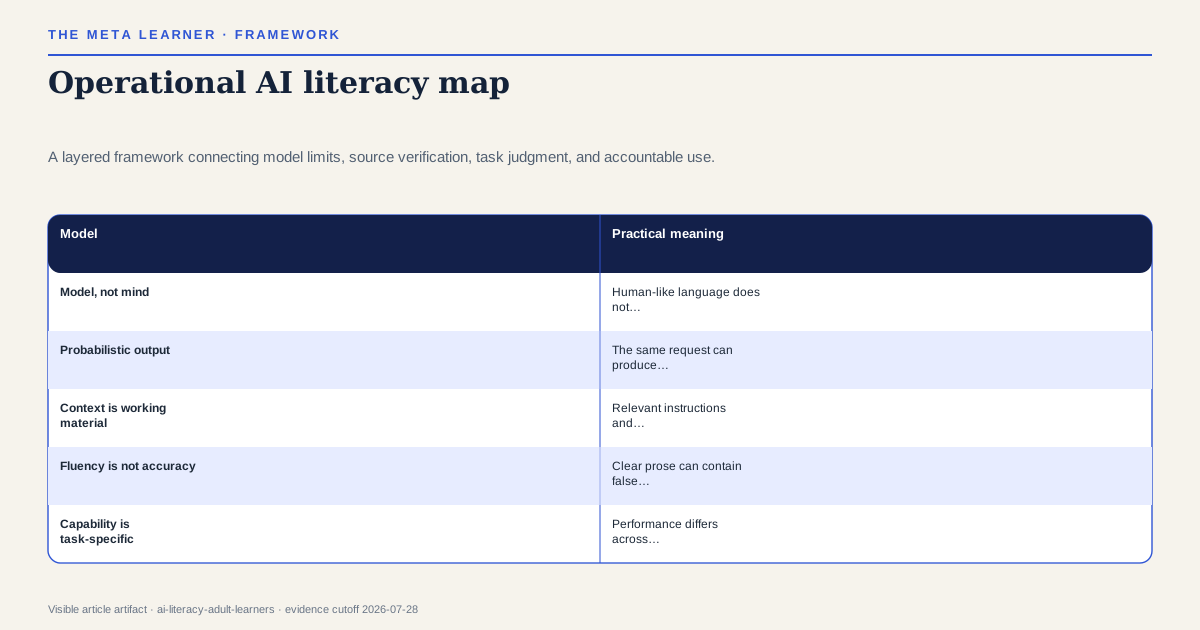
| Model | Practical meaning | |---|---| | Model, not mind | Human-like language does not establish human understanding or intention | | Probabilistic output | The same request can produce different answers | | Context is working material | Relevant instructions and evidence must be supplied or retrieved | | Fluency is not accuracy | Clear prose can contain false claims or fabricated citations | | Capability is task-specific | Performance differs across domains, formats, languages, and constraints | | Workflow beats magic prompt | Checks, tools, data, and iteration determine reliability | | Accountability stays human | Consequences are not transferred to the model |
These are simplifying models, not complete technical descriptions. Their value is predictive: they help a learner anticipate failure and choose controls.
What current guidance and evaluations establish
UNESCO frames AI competence around a human-centered mindset, ethics, techniques and applications, and system design. NIST organizes generative-AI risk around governance, mapping context, measurement, and management. Both approaches treat literacy as more than tool operation and emphasize risk-appropriate human oversight.
1, 2, 3, 4Match use to consequence
The same error rate can be trivial or dangerous depending on the task. Brainstorming ten possible headings is easy to inspect and reverse. Giving medication advice, interpreting a contract, or exposing confidential customer data has higher stakes and requires qualified review, secure handling, and often a different tool.
A useful decision grid has two axes:
- Consequence of error: low to high.
- Ease of verification: easy to hard.
Low-consequence, easy-to-check tasks are good places to experiment. High-consequence, hard-to-check tasks demand stronger evidence, bounded systems, or non-use.
Understand the workflow
An AI result is shaped by the model, system instructions, user context, retrieved material, tools, and post-processing. When output fails, “improve the prompt” is only one possible response. You may need better source data, a narrower task, a deterministic calculation, a second reviewer, or an explicit refusal condition.
Keep facts and transformations separate. Asking a model to rewrite a paragraph you supplied is different from asking it to invent market statistics. The second task creates an evidence obligation.
Case: a polished proposal with invented evidence
A team sees a model produce a strong proposal and concludes that it understands the market. The same system invents a customer quotation when asked for supporting evidence.
AI literacy begins when a plausible output becomes a claim to inspect. Classify the signal before choosing whether to trust, verify, revise, or refuse it:
| Observed signal | What it may mean | Next response | |---|---|---| | Plausible synthesis | Useful pattern completion | Separate generation from factual verification | | Tool access | The system can act beyond text | Constrain permissions and log actions | | Long context | More material can be considered | Do not infer perfect recall or faithful use |
The team evaluates the workflow by task: drafting may tolerate easy correction; customer evidence requires source-linked retrieval; external actions require approval. Literacy appears as calibrated delegation, not memorized terminology.
The example is an operational check, not a complete model evaluation. It helps an adult learner decide what evidence is missing before relying on an output.
Move the same judgment to another tool
Use the same verification sequence on a different model and a different type of claim. Keep the source and scope checks constant. If the procedure only works on one interface or familiar subject, the literacy has not yet transferred.
Separate model product and organization
A durable mental model separates model, system, and workflow. The model generates or scores outputs. The system adds retrieval, tools, memory, policies, and interfaces. The workflow adds people, incentives, checks, and consequences. A result can fail at any layer. When the answer is wrong, asking only whether the model is capable obscures bad source retrieval, ambiguous instructions, excessive permissions, or a missing review step.
Change the verification depth according to stakes and reversibility. A low-stakes brainstorming prompt may need a light check; a consequential recommendation needs source tracing, domain review, and a documented decision.
Audit one AI-assisted workflow
Choose one recurring AI task and create a literacy card:
- State the exact purpose and intended user.
- List the inputs and whether any are sensitive.
- Describe three likely failure modes.
- Define what must be checked and by whom.
- Set a stop rule for uncertainty or high consequence.
- Save one good and one bad output as calibration examples.
Repeat the task with and without extra context. Then remove the tool and explain the workflow, limitations, and checks to another person. If you cannot explain where the result came from, you do not yet control the process.
Run an operational literacy audit
Record one representative task as a chain: input, model or service, retrieved material, tools, output, reviewer, decision, and consequence. Mark the point at which a false claim, private datum, or unauthorized action could escape. Assign an accountable decision owner to every consequential branch. Then build a representative test set with an ordinary case, an ambiguous case, an adversarial case, and a case the system should refuse. Literacy becomes operational when another person can inspect both the limits you named and the human checkpoint you installed.
Literacy failures hidden by fluent output
- Treating “AI” as one stable capability.
- Inferring correctness from confidence or formatting.
- Uploading private material without checking data handling.
- Assuming cited links support the adjacent claim.
- Automating a process whose success criteria remain undefined.
- Using benchmarks as a substitute for testing your real task.
Assign an independent reviewer
When the learner lacks domain knowledge, ask a qualified reviewer to inspect the claim and the verification process separately. A correct answer reached through a weak process should not be mistaken for reliable judgment.
Extend the accountability map
Literacy becomes visible in use. Apply these mental models while using AI as a tutor, then compare that experience with the stricter demands of source verification. For the larger institutional picture, examine what changed in AI-assisted learning.
What literacy does not guarantee
The evidence in this article supports a bounded design choice, not a mathematical machine-learning course or a catalog of rapidly changing product features. What counts as competent AI use changes with domain knowledge, access to evidence, the cost of error, and the authority granted to the system. Use the case to expose the division of labor: record what the model produced, what the human verified, which judgment changed, and which risks were never exercised. In regulated or high-impact work, interface fluency is not authorization; involve the responsible domain professional and evaluate the complete workflow before use.
Where general AI literacy stops
Capabilities, products, policies, and interfaces change rapidly. A literacy guide cannot certify a specific system for a specific context. Re-check current provider documentation, organizational policy, and applicable professional requirements before consequential use.
AI literacy is not fear or enthusiasm. It is calibrated agency: knowing what the system contributes, what it cannot establish, and what remains yours to decide.
Named sources
Evidence and further reading
Published July 29, 2026. Substantively updated July 29, 2026. Evidence last verified July 28, 2026.
- : Revised for the finite 200-article evidence-led corpus and unpublished release gate.