How to Use AI as a Tutor Without Becoming a Passive Learner
Use AI to question, hint, simulate, and give feedback while preserving the independent retrieval and productive struggle that learning requires.
Use AI as a tutor by making it manage practice conditions rather than perform the target skill for you. Require an independent attempt, ask for graduated hints and diagnostic feedback, verify important claims, and finish with unaided retrieval or transfer. An AI tutor may misdiagnose, invent facts, oversimplify, or adapt difficulty poorly.
When an AI tutor helps rather than substitutes
This guide is for adult learners who want responsive explanation and practice without outsourcing the cognitive work that creates learning. It covers diagnosis, hints, questioning, retrieval, feedback, and gradual removal of support. It is not medical or clinical tutoring, unsupervised high-stakes instruction, or proof that an AI answer is correct. Try the tutor on one capability you can test without help. The session succeeds only if its hints can be removed and you can still retrieve, explain, or apply the idea later.
A good tutoring interaction changes what the learner does next. A poor one merely produces a polished explanation that feels easy to understand. The design question is therefore not “Did the AI answer?” but “Which cognitive work did I perform?”
Four useful tutor roles
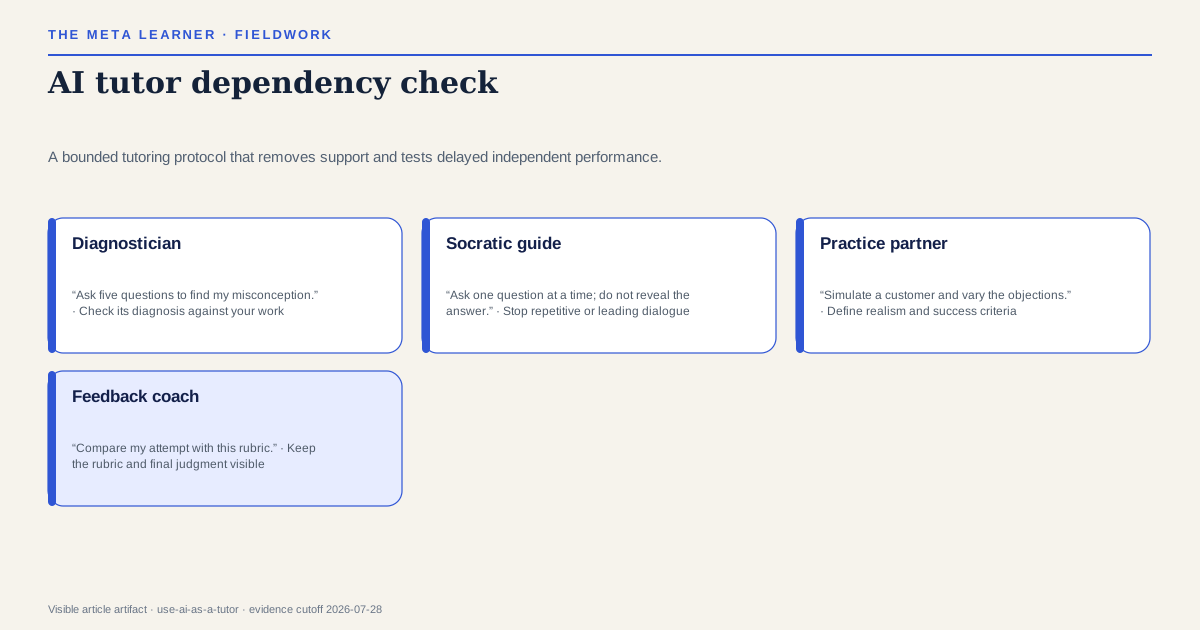
| Role | Good request | Safeguard | |---|---|---| | Diagnostician | “Ask five questions to find my misconception.” | Check its diagnosis against your work | | Socratic guide | “Ask one question at a time; do not reveal the answer.” | Stop repetitive or leading dialogue | | Practice partner | “Simulate a customer and vary the objections.” | Define realism and success criteria | | Feedback coach | “Compare my attempt with this rubric.” | Keep the rubric and final judgment visible |
The model can switch roles during a session, but tell it which role is active. Otherwise it often defaults to completing the task.
What AI-tutoring studies currently support
Retrieval practice improves long-term learning more reliably than additional study in many settings, and feedback is most informative when connected to a goal and the learner’s current performance. UNESCO guidance also emphasizes human agency and the need to evaluate generated content. These principles favor attempt-first tutoring with visible checks.
1, 2, 3The attempt–hint–explain–transfer loop
Begin with a diagnostic question at the edge of your ability. Attempt it without AI. Then request the smallest useful hint: a question, a missing distinction, or the next step—not a complete answer.
After revising, ask the tutor to identify the first point at which your reasoning diverged from a strong solution. Request an explanation in one representation that suits the problem: a causal chain, example and non-example, timeline, or diagram description.
Close the chat. Reconstruct the answer from memory and solve a new case. If you can only recognize the explanation when it is present, the session created familiarity, not dependable retrieval.
A reusable tutor contract
At the beginning of a conversation, provide:
My goal is [observable capability]. First diagnose me with a representative task. Do not solve it before I attempt it. Give one hint at a time, distinguish facts from uncertainty, and cite sources for claims I should verify. Use this rubric: [criteria]. End with an unaided transfer task and a short error summary.
The contract is a starting configuration. Your own instructions and provider controls do not guarantee compliance, so watch what the system actually does.
Case: the explanation arrives before the attempt
A learner asks for complete solutions to every programming exercise. Sessions feel smooth, but a blank editor reveals that the model performed the crucial decomposition.
A tutoring interaction should be judged by what the learner can later do alone. Translate each attractive feature into evidence about retrieval, explanation, feedback, or transfer:
| Observed signal | What it may mean | Next response | |---|---|---| | Immediate full answer | Support arrived before effort | Require an attempt and request one hint | | Agreement with learner | Feedback may be overly accommodating | Ask for a rubric and counterexample | | Success with chat open | Support dependence is possible | Repeat later without assistance |
The learner submits a plan first, receives a question rather than code, explains the error after correction, and repeats a parallel task the next day. The tutor becomes a feedback instrument inside a testable practice loop.
The protocol tests dependency in one bounded task. It cannot establish that the same tutor behavior benefits every learner, subject, or accessibility need.
Complete the task after the tutor disappears
After an assisted session, delay the test and change the problem surface. Ask the learner to explain the principle, solve a new case, and identify uncertainty without AI. Tutor support is useful when those abilities remain available.
Keep tighten or remove the tutor role
Use a three-round tutoring sequence. In round one, ask the AI to diagnose an error but not provide the final answer. In round two, ask for a contrasting example and explain the difference in your own words. In round three, close the conversation and solve a new case without assistance. Record where you first became unable to proceed. If the failure appears only after the tutor disappears, redesign the prompts to require more retrieval and generation before help is offered. If performance improves while prompt dependence falls, the tutor is acting more like scaffolding than substitution.
Run three tutor rounds with a no-tutor finish
Run two twenty-minute sessions on comparable material.
- In session A, ask for a clear explanation and study it.
- In session B, use the attempt–hint–explain–transfer loop.
- The next day, answer five questions without either transcript.
- Compare accuracy, reasoning quality, and confidence.
- Record which tutor behaviors helped and which removed useful effort.
The comparison creates personal evidence. Repeat it before drawing a general conclusion.
Watch how the scaffold fades
Good assistance should become removable. Plan the fading sequence before the session: begin with a worked contrast if necessary, move to a prompt or partial cue, then require an unaided response and a delayed transfer attempt. Retrieval research and feedback guidance support making the learner produce an answer and use information about the gap, rather than repeatedly studying a polished solution. 1, 2
Record the exact support used at each round. “Solved with one conceptual hint” is different evidence from “solved while viewing the model’s full answer.” If the learner continues to need the same cue, diagnose whether prerequisite knowledge, task difficulty, or the tutor’s feedback is the bottleneck. Fading support is not a ritual: accessibility needs or a genuinely new task may justify restoring it. The decision should follow observable performance, not a desire to appear independent.
Run the no-tutor dependency check
Keep a compact trace of each session: the learner’s first attempt, the smallest hint used, the correction, and the unaided follow-up. Once a week, present a representative test that the tutor has not seen and prohibit hints, retrieval, and answer checking until the learner commits. The human learner remains the decision owner for what counts as mastery; a teacher or qualified reviewer should own consequential evaluation. If performance rises only inside the chat, treat dependence as a failure condition and reduce the model’s access to the target step.
Tutor patterns that manufacture dependency
- Letting the model answer before you commit to an attempt.
- Asking “Do you understand?” instead of testing performance.
- Accepting feedback without a stable rubric.
- Leaving the transcript open during the final test.
- Treating generated encouragement as calibration.
- Using one chat as the sole source in a high-stakes subject.
Connect tutoring to verification and workflow design
The tutor protocol depends on the capability boundaries in AI literacy. Its feedback becomes decision-grade only when paired with source verification. To move from a learning session to an operational system, study the executed human-checkpoint workflow.
What tutor evidence cannot establish
An AI tutor may misdiagnose, invent facts, oversimplify, or adapt difficulty poorly. It cannot reliably replace qualified instruction, safeguarding, or professional supervision. Learners with little prior knowledge may be least able to detect confident errors and should use authoritative materials and human feedback.
The best AI tutor is not the one that makes learning feel effortless. It is the one whose structure helps you do the right kind of effort and see the result honestly.
Named sources
Evidence and further reading
Published July 29, 2026. Substantively updated July 29, 2026. Evidence last verified July 28, 2026.
- : Revised for the finite 200-article evidence-led corpus and unpublished release gate.