Prompting for Learning: Questions, Context, Feedback, and Retrieval
Prompt AI for better learning by specifying the capability, prior knowledge, practice rules, evidence standard, feedback rubric, and final retrieval test.
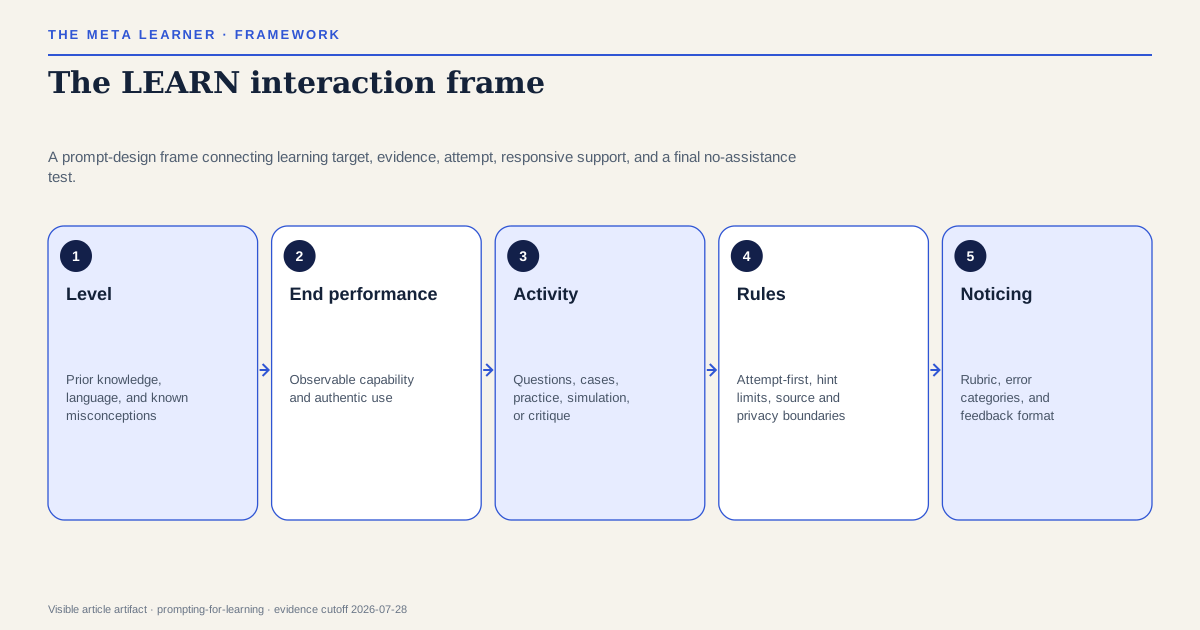
Effective prompting for learning defines the learner’s target and current state, tells the AI what kind of interaction to run, establishes evidence and feedback rules, and protects an unaided final test. The most important prompt is often a question the learner must answer, not an instruction that makes the model produce more text.
When prompting becomes a learning instrument
This guide is for learners who want prompts to create productive practice rather than polished passive explanations. It covers goal framing, context, attempt-first interaction, feedback, retrieval, and fading support. It is not magic phrases, model-specific prompt tricks, or a claim that prompting skill replaces subject knowledge. Use the prompt on one target performance and inspect what it makes you do. A good learning prompt creates attempts, discrimination, feedback, and fading support; it does not merely elicit elegant prose.
Prompting cannot turn an unreliable source into an authoritative one, and a long prompt is not automatically a good prompt. It is better understood as designing a small learning environment: what information is present, who acts first, what feedback is allowed, and what counts as success.
The LEARN prompt frame
| Element | What to include | |---|---| | Level | Prior knowledge, language, and known misconceptions | | End performance | Observable capability and authentic use | | Activity | Questions, cases, practice, simulation, or critique | | Rules | Attempt-first, hint limits, source and privacy boundaries | | Noticing | Rubric, error categories, and feedback format |
Add the final retrieval condition separately: “End with a new task that I complete without seeing the earlier explanation.”
What the research permits
Current provider guidance recommends clear instructions, relevant context, examples where useful, and evaluation against the real task. Learning research adds an essential constraint: retrieving knowledge and producing an answer can create stronger learning than further exposure alone. Prompt quality should therefore be evaluated by learner performance, not by how polished the model’s response appears.
1, 2, 3Prompt the interaction, not just the answer
Compare these requests:
Explain opportunity cost.
My goal is to identify opportunity cost in unfamiliar business decisions. First give me a case and ask for my analysis. Do not explain until I commit. Then identify one error using the definition from the linked source, give a contrasting case, and finish with a new case without hints.
The second request specifies a performance, sequence, feedback boundary, and transfer test. It may still produce flawed output, but the learner can inspect the process.
Context and evidence
Supply the source material when the answer must be grounded in it. Ask the model to distinguish source statements from inferences and to quote sparingly with location markers you can check. If current facts matter, use a system with retrieval and open the referenced pages.
Do not add sensitive personal, employer, client, or student data simply because it would personalize the response. Replace it with a minimal abstraction unless you have verified the system’s data handling and have authority to share it.
Case: turning a summary request into practice
A history learner asks for a comprehensive summary and rereads it. A better prompt turns the same material into a claim comparison and delayed reconstruction task.
The prompt should expose the learning decision that a fluent answer would hide. In this history task, diagnose whether the problem lies in the goal, the amount of help, or the criteria before changing the wording:
| Observed signal | What it may mean | Next response | |---|---|---| | Generic output | Goal or context is underspecified | State the performance and learner attempt | | Too much help | The model is solving the target step | Set a hint budget and require questions | | Feedback without criteria | Judgment may drift | Supply or co-create a visible rubric |
The prompt includes the target, source boundary, current attempt, desired feedback type, and a final no-help test. Prompt quality is judged by the practice it causes, not by eloquence of the response.
This redesign concerns one source-bound history task. It does not show that the LEARN frame benefits every learner, that model output is reliable, or that a well-written prompt caused durable knowledge. Only the later blank-screen reconstruction can distinguish supported performance from learning that survived the chat.
The blank-screen test
Close the chat, wait long enough for the wording to fade, and complete a new task whose surface details differ but whose target principle is the same. Record what you can generate without the transcript, which error returns, and whether confidence matches performance. Repeat once with a different model or no model at all. If the supposed learning disappears with the interface, the prompt optimized assisted performance rather than durable capability.
Build and test one LEARN prompt
Build a prompt in six lines:
- “I am learning ___ so that I can ___.”
- “I currently know ___ and struggle with ___.”
- “Use this source or standard: ___.”
- “Start by asking me to ___; do not complete it first.”
- “Give feedback using these criteria: ___.”
- “End with a delayed or novel retrieval task.”
After the session, score the interaction on three outcomes: Did it reveal an error? Did you correct the error? Could you perform on a new case without the chat? Revise the procedure, not merely the wording.
Archive the learning trace
Save the initial attempt, the exact help requested, the model response, the learner’s revision, and the no-assistance result. Label unsupported claims and any human checkpoint. This trace lets an accountable reviewer distinguish better prompting from better learning and compare representative tests across tools. For a fuller tutoring loop, continue with How to Use AI as a Tutor Without Becoming a Passive Learner; apply How to Verify AI Explanations and Sources to factual material; then place prompts inside How to Build an AI-Assisted Learning System Without Losing Agency.
Prompt patterns that outsource the learning
- Asking for a difficulty level without describing prior knowledge.
- Requesting “step by step” when an independent attempt is needed.
- Using role-play labels instead of concrete quality criteria.
- Filling the context window with irrelevant notes.
- Requesting citations but never opening them.
- Saving prompts without recording whether they improved learning.
Where prompting evidence stops
Models may ignore constraints, leak answers through leading hints, or give inaccurate feedback. Prompting is a probabilistic control, not a guarantee. The procedure must be paired with source verification, suitable privacy practices, and external assessment when the stakes or domain demand it.
A useful learning prompt leaves the learner with more capability, not merely more generated material.
Named sources
Evidence and further reading
Published July 29, 2026. Substantively updated July 29, 2026. Evidence last verified July 28, 2026.
- : Revised for the finite 200-article evidence-led corpus and unpublished release gate.