Build Your First Useful AI Workflow: Agents, Automation, and Human Checkpoints
A documented ten-item pilot for turning one bounded task into an AI-assisted workflow with explicit inputs, checks, failure routes, and accountability.
Build a first AI workflow around one frequent, low-consequence, reversible task with an output you can judge. Specify the inputs, divide the task into observable stages, add human checkpoints at uncertainty and consequence boundaries, and compare results with the existing process. Provider behavior, prices, and tool interfaces change; verify them before relying on the workflow.
The smallest credible workflow experiment
This guide is for individuals and small teams building their first repeatable AI-assisted process. It covers bounded task selection, structured stages, evaluation records, human checkpoints, and adoption decisions. It is not autonomous high-impact action, a universal return-on-investment claim, or a production security architecture. Pilot one reversible workflow against its current baseline. Keep it only if the full path—including review and exceptions—improves without hiding new risk or labor.
An agent is not valuable because it acts autonomously. It is valuable when the total system produces a useful result at acceptable cost and risk. For a first experiment, transparency beats ambition.
Predetermined question and baseline
The predetermined research question was: can a bounded research-triage workflow preserve source provenance and produce a usable first classification without taking an external action? The baseline was a human-only pass through the same ten titles and URLs under the publication's six-domain taxonomy. Time was not recorded in either condition, so speed was excluded from the result before the run began. The system proposed relevance; a human checked the source identity and decided what would enter the reading queue.
Protocol and architecture
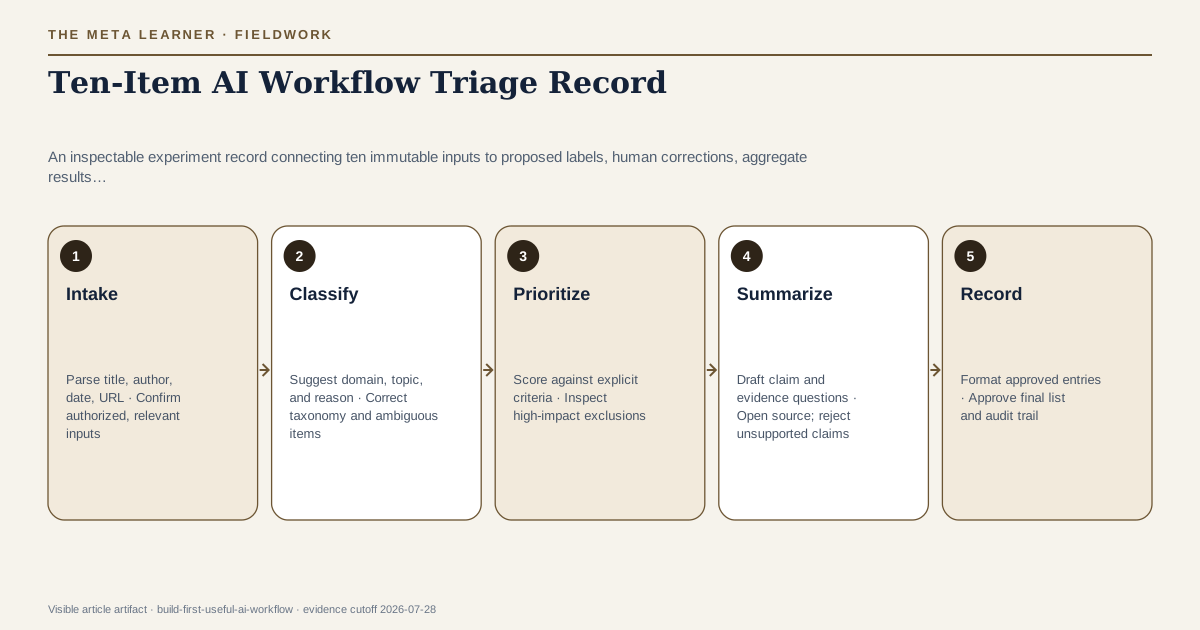
| Stage | Machine role | Human checkpoint | |---|---|---| | Intake | Parse title, author, date, URL | Confirm authorized, relevant inputs | | Classify | Suggest domain, topic, and reason | Correct taxonomy and ambiguous items | | Prioritize | Score against explicit criteria | Inspect high-impact exclusions | | Summarize | Draft claim and evidence questions | Open source; reject unsupported claims | | Record | Format approved entries | Approve final list and audit trail |
No stage is allowed to publish, contact an author, or add a factual claim to an article without human approval.
Ten-Item AI Workflow Triage Record: evidence and boundary
Current agent guidance from major model providers emphasizes starting with the simplest architecture that works, using tools and evaluation deliberately, and adding complexity only when justified. NIST’s framework adds context mapping, measurement, governance, and risk management. These support a workflow-first experiment with observable checkpoints.
1, 2, 3, 4Define success before building
Baseline the current task for two weeks or use a representative batch. Measure:
- minutes from intake to approved reading queue;
- false inclusions and false exclusions;
- percentage of records with complete provenance;
- reviewer confidence and correction time;
- model and service cost.
Set an acceptance rule, such as: reduce median triage time by 30 percent, preserve 100 percent of source links, and introduce no high-priority false exclusions in the test set. The exact thresholds depend on the task; writing them prevents a captivating demo from moving the goalposts.
Implementation notes
Use structured fields rather than free-form prose between stages. Keep original inputs immutable. Log the model version, instructions, output, human correction, and final decision. If the workflow touches personal or confidential data, stop until authority, retention, and provider controls are clear.
An “agent” that selects tools dynamically adds failure paths. Begin with a fixed sequence. Add branching only when test cases show that it improves outcomes.
The ten-link triage case
A weekly research queue contains ten mixed-quality links. The experiment asks whether assisted classification can preserve provenance and priority while reducing avoidable sorting work.
A useful workflow makes the automation boundary inspectable. For each signal, identify what the system produced, what a person still judged, and what result could falsify the design:
| Observed signal | What it may mean | Next response | |---|---|---| | Missing source URL | Provenance failure | Reject the record before scoring relevance | | High score with weak reason | Opaque prioritization | Require a criterion-linked rationale | | Human correction clusters | A systematic rule is wrong | Revise the stage, not individual outputs only |
The pilot retains immutable inputs, records the proposed category and priority, logs every correction, and reports quality before speed. One failed record is preserved as an evaluation case instead of silently repaired.
The workflow is a controlled first deployment, not proof of general productivity or learning gains. Its value is that failures remain reversible and attributable.
Test for transfer
Move the workflow to a second task only after the first produces a stable review record. Preserve the human decision gate and failure criteria; change the inputs and output measure. Transfer fails if the workflow needs hidden exceptions to remain safe.
Why constrained interfaces matter
Workflow reliability comes from constrained interfaces between stages. Each stage should receive named fields, produce named fields, and have a defined failure route. Free-form handoffs hide omissions and make evaluation expensive. A human checkpoint belongs where uncertainty meets consequence: before a source becomes evidence, before a low score excludes a valuable item, and before any output leaves the system.
Adjust one component—prompt, evidence source, review gate, or output measure—then rerun the same task. Multiple simultaneous changes make it impossible to learn why the workflow improved.
Reproduce the ten-record trial
Run a ten-item pilot:
- Choose one bounded task performed at least weekly.
- Save five normal, three difficult, and two failure examples.
- Write the output schema and acceptance criteria.
- Implement the smallest sequence, even if some steps are manual.
- Review every result and label error types.
- Compare time, quality, and cost with the baseline.
- Decide: adopt, revise, or stop.
Preserve the rejected examples. They are the beginning of an evaluation set and often reveal more than the showcase case.
Results, raw records, and interpretation
The documented launch pilot processed ten source records and preserved all ten URLs exactly. Nine of ten proposed domains matched the reviewed publication taxonomy before correction; eight of ten priority labels matched; one domain and two priority labels were corrected; no record was published or used for an external action. Elapsed time was not measured, so this run makes no speed or return-on-investment claim.
Claim sources: 4
The run used only title and URL as inputs. The assisted pass returned a domain, priority, and one-sentence reason under a fixed six-domain taxonomy. Review changed the UNESCO education guidance from AI Skills to Learning Science and reduced its priority; it also reduced the priority of the OECD labour-market source because the target launch article concerns task redesign rather than market forecasting.
The complete JSON raw record preserves configuration, inputs, initial outputs, reviewed labels, corrections, aggregate results, and limitations. A flat CSV version is available for inspection. The model identifier and temperature were not exposed by the task runtime, which is recorded as a reproducibility limitation rather than guessed.
The principal negative finding is equally important: the run produced no evidence about time savings, learning gains, or return on investment. It also did not test source-content summarization, autonomous tool use, or rare failures. Those absences are results of the protocol boundary, not details to repair with retrospective estimates.
This is one development run on a deliberately small, publication-specific batch. It supports the claim that the workflow was executed and that its provenance and correction trail can be inspected. It does not establish production reliability, universal classification accuracy, or time savings.
Preserve the adoption decision
Before changing the triage process, record five fields: the workflow outcome, the present baseline, the change being tested, the predicted result, and the acceptance rule. Here, a missing source URL is a stop condition rather than an invitation to reconstruct provenance after the fact. Keep the original proposal beside every human correction, then append the adopt, revise, or stop decision. That record prevents a polished final queue from hiding how much repair the assisted path required.
Where first workflows become untrustworthy
- Automating a rare task because it demos well.
- Using the model to define and grade its own success.
- Hiding raw inputs and intermediate decisions.
- Escalating from draft to external action without approval.
- Adding multiple agents before testing a fixed workflow.
- Reporting only average speed and omitting costly failures.
Ask a reviewer where the gate fails
Give a reviewer the immutable input, proposed label, rationale, correction, and final decision. Ask which error could still pass the current gate and which evidence the reviewer would need to stop it. Strengthen that specific handoff before increasing volume; a second reviewer is useful only if the record makes disagreement diagnosable.
Continue the inquiry
The experiment operationalizes the Map–Practice–Test–Adapt method under the capability limits described in AI literacy. Its next use is not a larger agent; it is a more exact audit of automation, augmentation, and judgment.
What the result permits
The evidence in this article supports a bounded design choice, not autonomous high-impact action, a universal return-on-investment claim, or a production security architecture. A workflow that saves minutes in drafting may still lose time in review, fail on atypical inputs, or move risk to someone who cannot see it. Preserve the baseline, test cases, corrections, and exceptions so that a favorable demo cannot masquerade as evidence of operational value. If the workflow can affect rights, safety, money, or regulated records, require named ownership, domain review, security controls, and a tested path to stop or reverse it.
What this pilot does not establish
Provider behavior, prices, and tool interfaces change. Small pilots miss rare failures, and human review can become a hidden cost. High-impact decisions require stronger validation, access controls, monitoring, and accountable domain owners than this starter protocol provides.
The useful artifact is not the agent diagram. It is a measured process whose boundaries, evidence, and handoffs remain legible.
Named sources
Evidence and further reading
Published July 29, 2026. Substantively updated July 29, 2026. Evidence last verified July 28, 2026.
- : Rebuilt as an executed Field Lab with predetermined measures, raw records, negative findings, and the unpublished corpus gate.