How to Audit Your Work for Automation, Augmentation, and Human Judgment
Decompose a job into tasks, decisions, data, consequences, and feedback to decide what AI can automate, augment, or should leave human-led.
Audit work at the task level, not the job-title level. For each recurring task, identify the inputs, output standard, variation, consequence of error, verification cost, sensitive data, and learning value; then classify it for automation, augmentation, human retention, or a controlled experiment. Work redesign intersects with employment obligations, sector regulation, cybersecurity, privacy, accessibility, and organizational power.
A job title is the wrong unit
This guide is for professionals and teams deciding how AI should change a role without reducing it to a list of software features. It covers task inventory, automation suitability, augmentation, consequence, human judgment, controls, and redesign. It is not a prediction of job loss, a vendor selection, or permission to automate regulated or high-impact decisions. Audit one recurring task from request to consequence. The decision should rest on total workflow performance, reviewer burden, exceptions, and accountability—not on the speed of the most visible step.
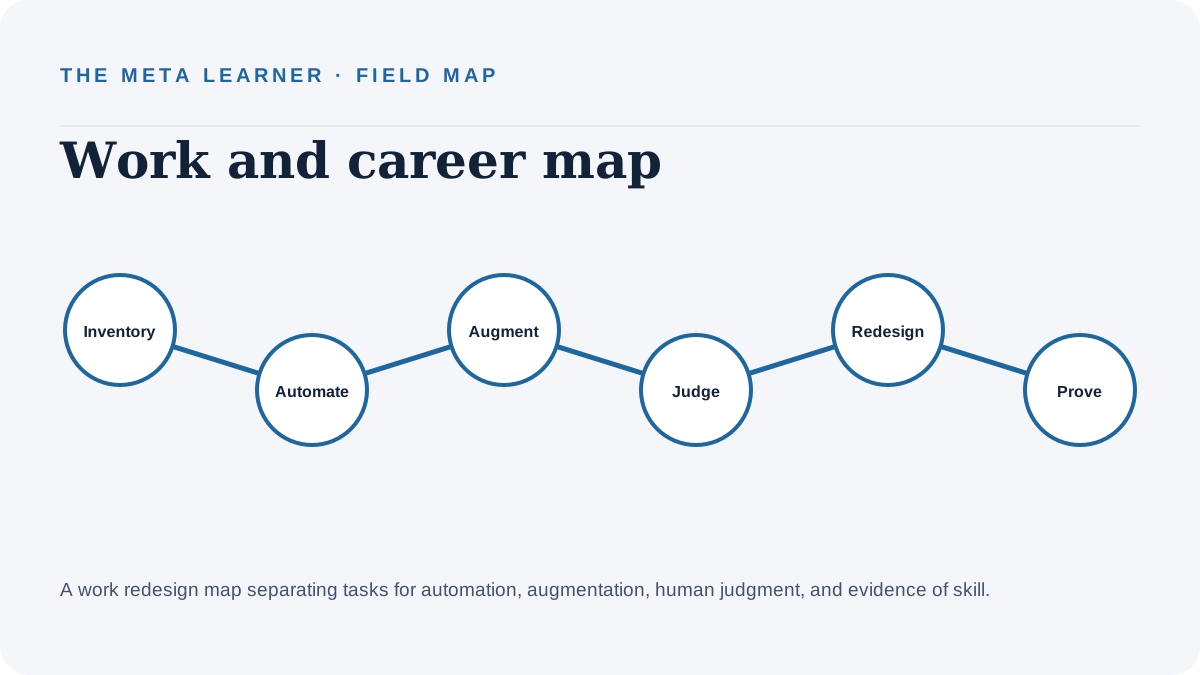
Jobs bundle communication, coordination, judgment, execution, and responsibility. AI may change some tasks substantially while leaving the role’s purpose intact—or may create new review and integration work. A task audit produces a more defensible plan than a prediction that a whole occupation will “disappear.”
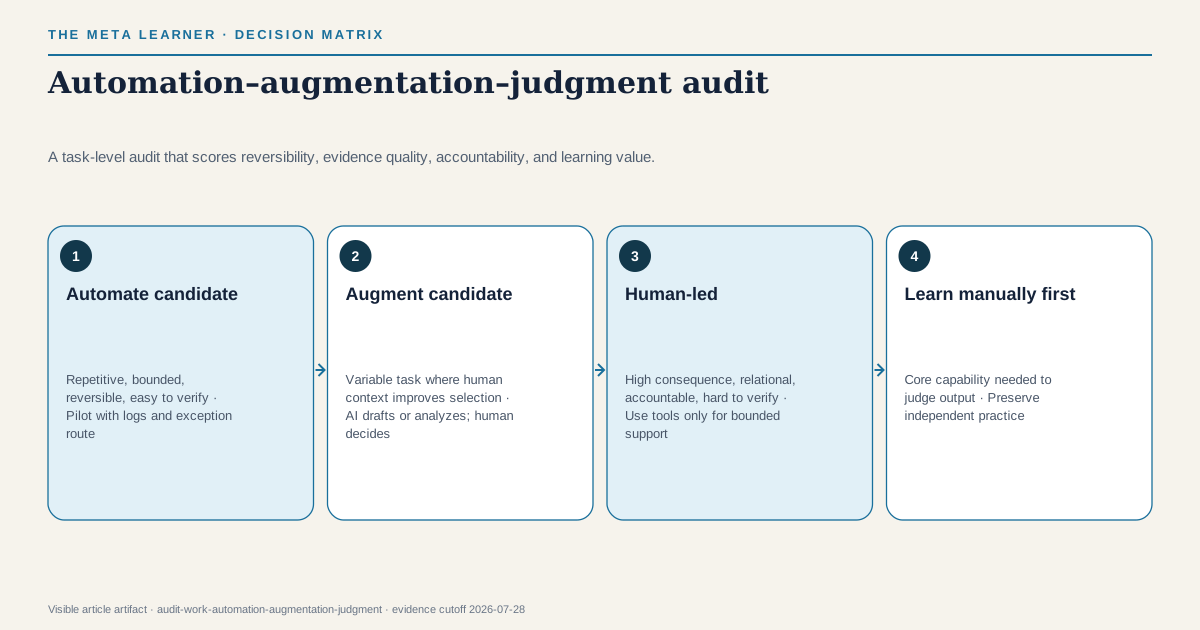
Allocate tasks across four operating modes
| Category | Typical conditions | Design response | |---|---|---| | Automate candidate | Repetitive, bounded, reversible, easy to verify | Pilot with logs and exception route | | Augment candidate | Variable task where human context improves selection | AI drafts or analyzes; human decides | | Human-led | High consequence, relational, accountable, hard to verify | Use tools only for bounded support | | Learn manually first | Core capability needed to judge output | Preserve independent practice |
A task can move categories as capability, regulation, or tooling changes.
Map the workflow as it actually runs
For two weeks, log tasks as performed, not as the job description imagines them. Record:
- trigger and frequency;
- inputs and their sensitivity;
- output and recipient;
- decisions embedded in the task;
- error consequence and reversibility;
- time, waiting, and rework;
- how quality is currently known.
Separate transforming known material from generating new claims. A formatting step and a legal interpretation may share a document but require very different controls.
What labor evidence can—and cannot—predict
Labor-market reports emphasize that AI exposure varies within occupations and often involves task transformation rather than simple job replacement. OECD and World Economic Forum analyses also point to skill change, organizational choices, and worker transition. These are scenario and survey signals, not precise forecasts for one person’s role.
1, 2, 3Treat judgment capacity as infrastructure
Automation can remove novice work that previously built the knowledge needed for later oversight. Ask which tasks teach patterns, exceptions, and customer context. If a junior employee never performs or reviews the underlying work, “human in the loop” may become ceremonial.
Design capability checkpoints: blind sampling, independent problem solving, error review, and rotation through manual cases. The goal is not to preserve drudgery; it is to prevent oversight from losing substance.
Decompose the supposedly automatable marketer
A marketing role is labeled “automatable,” although it contains data cleanup, draft production, stakeholder negotiation, and accountable claims approval.
The audit must separate technical feasibility from accountable delegation. Convert each task signal into a decision about reversibility, evidence, judgment, and learning value:
| Observed signal | What it may mean | Next response | |---|---|---| | High volume, clear rules | Automation candidate | Test exceptions, reversibility, and monitoring | | Ambiguous synthesis | Augmentation may fit | Keep source review and decision ownership | | External consequence | Human accountability is material | Require authority and an approval gate |
The role is decomposed into observable tasks. Low-risk formatting is automated; research synthesis is assisted with citations; claims and stakeholder commitments remain human decisions. Time saved is reinvested in evidence and customer contact.
The matrix supports a task-level decision; it does not eliminate organizational, legal, security, or professional obligations that may impose stricter controls.
Move the matrix to a higher-stakes workflow
Apply the audit to a second workflow with different stakes. Keep the criteria stable and compare why the allocation changes. A sound audit should explain the difference rather than produce the same automation answer everywhere.
The task is the unit of analysis; the workflow is the unit of redesign
The unit of analysis should be the task, but the unit of redesign is the workflow. Automating one step can move work to review, exception handling, or data preparation. It can also remove the junior tasks through which people once learned the role. A serious audit therefore records upstream inputs, downstream consequences, hidden review time, and the capability pipeline—not just whether a model can produce an output.
Change the allocation for the task whose risk signal changed. Preserve the surrounding workflow long enough to observe whether the new boundary improves quality, speed, or accountability.
Run one controlled task pilot
Choose one low-consequence task:
- Save ten representative cases, including failures.
- Define acceptable output and forbidden actions.
- Measure the current time and error pattern.
- Test AI as a draft, not an autonomous actor.
- Review every output and classify corrections.
- Calculate total time, including checking and setup.
- Decide whether to automate, augment, redesign, or stop.
Document who owns the final decision and where uncertain cases go.
Precommit the stop conditions
Before deployment, specify the conditions that would stop or narrow it: a severe error, rising total review time, loss of a required skill, unauthorized data handling, untraceable output, or responsibility without authority. Record the baseline and threshold. A pilot without a precommitted reversal rule invites teams to reinterpret every warning as an implementation detail after costs have already been sunk.
Automation audits that hide the real cost
- Auditing job titles rather than workflows.
- Optimizing model speed while ignoring review cost.
- Piloting only clean examples.
- Uploading confidential data without authorization.
- Removing training work without replacing skill development.
- Treating vendor demos or forecasts as local evidence.
Bring in the people who absorb failure
Invite the person accountable for the downstream outcome to challenge the task map. Ask which failure would be hardest to detect and who would bear the cost. Add that failure to the review gate before automating further.
Also invite an affected worker who performs the exceptions; formal owners often cannot see the repair work, informal workarounds, or lost learning routes hidden by aggregate metrics.
Follow the work-redesign path
Use the executed AI workflow experiment to see what a checkpoint looks like at task level. Then place the audit against current AI-assisted learning conditions and the deeper distinction between meta-learning and productivity. Together, those boundaries keep redesign from becoming a speed-only exercise.
The decision this evidence can support
The evidence in this article supports a bounded design choice, not a prediction of job loss, a vendor selection, or permission to automate regulated or high-impact decisions. The same automation can help an expert, mislead a novice, accelerate a queue, or create a new verification bottleneck depending on where it enters the work. Keep the task inventory, baseline, sampled failures, and redesign assumptions together; otherwise a local gain can be detached from the conditions that produced it. Do not automate a consequential judgment merely because its inputs look routine; assign a qualified owner, test edge cases, and preserve an effective appeal or reversal path.
Authority, regulation, and organizational power
Work redesign intersects with employment obligations, sector regulation, cybersecurity, privacy, accessibility, and organizational power. A personal audit cannot authorize deployment. Material changes require the relevant owners, affected workers, security teams, legal review, and current policies.
The best audit does not ask whether AI can touch the task. It asks whether the redesigned system is more useful, safer, learnable, and accountable end to end.
Named sources
Evidence and further reading
Published July 29, 2026. Substantively updated July 29, 2026. Evidence last verified July 28, 2026.
- : Rebuilt as a task-to-workflow audit with adoption, accountability, learning, and reversal tests.