Make It Stick: An Evidence-Led Book Analysis
Test Make It Stick’s argument for effortful learning against later retention, transfer, expertise, motivation, accessibility, and the limits of memory research.
The book’s strongest claim is that immediate fluency is a poor proxy for durable learning: retrieval, spacing, and appropriately mixed practice can improve later access and discrimination. Its limit is equally important. Difficulty helps only when it exercises the target process, feedback can correct error, and the final test represents the capability the learner actually needs.
Reconstructing the book’s argument
Peter C. Brown, Henry L. Roediger III, and Mark A. McDaniel organize Make It Stick around a challenge to intuitive study. Rereading and massed practice often produce rapid improvement and familiarity. Learners interpret that ease as mastery. The authors argue that later performance tells a different story: effortful retrieval, distributed encounters, mixed problem types, generation, reflection, and calibration can make knowledge more durable and usable.
The central argument is not that discomfort has educational value. It is that some conditions which slow performance during practice induce the learner to retrieve, discriminate, reconstruct, or update in ways that support a later test. The measure shifts from “How smooth was study?” to “What can I recover and do after time has passed?”
That is a powerful correction, but the book’s examples move across facts, concepts, athletics, medicine, aviation, and professional judgment. A principle that survives those stories still needs a task-specific implementation.
Intellectual inheritance behind Make It Stick
The intellectual genealogy begins with Hermann Ebbinghaus’s experimental study of memory and forgetting, and with William James’s effort to connect attention, habit, and education. Twentieth-century cognitive psychology distinguished encoding, storage, and retrieval, while laboratory work showed that a test can change memory rather than merely measure it.
Robert and Elizabeth Bjork’s work on desirable difficulties supplied a crucial distinction between performance during acquisition and learning inferred from later retention or transfer. The “testing effect,” spacing research, generation effects, metacognitive calibration, and studies of interleaving form the book’s nearer intellectual lineage.
The predecessors also expose a boundary. Memory research often isolates variables so mechanisms can be estimated. Expertise research asks how knowledge is organized with perception, judgment, deliberate practice, feedback, motivation, identity, and a field’s social standards. A complete learning system needs both levels.
Counterevidence and boundary conditions
The provocative phrase “desirable difficulties” is easy to corrupt into “harder is better.” Counterevidence begins with irrelevant difficulty: inaccessible presentation, ambiguous instructions, avoidable anxiety, missing prerequisites, distraction, and punitive testing can increase effort without engaging the target process.
Retrieval can also fail. A novice may retrieve nothing, repeatedly reconstruct an error, or learn a cue so narrow that the answer remains unavailable elsewhere. Feedback, graduated support, and varied cues change that result. Rereading, often cast as the villain, can be appropriate for initial orientation, checking a disputed passage, or rebuilding context before an attempt.
Most importantly, retention is not identical to transfer. Remembering a diagnostic criterion does not prove a clinician can notice it in a noisy case. Recalling vocabulary does not prove conversational timing. Reproducing a design principle does not prove a person can negotiate competing requirements.
The counterargument is not that the book is wrong. It is that a method should inherit the structure of its final demand.
The target-process application matrix: the claim-bearing evidence
The book’s account is consistent with influential experimental evidence on test-enhanced learning and with a major review that rated practice testing and distributed practice highly useful across studied conditions. The evidence supports delayed retention more directly than universal far transfer or expertise. Effects vary with material, retrieval success, feedback, spacing, prior knowledge, delay, and outcome measure.
1, 2, 3A worked language-learning case
A learner turns every new expression into a recognition flashcard. Accuracy rises quickly because the prompt is familiar and alternatives are visible. Conversation remains hesitant.
The final capability is not selecting a translation. It is retrieving an appropriate phrase under time pressure, hearing the partner’s response, and adapting. The learner keeps spaced retrieval for form and meaning, but replaces some cards with audio prompts, short free recall, contrastive situations, and live exchanges. Feedback covers pronunciation and pragmatics, not only lexical correctness.
The delayed test uses an unfamiliar scenario and removes the deck. If the learner recalls phrases but chooses them inappropriately, the evidence supports memory while rejecting the broader transfer claim. The next intervention is contrastive practice, not simply more cards.
Test the central claims
| Book claim | Strongest interpretation | Boundary to test | |---|---|---| | Retrieval strengthens learning | Reconstructing an answer can improve later access | Prompt, success, feedback, and final use must align | | Spacing beats massing | Repeated encounters distributed over time can improve retention | The useful interval depends on difficulty and horizon | | Interleaving supports discrimination | Choosing among related strategies can improve category selection | Novices may need initial examples or blocked stability | | Generation can help | An attempt can activate relevant structure before study | Unbounded failure can teach error or overload | | Elaboration builds connection | Explaining relations can organize knowledge | Fluent but false explanations require external correction | | Calibration matters | Prediction plus testing can reveal misjudgment | One test samples performance under one set of conditions |
The book is strongest when each row becomes a hypothesis about a named task, not a slogan about studying.
Run a target-process comparison
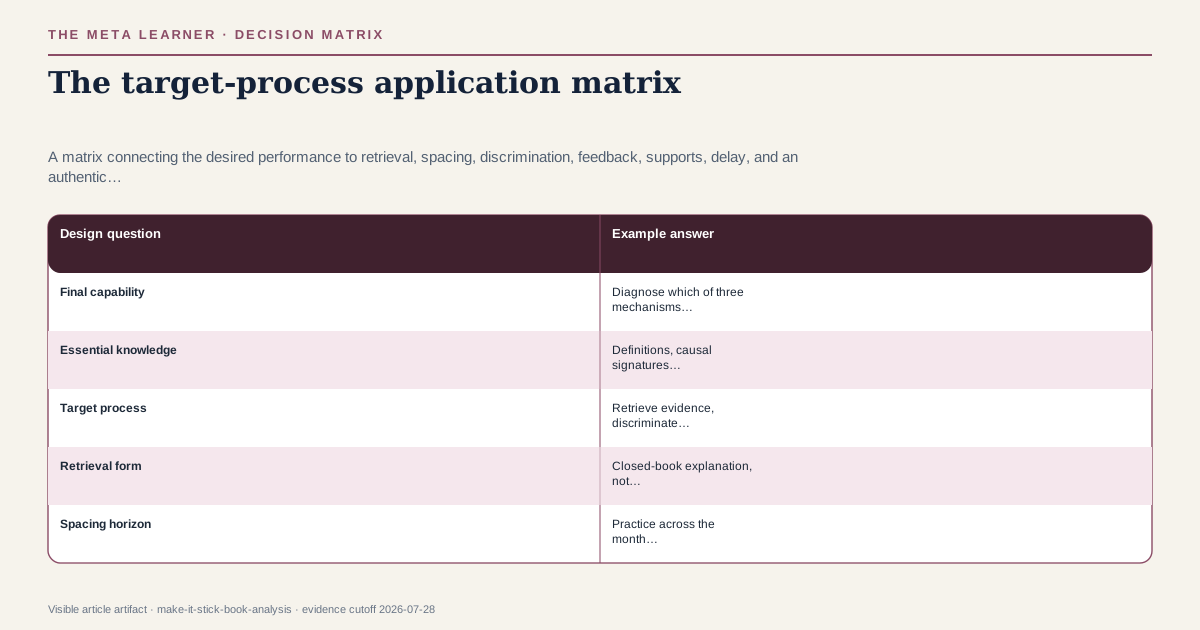
Complete this matrix before choosing a technique:
| Design question | Example answer | |---|---| | Final capability | Diagnose which of three mechanisms explains a new case | | Essential knowledge | Definitions, causal signatures, boundary conditions | | Target process | Retrieve evidence, discriminate models, justify selection | | Retrieval form | Closed-book explanation, not recognition | | Spacing horizon | Practice across the month before an applied assessment | | Mixing rule | Interleave only after each model has an initial worked example | | Feedback source | Answer key for facts; expert rationale for judgment | | Support to fade | Comparison table first, blank decision frame later | | Delayed test | A novel case one week later without the table | | Reversal signal | Errors show missing prerequisite rather than retrieval weakness |
The matrix makes an intellectual contribution the book’s memorable list alone cannot: it connects method choice to the process required at the end.
Use the target-process matrix
Run one interpretable learning comparison:
- Name the performance needed outside study.
- Create a delayed baseline task before changing the method.
- Identify whether the present failure is encoding, retrieval, discrimination, feedback, motivation, or transfer.
- Change one practice feature supported by the diagnosis.
- Preserve correction after unsuccessful attempts.
- Test with a new item, context, or cue after a meaningful delay.
- Record what improved and what remained unchanged.
If immediate practice becomes slower while delayed target performance improves, the difficulty may be desirable. If both worsen, investigate prerequisites, task validity, accessibility, feedback, and load before adding effort.
Attractive misreadings
- Every struggle is a desirable difficulty.
- Frequent testing should be high-stakes.
- Flashcards are retrieval practice’s universal form.
- Spacing has one optimal interval for every goal.
- Interleaving should replace all blocked instruction.
- Strong memory proves flexible judgment.
- One successful study experiment establishes expertise.
These misreadings share a pattern: a conditional mechanism becomes a universal recipe.
The boundary of this reading of Make It Stick
This article is a selective critical analysis, not a substitute for the book or a current systematic review of every method it discusses. The cited studies do not establish one universal schedule, far transfer, expert judgment, or equal effects across learners and contexts. High-stakes professional practice needs authentic assessment, domain feedback, accessibility, and accountable supervision beyond memory techniques.
Implement the retrieval claim through active recall, design timing through spaced repetition, and compare sequencing through interleaving versus blocked practice.
Named sources
Evidence and further reading
Published July 29, 2026. Substantively updated July 29, 2026. Evidence last verified July 28, 2026.
- : Rebuilt as a critical argument test with independent evidence, intellectual genealogy, transfer boundaries, and an application matrix.