Spaced Repetition: A Practical Evidence-Based Guide
Space retrieval over time to make memory more durable, while avoiding overloaded decks, context-free cards, and false precision about schedules.
Spaced repetition means revisiting information through retrieval across separated sessions rather than concentrating repetitions together. The useful interval depends on how long you need the knowledge, how successfully you retrieve it, and what kind of material you are learning. No universal schedule fits every learner or knowledge type, and card retention does not establish integrated performance.
When knowledge deserves a schedule
This guide is for learners who must retain knowledge beyond the current week and can revisit it over time. It covers distributed encounters, retrieval scheduling, item repair, and matching intervals to a retention horizon. Use this when a durable knowledge component is worth repeated retrieval and a future use date can be named. Do not use it for every sentence in a source, for a one-off lookup, or as a substitute for performing the whole skill. There is no single optimal schedule or app, and spaced cards alone do not establish broad expertise. Evaluate the schedule through delayed, unaided retrieval of the right material; streaks, review counts, and interface fluency are only activity measures.
Spacing is a principle, not a particular app. A calendar, question list, conversation routine, or software scheduler can all create distributed encounters. The mechanism is most useful when each review demands retrieval and connects knowledge to varied contexts.
Massed and spaced practice
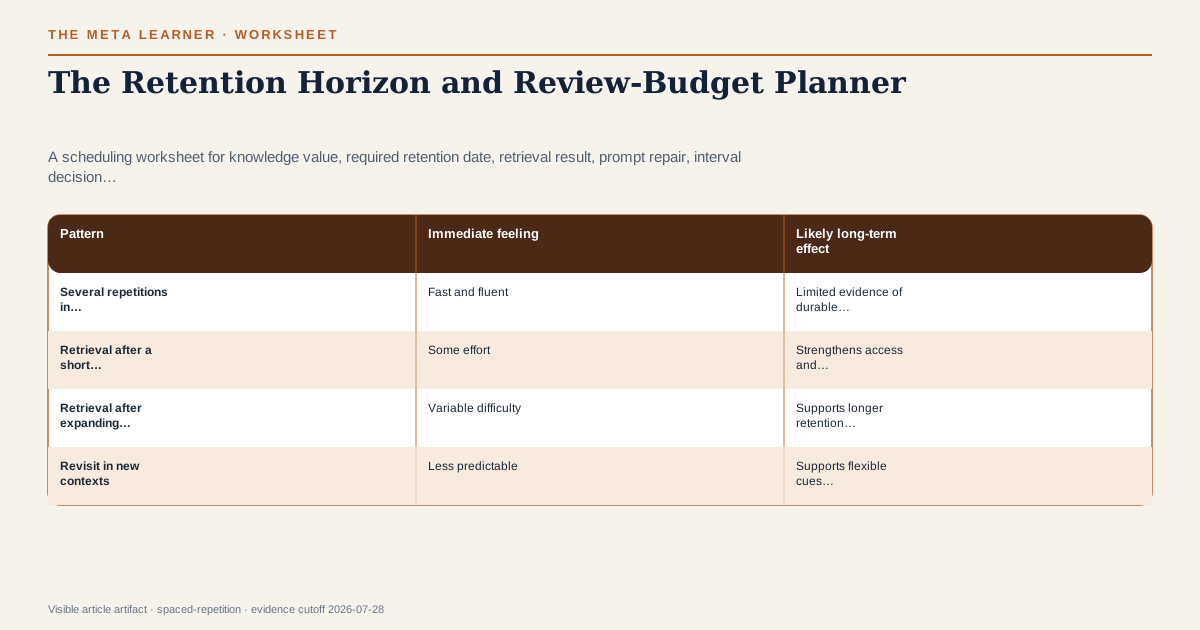
| Pattern | Immediate feeling | Likely long-term effect | |---|---|---| | Several repetitions in minutes | Fast and fluent | Limited evidence of durable access | | Retrieval after a short gap | Some effort | Strengthens access and diagnoses errors | | Retrieval after expanding gaps | Variable difficulty | Supports longer retention when successful | | Revisit in new contexts | Less predictable | Supports flexible cues and transfer |
The right amount of forgetting is not a universal percentage. A failed retrieval can still be informative if feedback follows, but constant failure signals that the gap or card design is too difficult.
What spacing research establishes
A large quantitative literature documents a spacing effect: distributing study generally improves later retention relative to massing. Research also shows an interaction between spacing gap and desired retention interval. This is evidence for planning delayed encounters, not for one perfect schedule that fits every learner and knowledge type.
1, 2, 3Decide what deserves scheduling
Use deliberate spacing for foundational facts, vocabulary, distinctions, procedures, and concepts that must remain available. Do not turn every sentence from a source into a permanent card. Low-value items create a review debt that crowds out application.
Cards should be atomic enough to answer but meaningful enough to use. Add context or an example when ambiguity is unavoidable. For linked knowledge, combine cards with periodic free recall, concept mapping, and whole tasks.
A simple schedule
For a starting experiment, retrieve after roughly one day, three days, one week, two weeks, and one month. Treat these as planning anchors, not scientific constants. Increase the gap after strong, quick retrieval; shorten it or repair the prompt after failure.
Set a review budget. When daily reviews exceed it, stop adding new material and delete, suspend, or combine low-value items. A sustainable smaller system beats an abandoned comprehensive one.
Adaptations by knowledge type
Adapt the representation before changing the interval. A factual association may need a short production prompt; a concept may need an example and a boundary case; a procedure may need a partially completed sequence; and a decision rule may need mixed scenarios in which the learner must first decide whether the rule applies. For a beginner, keep early gaps short enough that feedback can repair the model. For an experienced learner, use fewer cues and longer gaps, then insert whole-task variants so successful cards do not conceal failure in practice. Accessibility adaptations can change input or response modality while preserving the retrieval demand.
Case: a six-month goal and a one-week cram
An analyst learns regulatory definitions for an exam in six months and reviews them intensively in the first week, then scarcely at all.
A calendar cannot repair a broken item or a missing prerequisite. The learner first distinguishes an interval problem from a representation problem and a context problem:
| Observed signal | What it may mean | Next response | |---|---|---| | Immediate ease | Interval may be too short | Delay until retrieval requires effort | | Persistent failure | Item or prerequisite may be broken | Simplify, clarify, or relearn before rescheduling | | Card success only | Context is too narrow | Add mixed cases and real documents |
Reviews are distributed toward the six-month horizon, with retrieval before feedback and periodic use in scenario questions. Scheduling serves the retention goal rather than becoming the goal.
The proposed intervals are planning anchors for this retention horizon, not a universal schedule. Success on these regulatory definitions would not establish judgment in a live case. The later scenario test determines whether preserved access supports use.
Transfer beyond The Retention Horizon and Review-Budget Planner
After several scheduled retrievals, run an unaided test in a new context that does not display the deck, card wording, or category label. Ask the learner to recognize when the knowledge is relevant, retrieve it, and use it in a representative task. Compare confidence, item recall, and whole-task performance separately. If card accuracy remains high while selection or application fails, the spacing schedule preserved an item but did not produce transfer; adapt the prompt or add discriminating cases rather than merely shortening the interval.
Build a fifteen-prompt retention system
Create fifteen prompts from one active project:
- Select facts and distinctions that enable later reasoning.
- Write questions in the direction you must retrieve.
- Attempt each before revealing the answer.
- Mark correct, hesitant, or incorrect.
- Schedule later retrieval according to result and retention need.
- Once a week, use several items together in a real task.
- At one month, test without the deck and revise.
Track transfer failures separately. A remembered definition that is never selected when relevant needs application practice, not merely another interval.
Diagnose interval or item failure
Before changing the learning process, record five fields: the target performance, the present evidence, the change you will make, the result you predict, and the date of review. For this topic, “immediate ease” is a signal to investigate, not a conclusion. Record why an interval was shortened or lengthened and which delayed recall pattern would show that the schedule is mistimed. After the review, retain the original entry and append the outcome. That history separates a schedule that adapts to memory from one that merely rationalizes every lapse after it happens.
Scheduling choices that create review debt
- Adding hundreds of cards during a burst of enthusiasm.
- Reviewing by recognition rather than production.
- Trusting an algorithm without inspecting card quality.
- Memorizing disconnected facts before building a model.
- Never varying examples or retrieval cues.
- Keeping obsolete knowledge in the permanent queue.
Choose the next memory intervention
Use Active Recall to improve the quality of each retrieval attempt. Compare temporal spacing with Interleaving vs Blocked Practice when the learner must choose among confusable categories. When scheduled knowledge is available but remains tied to the original cue, run the Retrieval-to-Transfer Protocol.
Where spacing stops helping
Most spacing research uses bounded material and tests that may not capture complex professional performance. Scheduling can maintain components but cannot replace synthesis, feedback, or authentic practice. Optimal gaps vary, and algorithmic recommendations are estimates rather than guarantees.
Space what matters, retrieve it honestly, and reconnect it to use. The schedule serves the capability—not the other way around.
Named sources
Evidence and further reading
Published July 29, 2026. Substantively updated July 29, 2026. Evidence last verified July 28, 2026.
- : Added entry and non-use conditions, a budgeted scheduling procedure, adaptations, failure modes, and unaided transfer testing.