The Retrieval-to-Transfer Protocol: From Recall to Real-World Performance
Progress from accurate recall through variation, selection, and distant performance so that memory practice earns a bounded claim about transfer.
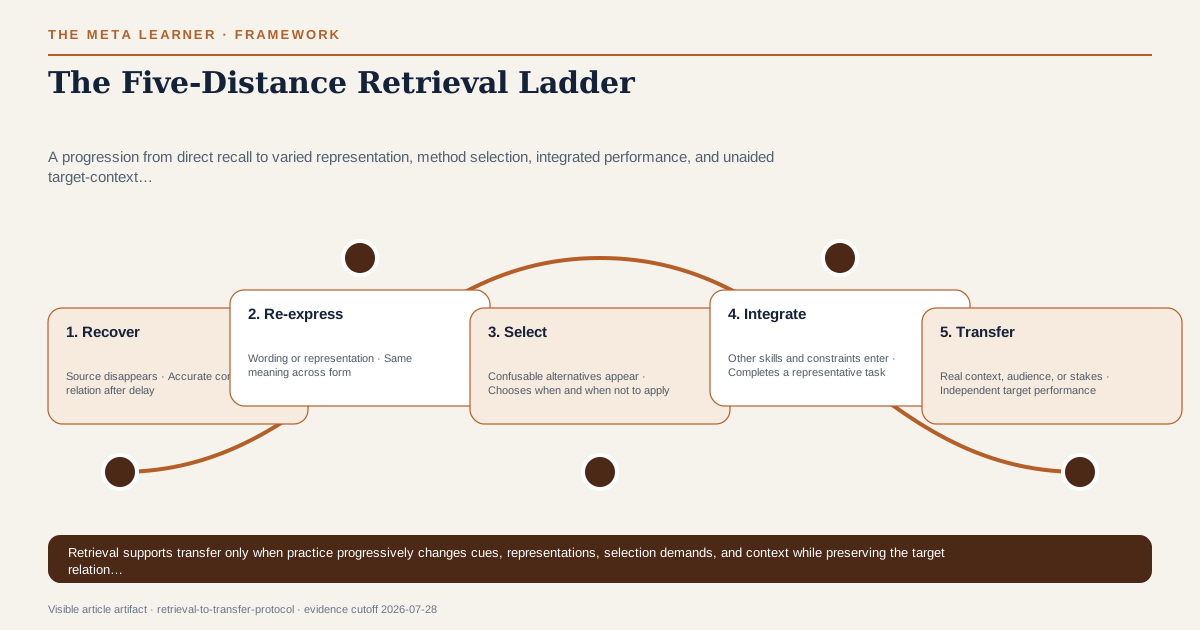
Move from recall to transfer in five distances: retrieve the core relation, vary its representation, discriminate when it applies, integrate it into a realistic task, and perform in the target context without help. Advance only when delayed performance at the current distance is accurate enough; otherwise repair the specific failure rather than adding harder novelty.
Use this when recall is necessary but insufficient
Use this protocol when knowledge must guide a later decision, explanation, procedure, or performance rather than merely appear on a familiar test. It is especially useful when flashcards, quizzes, or rehearsed examples are already successful but real work remains fragile.
Do not use it before the learner has enough core knowledge to attempt retrieval, when the target task cannot be safely simulated, or when a regulated procedure requires supervised certification. Transfer practice does not replace prerequisite instruction, and “make it harder” is not a design principle unless the changed difficulty belongs to the target.
Experimental work has shown retrieval benefits on some new inferential questions relative to repeated study. butler, barnett Transfer research also warns that “far” and “near” depend on multiple dimensions, including domain, context, function, time, and modality. barnett
Worked progression: interpreting a confidence interval
At distance one, the learner reconstructs the interval’s meaning without notes. At distance two, the learner explains the same relation from a graph. At distance three, the learner distinguishes a confidence interval from a prediction interval and refuses an invalid probability statement.
At distance four, the learner reads a short study containing sample details, point estimates, intervals, and distracting significance language, then writes a bounded interpretation. At distance five, the learner reviews an unfamiliar report for a colleague without prompts. A correct definition on a card is valuable, but it is not the final claim.
The five-distance ladder
| Distance | Changed feature | Evidence | |---|---|---| | 1. Recover | Source disappears | Accurate core relation after delay | | 2. Re-express | Wording or representation | Same meaning across form | | 3. Select | Confusable alternatives appear | Chooses when and when not to apply | | 4. Integrate | Other skills and constraints enter | Completes a representative task | | 5. Transfer | Real context, audience, or stakes | Independent target performance |
The ladder is an executable asset: write one task for each row before beginning. If the fifth row is vague, the learning goal is still vague.
Evidence inside the case boundary: the Five-Distance Retrieval Ladder
Research supports transfer from retrieval under some conditions and provides taxonomies for describing transfer distance. It does not show that retrieval automatically produces far transfer or that five rungs are universally optimal. The ladder translates the evidence into a falsifiable progression.
butler, barnettClimb the five retrieval distances
Step 1 — Define the unchanged relation. Name the concept, decision rule, causal structure, or procedure that should survive every task.
Step 2 — Build the recovery prompt. Remove the source and retrieve after a meaningful delay. Correct errors before proceeding.
Step 3 — Change representation. Move text to diagram, equation to explanation, worked example to blank problem, or listening to response. Preserve the relation.
Step 4 — Add discrimination. Mix cases where the method applies with near neighbors where it does not. Require a reason for selection.
Step 5 — Integrate. Put the relation inside a fuller task containing irrelevant information, competing goals, and realistic constraints.
Step 6 — Test the target context. Remove study cues, change audience or environment, and require independent performance.
Step 7 — Route the error backward. A selection error returns to discrimination; a missing fact returns to retrieval; a context failure returns to representative integration.
Adapt the distance without corrupting it
- Novice: keep content familiar while changing only representation.
- Advanced: include rival methods, incomplete evidence, and consequential trade-offs.
- Motor or performance skill: change environment or timing only after safe form is stable.
- Team skill: test handoffs and shared representations, not only one individual.
- Accessibility adaptation: preserve assistive tools that belong in the target context; remove only scaffolds that will not be available later.
The adaptation rule is to vary one interpretable dimension at a time until integration, then combine dimensions.
Before advancing, set a rung-specific gate: accuracy threshold, delay, number of varied cases, and maximum permitted support. Record both success and the error type. A learner who passes by recognizing a recurring surface cue should not advance to integration; replace the cue and retest selection. The gate makes progression an evidence decision rather than a reward for finishing exercises.
Failure modes that keep practice inside the cue
- Using identical questions and calling the final repetition transfer.
- Changing every feature at once and learning nothing from failure.
- Increasing difficulty with irrelevant puzzle elements.
- Omitting cases where the method should not be used.
- Giving hints that name the principle during the test.
- Scoring the final answer while ignoring selection and reasoning.
- Treating one successful case as a general capability.
When practice performance is high and transfer remains low, inspect cue dependence before adding repetitions.
Test the Five-Distance Retrieval Ladder beyond the original case
Specify the distance in advance: changed topic, representation, function, social context, modality, physical setting, delay, or combination. Give no cue naming the method. Score whether the learner notices relevance, selects correctly, performs, explains a boundary, and recovers from an exception. Preserve the task and result.
Build accurate retrieval with Active Recall, improve discrimination with Interleaving, and design the final claim through The Transfer Test.
Transfer is a measured distance not a feeling
The protocol cannot guarantee far transfer, and performance may depend on domain knowledge, feedback, delay, motivation, accessibility, and the fidelity of the test context. A simulation can omit the social and material conditions of real work. Some high-stakes capabilities require supervised practice and formal assessment. Report the exact distance tested rather than claiming a general transferable skill.
The ladder earns a narrow statement: this knowledge survived these changed conditions, for this learner, on this date.
Named sources
Evidence and further reading
Published July 29, 2026. No substantive revision has been recorded. Evidence last verified July 28, 2026.