The Transfer Test: Prove a Skill Works Outside Practice
Define transfer distance before practice, remove unavailable supports, test method selection in a changed context, and report the exact boundary passed.
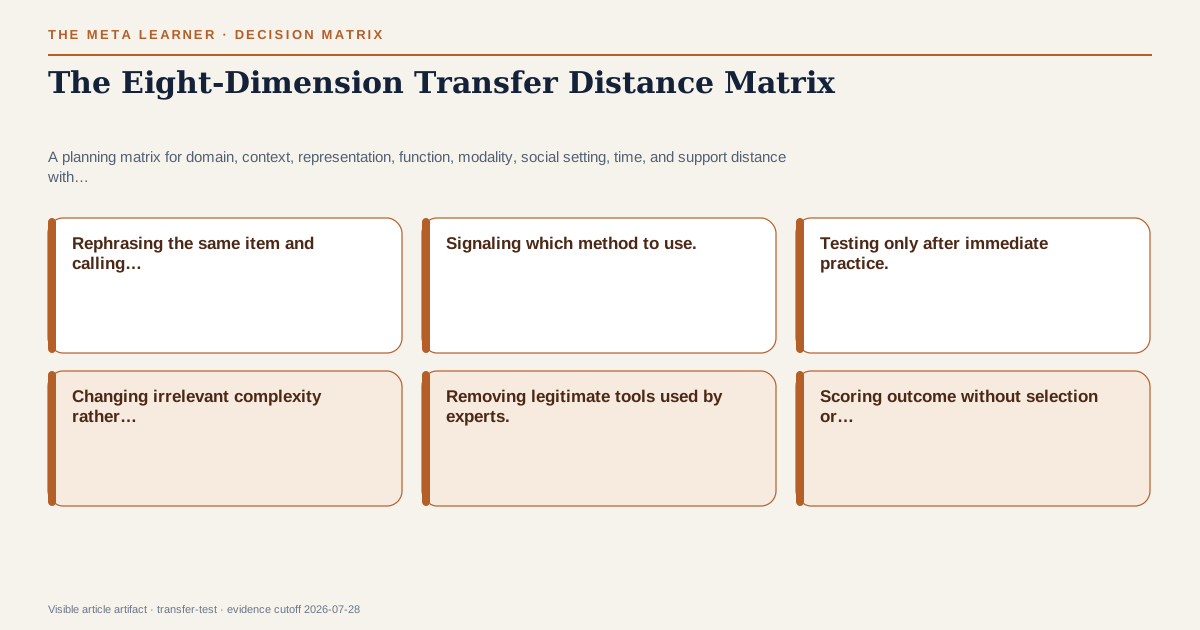
Before practice, define the target performance and which dimensions the final task will change: domain, context, representation, function, modality, social setting, delay, and available support. Build an equivalent baseline, keep the target relation relevant, remove cues that will not exist in use, require method selection, and report only the exact distance passed.
Use this before practice design is locked
Use this method whenever a course, tutorial, simulation, coaching program, or AI assistant claims to create capability beyond its exercises. Designing the test first prevents practice from quietly becoming the test.
Do not use one transfer score to certify unrestricted professional competence, compare learners exposed to materially different prerequisites, or place people at risk. Some authentic skills require licensed assessment, supervised performance, or multiple observations. Accessibility tools that belong in the target context are not “help” to remove.
Transfer scholarship offers taxonomies precisely because distance can vary across knowledge domain, physical and social context, temporal context, function, and modality. taxonomy, nasem The National Academies synthesis emphasizes the roles of prior knowledge, context, culture, and learning design. nasem
Specify administer and interpret the transfer test
Step 1 — State the capability. Use an observable verb, artifact, audience, standard, and consequence.
Step 2 — Identify the invariant. Name the relation, principle, or procedure that should remain useful despite surface change.
Step 3 — Declare distance. Complete the matrix before instruction and explain why each change belongs to the intended claim.
Step 4 — Create equivalent baselines. Use parallel tasks, not the final task repeated until familiar.
Step 5 — Remove unavailable cues. Hide examples, answer keys, method labels, and AI help that will not exist in use.
Step 6 — Require selection. Include cases where a competing method is more appropriate or no action is justified.
Step 7 — Score the process and outcome. Measure noticing, selection, execution, explanation, recovery, and consequence as relevant.
Step 8 — Route the failure. Identify whether the learner lacked knowledge, selected wrongly, could not execute, or failed under context.
Step 9 — Report the boundary. State learner population, tasks, delay, supports, assessor, and exact dimensions changed.
The eight-dimension matrix
| Dimension | Practice | Test | Intended distance | |---|---|---|---| | Domain or topic | | | | | Physical context | | | | | Representation | | | | | Function or goal | | | | | Modality | | | | | Social setting | | | | | Delay | | | | | Available support | | | |
Add baseline, scoring criteria, assessor, and failure routing. The asset turns “new context” into an inspectable design.
Why the evidence supports the Eight-Dimension Transfer Distance Matrix
Worked test: evidence verification
Practice uses health claims with a visible checklist and linked sources. A counterfeit test swaps in nutrition claims but leaves the checklist, source type, and explicit instruction “verify this.”
A stronger near-transfer test supplies an unfamiliar employment claim among other editing tasks, removes the checklist, and requires the learner to notice that verification is needed. A farther test asks the learner to advise a colleague under time pressure with current primary sources and an escalation boundary.
Passing the near test supports selection across topic. It does not establish regulated professional judgment.
Adaptations that preserve the claim
- Novice: change one dimension and provide the normal target-context tools.
- Advanced: vary several dimensions and include conflicts among methods.
- Team capability: score coordination, handoff, and shared recovery.
- Motor or clinical skill: use safe simulation before supervised authentic performance.
- AI-supported learning: remove AI only if it will be unavailable later; otherwise change its role and test human oversight.
Adaptation should match the real environment, not an ideology of unsupported performance.
Check equivalence before interpreting the gap
Have a qualified reviewer inspect practice, baseline, and transfer tasks without seeing their labels. They should judge target-knowledge demand, difficulty, scoring, language, accessibility, and prerequisite knowledge. If the transfer task requires an unstated domain fact or a more complex output, failure cannot be attributed cleanly to transfer.
Include a non-use condition. At least one item should look similar while requiring another method or no action. This tests whether the learner selects from features rather than executes whenever cued. Preserve all prompts, allowed tools, time, and scoring decisions so another reviewer can reconstruct the distance. A result becomes interpretable only after task alignment and changed conditions are both visible.
Failure modes that counterfeit transfer
- Rephrasing the same item and calling it novel.
- Signaling which method to use.
- Testing only after immediate practice.
- Changing irrelevant complexity rather than application conditions.
- Removing legitimate tools used by experts.
- Scoring outcome without selection or recovery.
- Teaching to the hidden transfer item.
- Generalizing from one learner and one case.
A difficult test can still be invalid if the difficulty is unrelated to the target capability.
Verify the Eight-Dimension Transfer Distance Matrix outside rehearsal
The method itself transfers when a designer receives a new skill and, without the matrix, specifies the invariant, declares at least three relevant distance dimensions, builds a parallel baseline, removes only non-target supports, includes a non-use case, and reports the precise boundary. An independent reviewer checks alignment.
Build the progression through The Retrieval-to-Transfer Protocol, repair components with Deliberate Practice, and train selection through Interleaving.
One passed distance is not a general transferable skill
Authentic tasks are difficult to equate, and context changes can introduce motivation, culture, language, equipment, and social effects. Repeated exposure can contaminate later tests. A finite assessment cannot prove adaptability to all future settings. High-stakes certification requires validated instruments, qualified assessors, and often multiple supervised performances.
The honest conclusion is deliberately narrow: the skill survived these changes, under these conditions, with these supports.
Named sources
Evidence and further reading
Published July 29, 2026. No substantive revision has been recorded. Evidence last verified July 28, 2026.