Deliberate Practice, Feedback, and the Path to Expertise
Deliberate practice targets a specific performance gap with focused attempts, informative feedback, repetition, and recovery.
Deliberate practice is focused work on a specific weakness just beyond current reliable performance, using a clear representation of quality, repeated attempts, and feedback that informs the next attempt. It is demanding and domain-specific; time spent alone does not make practice deliberate. Opportunity, coaching, resources, motivation, development, and domain structure constrain outcomes; demanding repetition is not automatically deliberate.
When repetition has stopped changing performance
This guide is for learners improving a complex skill after ordinary repetition has stopped producing reliable gains. It covers specific subskills, stretch tasks, informative feedback, correction, and integration into whole performance. Use this when a recurring weakness can be observed, a credible standard exists, and feedback can change the next attempt. Do not use it as a fixed hour rule, solitary grinding, punishment, or a substitute for qualified supervision in a high-risk domain. Motivation, opportunity, recovery, and access to coaching still matter. Judge the intervention by changed performance and transfer, not by effort alone.
The phrase is often used for any disciplined habit. That erases its most useful elements: a defined task, immediate evidence, correction, and a training structure connected to expert performance.
Practice versus performance
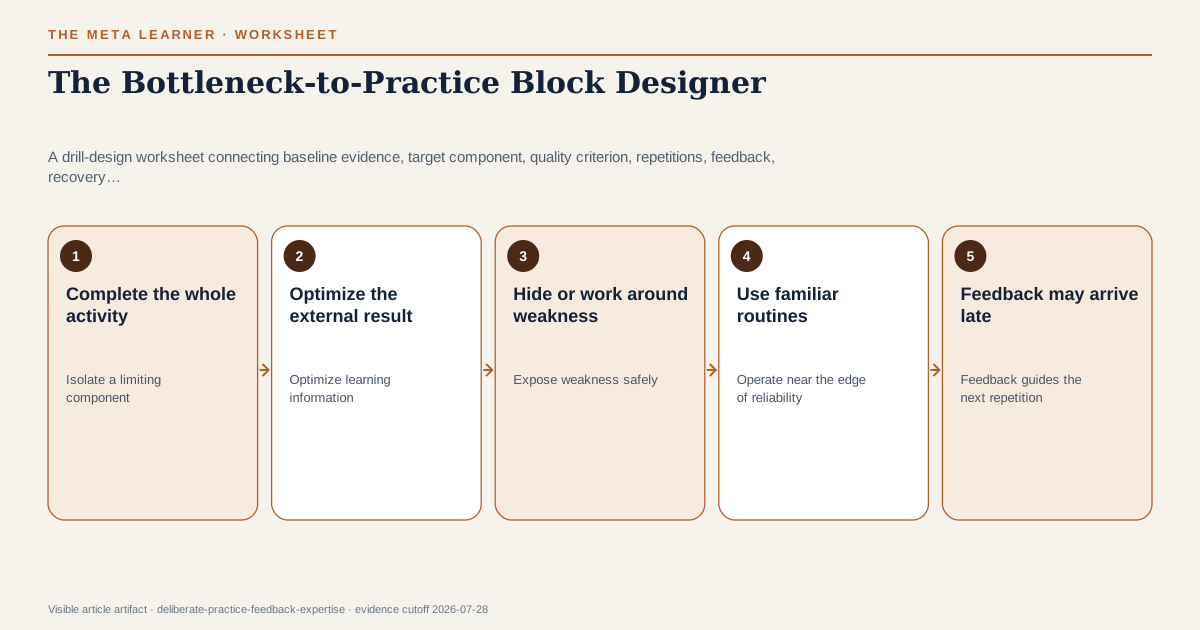
| Performance | Deliberate practice | |---|---| | Complete the whole activity | Isolate a limiting component | | Optimize the external result | Optimize learning information | | Hide or work around weakness | Expose weakness safely | | Use familiar routines | Operate near the edge of reliability | | Feedback may arrive late | Feedback guides the next repetition |
Real projects matter, but performance can reward coping strategies that leave a weakness unchanged. Training creates conditions where the weakness cannot hide.
What expertise research permits
Foundational deliberate-practice research describes structured activities designed to improve performance through effort and feedback. Later meta-analysis finds a meaningful but domain-varying relationship between deliberate practice and performance, while showing that it does not explain all individual differences. Expertise also depends on opportunity, coaching, prior development, motivation, and domain conditions.
1, 2, 3Find the training target
Compare a recent artifact with a credible model or rubric. Identify the earliest point where quality diverges. “Become a better writer” is not a target; “make paragraph claims explicit and connect evidence to them” is.
Select a drill that preserves the relevant decision. A writer might revise ten claim-evidence pairs. A speaker might practise recognizing and repairing one recurrent sound contrast. An analyst might classify twenty cases before calculating anything.
Feedback should be specific enough to change the next attempt. “Good job” and an overall score offer little direction. A useful signal names what happened, what the standard requires, and what adjustment to try.
The exact practice-block protocol
Use this forty-minute procedure, shortening it when fatigue degrades the target decision:
- State one target and one quality criterion.
- Warm up with a representative easy attempt.
- Complete three to five concentrated repetitions.
- Inspect feedback after each or short batch.
- Change one variable and repeat.
- Finish with the component inside a whole task.
- Record the error pattern and recovery need.
High concentration limits session length. Rest is part of the design because fatigued repetitions may stabilize compensations instead of the intended performance.
Adaptations without losing the target
Adapt the drill only after classifying the failure mode. If every attempt collapses, reduce complexity or restore one scaffold while keeping the target decision intact. If performance is consistently easy, vary the case, narrow the time limit, or remove a cue. If feedback arrives too slowly, work in shorter batches or use a reliable intermediate signal. For motor, linguistic, analytical, and interpersonal skills, the observable output will differ, but the adaptation rule remains: change one constraint, preserve the criterion, and save evidence from the next attempt. A variant that makes practice entertaining but removes the bottleneck is a different activity.
Case: the talk improves but hostile answers do not
A presenter gives the same talk repeatedly and remains weak at answering hostile questions.
Repeated full presentations hide the precise decision that fails under pressure. The error trail must distinguish an untargeted drill, unusable feedback, and failure to reintegrate the component:
| Observed signal | What it may mean | Next response | |---|---|---| | More repetition, same error | Practice is not targeting the bottleneck | Isolate the response skill | | General praise | Feedback lacks action | Request time-stamped, criterion-based evidence | | Drill success | Whole-task integration is unknown | Return the subskill to a live simulation |
Practice uses short adversarial question rounds, immediate review against a rubric, one correction target, and a later full presentation. The loop is effortful because it is specific, not because it is punishing.
This simulation isolates one response skill under one rubric. It does not establish general speaking expertise or the superiority of adversarial drills. Improvement must reappear in a new whole presentation without immediate coaching before the intervention earns a broader claim.
The unaided whole-task transfer test
Return the trained component to a new whole task, remove the drill labels and immediate coaching, and ask the learner to decide when the component is needed. This unaided test should change the audience, example, opponent, or operating condition while preserving the quality criterion. Score whether the learner selected the skill, executed it, and recovered after error. Drill gains without whole-task improvement are a negative transfer finding: revise the representation or task rather than adding more identical repetitions.
Design one week around a visible bottleneck
Choose one skill with observable output. Save a baseline and a high-quality reference. Ask a coach, peer, rubric, or instrument to identify the highest-leverage difference. Build a one-week drill and predefine the final test.
At the end, compare blind if possible: can a reviewer distinguish the later output, and do they name the targeted improvement? If not, examine whether the drill trained the real bottleneck or whether feedback arrived at the wrong level.
Decide from the error trail
Before changing the learning process, record five fields: the target performance, the present evidence, the change you will make, the result you predict, and the date of review. For this topic, “more repetition, same error” is a signal to investigate, not a conclusion. Specify the error mechanism the drill targets and the performance change that would show the bottleneck lies somewhere else. After the review, retain the original entry and append the outcome. A dated prediction keeps coaching accountable: repeated effort is not evidence of a sound drill when the same error survives.
Practice loops that preserve weakness
- Repeating the entire activity without isolating a weakness.
- Choosing difficulty so high that every attempt collapses.
- Receiving feedback long after the next decisions.
- Copying an expert surface feature without understanding its function.
- Measuring hours instead of performance change.
- Neglecting sleep, recovery, and sustainable motivation.
Route the next failure precisely
Classify recurring errors with the Error Taxonomy Method before changing the drill. Use the Transfer Test to determine whether the isolated component returns to whole performance. Compare with Active Recall when the bottleneck is access to knowledge rather than execution of the skill.
Where deliberate practice has less leverage
Not every field has stable rules, expert coaches, or short feedback loops. Deliberate practice explains only part of performance variation, and access to time and instruction is unequal. Overly narrow drills can also reduce adaptability if they never return to authentic contexts.
Expertise grows through a long conversation between a model of quality and evidence from attempts. Deliberate practice makes that conversation precise enough to act on.
Named sources
Evidence and further reading
Published July 29, 2026. Substantively updated July 29, 2026. Evidence last verified July 28, 2026.
- : Added entry boundaries, an exact practice-block protocol, adaptations, error routing, and an unaided whole-task transfer test.