Cognitive Load: Why More Information Can Reduce Learning
Working memory is limited. Learn how prior knowledge, task complexity, explanations, interfaces, and AI output affect mental load.
Cognitive load is the demand a task places on limited working-memory resources. Learning suffers when a novice must hold too many interacting elements, search through unnecessary information, or split attention across representations before stable knowledge structures exist. Cognitive load is difficult to measure directly and does not explain all effects of motivation, emotion, sensory access, sleep, or social context.
Load is a learner-task relation
Cognitive load does not belong to a page in isolation. It emerges when a particular learner must coordinate particular elements under particular supports. The same representation can orient an expert and overwhelm a novice.
The design problem is therefore not “How much information is too much?” It is which relations must be processed now, which prerequisites already exist, which demands are avoidable, and what support can later be removed. Cognitive load is not a fixed numerical capacity, a reason to make all learning easy, or a license for decorative simplification.
More detail can help an expert and overload a beginner. The relevant unit is not the number of words alone but the elements that must be coordinated relative to what the learner already knows.
Three design questions
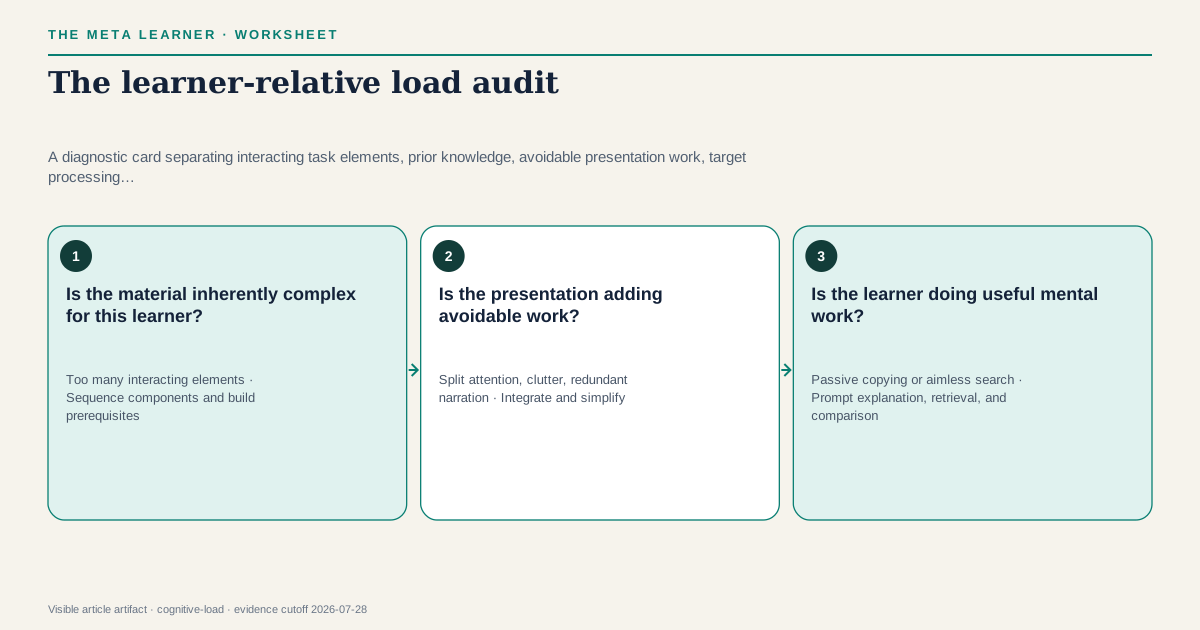
| Question | Typical problem | Response | |---|---|---| | Is the material inherently complex for this learner? | Too many interacting elements | Sequence components and build prerequisites | | Is the presentation adding avoidable work? | Split attention, clutter, redundant narration | Integrate and simplify | | Is the learner doing useful mental work? | Passive copying or aimless search | Prompt explanation, retrieval, and comparison |
Older presentations sometimes label these intrinsic, extraneous, and germane load. The labels have evolved in the literature; the practical distinction between necessary task complexity and avoidable design burden remains useful.
The learner-relative load audit: evidence and boundary
Cognitive-load theory connects limited working memory with the development of organized long-term knowledge. Research on worked examples and instructional design shows that guidance can benefit novices, while expertise can reverse which supports are useful. This supports adaptive fading rather than permanent simplification.
1, 2, 3Why AI can overload
AI makes it easy to request comprehensive answers containing definitions, caveats, tables, examples, and next steps at once. The result may be coherent yet exceed the learner’s capacity to decide what matters. Each follow-up adds branches, and the transcript becomes an expanding external memory with no hierarchy.
Control the output:
- Request one representation at a time.
- Limit the number of new concepts.
- Ask for a prerequisite check.
- Work through one example before generating ten.
- Summarize in your own words before adding detail.
- Preserve a map outside the chat.
The goal is not always minimal information. It is information arranged so the intended relationships can be processed.
Case: one screen, four simultaneous demands
A tutorial introduces a new interface, unfamiliar terminology, three exceptions, and a live exercise on the same screen.
A load symptom admits rival diagnoses. Make the learner-relative interpretation explicit before simplifying the material:
| Observed signal | What it may mean | Next response | |---|---|---| | Lost place | Transient information may overload | Externalize steps and keep references visible | | Easy but inert | Support may remove target processing | Fade guidance and require reconstruction | | Expert boredom | Prior knowledge changes effective load | Use a more integrated task |
The tutorial separates orientation from performance, removes decorative material, uses one worked example, and then fades the checklist. Load is managed so effort reaches the target relation.
The redesign predicts that beginners will complete the next problem with less search and can later solve a changed problem after the checklist fades. If only immediate completion improves, the support may have raised performance without building a durable schema.
Remove the scaffold to test the schema
After a delay, give a problem that preserves the underlying relationship but changes its surface details. Remove one scaffold and ask the learner to explain which elements must be coordinated. Compare novices with learners who already possess the prerequisite schema. If guidance helps the first group but obstructs the second, fade by knowledge state rather than assigning one permanent design.
Redesign one overloaded learning sequence
Take one confusing lesson, document, or AI transcript:
- Name the performance it should enable.
- Circle every concept that must be coordinated.
- Mark which concepts are already familiar.
- Remove decoration, duplicated explanations, and unnecessary choices.
- Place instructions beside the step they govern.
- Add one worked example followed by a partially completed and then independent problem.
- Test with a learner at the intended level.
Ask the learner where attention was spent, not merely whether the page looked clean. A sparse page can still impose heavy conceptual load.
Preserve the rival load diagnoses
Record the target performance, learner knowledge, observed breakdown, chosen design change, predicted result, and evidence that would reject the load diagnosis. “Lost place” may indicate split attention, missing prerequisite knowledge, unclear motivation, or inaccessible presentation. Preserve the rival accounts until the changed task identifies which one matters.
Load-design failures
- Calling all difficulty “bad cognitive load.”
- Simplifying until the core relationship disappears.
- Giving novices open-ended discovery with insufficient guidance.
- Keeping expert supports after they become redundant.
- Adding multimedia that repeats rather than coordinates.
- Mistaking short content for accessible content.
Limitations
Cognitive load is difficult to measure directly, and simplified taxonomies can be overapplied. Motivation, emotion, sleep, sensory access, and domain knowledge also shape performance. Design changes should be tested with real learners and outcomes, not inferred from aesthetics.
Good learning design makes complexity learnable. It removes avoidable competition for attention while preserving the thinking that builds the capability. Connect the audit to deliberate practice, compare it with interleaved practice, and place both inside a meta-learning loop. The decisive evidence is not a cleaner page but better delayed, less-supported performance by the intended learner population.
Named sources
Evidence and further reading
Published July 29, 2026. Substantively updated July 29, 2026. Evidence last verified July 28, 2026.
- : Replaced universal corpus boilerplate with an expertise-sensitive load audit and explicit transfer test.