Interleaving vs Blocked Practice
Blocked practice repeats one problem type; interleaving mixes related types. Learn when each helps and how to avoid random, premature mixing.
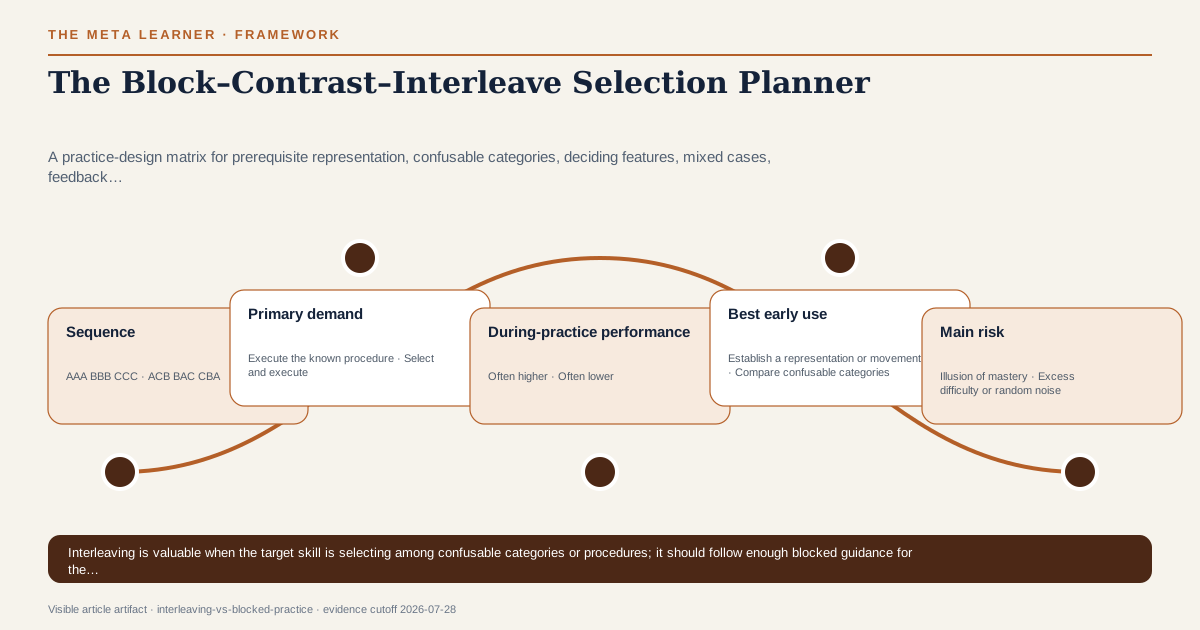
Blocked practice repeats one type of problem or movement before switching; interleaving alternates among related types so the learner must identify which response fits. Block first when a new procedure needs stable execution, then interleave when selection, discrimination, and transfer are the real challenge. Randomly mixing unrelated or poorly learned material may add irrelevant switching difficulty without useful discrimination.
When selection is harder than execution
This guide is for learners choosing whether to repeat one problem type or mix several related types. It covers when blocked practice builds an initial representation and when interleaving improves selection and discrimination. Use this when two or more cases are meaningfully confusable and future performance requires choosing among them without a label. Do not use interleaving as random variety, or before a novice can execute any of the component procedures with support. Mixing is not always superior. Judge the choice with evidence from delayed selection, performance, and transfer—not with session fluency.
Interleaving often feels slower because the learner cannot repeat the previous response automatically. That difficulty may be useful: real situations rarely announce which formula, grammatical structure, or strategic model should be selected.
The comparison
| Feature | Blocked practice | Interleaved practice | |---|---|---| | Sequence | AAA BBB CCC | ACB BAC CBA | | Primary demand | Execute the known procedure | Select and execute | | During-practice performance | Often higher | Often lower | | Best early use | Establish a representation or movement | Compare confusable categories | | Main risk | Illusion of mastery | Excess difficulty or random noise |
Mixing is purposeful only when items share a decision boundary. Randomly alternating unrelated subjects may add switching cost without training a useful distinction.
What interleaving studies actually test
Studies in mathematics and concept learning have found benefits from interleaving when it helps learners discriminate among problem types or categories. Effects vary with material, prior knowledge, schedule, and assessment. The literature supports strategic mixing, not a rule that every session should alternate constantly.
1, 2, 3The hidden skill: choosing
A blocked worksheet can say “solve ten problems using method A.” The heading has already made the most important decision. A mixed set removes that cue. The learner must notice structural features, distinguish surface details, and choose a method.
The same logic applies to language. Practising one past-tense pattern in a block helps formation. Later, describing mixed events forces selection among tense and aspect choices. In management, reading ten examples of one bias builds recognition; comparing similar cases builds discrimination.
How to combine both
Use a three-stage progression:
- Model and block: study a worked example, explain the steps, and repeat enough to reduce basic confusion.
- Contrast: compare A with a nearby B; state the cue that determines the choice.
- Interleave: mix A, B, and C without labels, then justify each selection.
Add spacing by returning to the mixed set later. Feedback should address both the chosen category and execution within it.
Adapt the contrast set
Adapt the mix according to the error, not according to a fixed ratio. If learners cannot execute any category, return temporarily to a worked example and a short block. If they execute correctly but choose badly, tighten the set around the two most confusable categories and require a reason before action. If superficial cues make selection easy, create a variant that changes the surface while preserving the deciding structure. As discrimination improves, remove labels, widen the category set, lengthen the delay, and introduce authentic cases. This progression keeps the useful comparison while controlling overload.
Case: perfect blocks and wrong choices
A trainee solves ten identical examples correctly but chooses the wrong method when several problem types appear together.
When a blocked score is high and mixed performance collapses, the error may sit in selection rather than execution. The comparison below routes each pattern to a different practice decision:
| Observed signal | What it may mean | Next response | |---|---|---| | Blocked success | Execution may be learned without selection | Mix nearby categories | | Mixed collapse | Initial models may be too weak | Return briefly to guided blocks | | Random variety | Differences may be irrelevant | Mix items that require meaningful discrimination |
The sequence uses short blocks to establish each method, then mixed sets that require naming why a method fits. Errors determine whether to strengthen the representation or continue discrimination practice.
This contrast set tests three related categories after basic execution is available. It does not show that random switching helps every subject or learner. Delayed, unlabeled cases are needed to show whether discrimination—not familiarity with the sequence—improved.
Transfer beyond The Block–Contrast–Interleave Selection Planner
Present an unaided test in a new context: omit the category names, change the surface details, and include at least one case in which none of the practised methods applies. Score selection separately from execution and require the learner to name the decisive feature. Transfer is supported when the learner chooses for structural reasons rather than because the test resembles the training order. If selection collapses, adapt the contrast set; if execution alone collapses, return briefly to blocked practice.
Build a three-category contrast set
Redesign one practice set:
- Select three commonly confused categories.
- Write four items for each, including varied surface features.
- Practise two examples of each in short blocks.
- Shuffle the remaining items.
- Before solving, label the category and cite the deciding feature.
- Review errors as selection, execution, or both.
- Test a new mixed set after several days.
Compare results with a blocked set of similar difficulty. Expect the mixed session to feel harder; judge it by delayed performance.
Separate selection from execution errors
Before changing the learning process, record five fields: the target performance, the present evidence, the change you will make, the result you predict, and the date of review. For this topic, “blocked success” is a signal to investigate, not a conclusion. Name the distinction that mixing is supposed to sharpen and the later classification error that would show the mixture is premature or badly designed. After the review, retain the original entry and append the outcome. The record lets you distinguish useful discrimination from random difficulty instead of praising any harder session after the fact.
Mixing patterns that add noise
- Interleaving before the learner understands any category.
- Mixing topics with no meaningful relationship.
- Changing so frequently that sustained execution disappears.
- Interpreting lower practice scores as failure.
- Providing labels that reveal the correct method.
- Failing to explain the discriminating features after errors.
Place interleaving in the wider practice system
Use Deliberate Practice when the main problem is execution of one observable component. Apply the Transfer Test after the category labels disappear, and use Spaced Repetition when the categories are understood but no longer accessible after delay.
Where interleaving stops generalizing
Interleaving results do not generalize equally across every subject and learner. Complex procedures may need extended blocked rehearsal, and switching can overload novices. Sequence should respond to diagnostic evidence rather than allegiance to a technique.
Blocked practice asks, “Can you execute this?” Interleaving adds the question that real life usually asks first: “Do you know when this is the right thing to do?”
Named sources
Evidence and further reading
Published July 29, 2026. Substantively updated July 29, 2026. Evidence last verified July 28, 2026.
- : Added entry and non-use rules, a contrast-set procedure, adaptations, selection failure analysis, and an unaided transfer test.