Active Recall: What It Is, Why It Works, and How to Use It
Active recall strengthens accessible memory by making you retrieve before checking. Learn how to design prompts, feedback, and transfer tests.
Active recall is the deliberate attempt to bring information or a procedure to mind before looking at the answer. It improves learning when retrieval is effortful but possible, feedback corrects errors, repetitions are distributed over time, and prompts match the knowledge you need to use. Retrieval effects vary with task, prior knowledge, feedback, delay, and final test, and recall alone cannot establish broad transfer.
When retrieval is the missing capability
This guide is for learners who need knowledge to remain accessible after the source or prompt disappears. Use this when the target idea or procedure has already been encountered and the next problem is independent access, discrimination, or application. Do not use active recall as a substitute for first building an intelligible model, receiving necessary demonstration, or performing the complete skill. The method covers cue strength, feedback, spacing, and alignment with future use; it does not imply that every subject reduces to flashcards or that recall alone guarantees transfer.
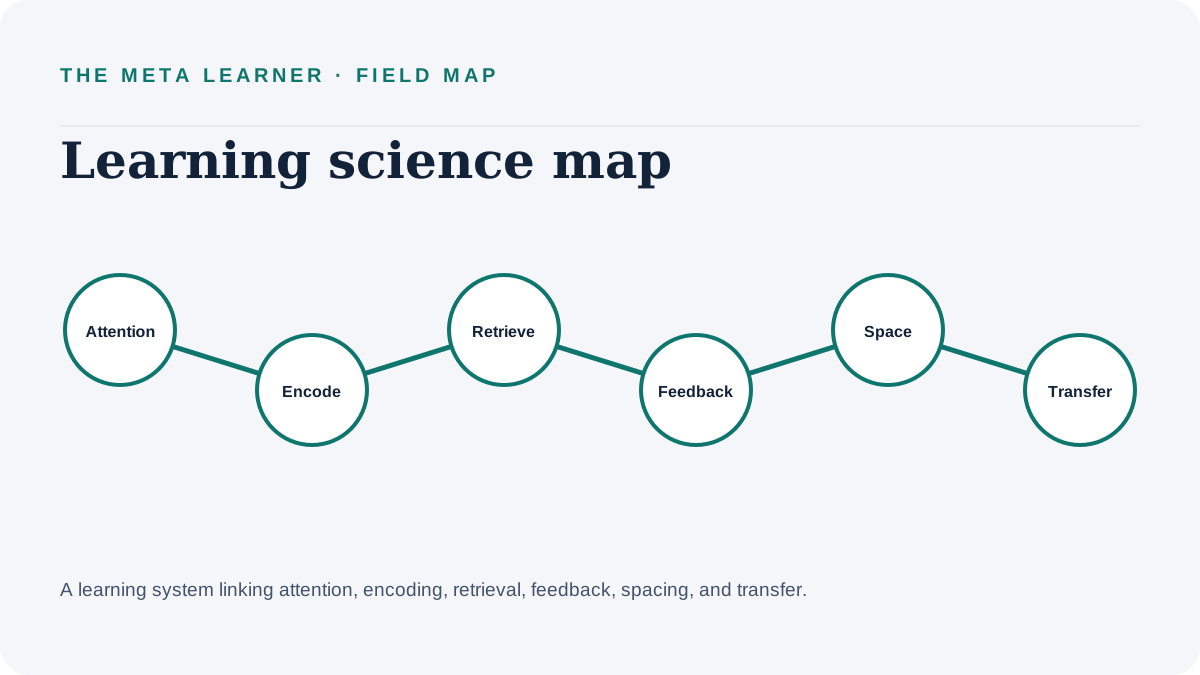
The method is often reduced to flashcards, but the principle is wider. Closing a book and reconstructing an argument, drawing a process from memory, predicting the next step, explaining a concept, and solving a problem without a worked example are all forms of retrieval.
Recognition is not recall
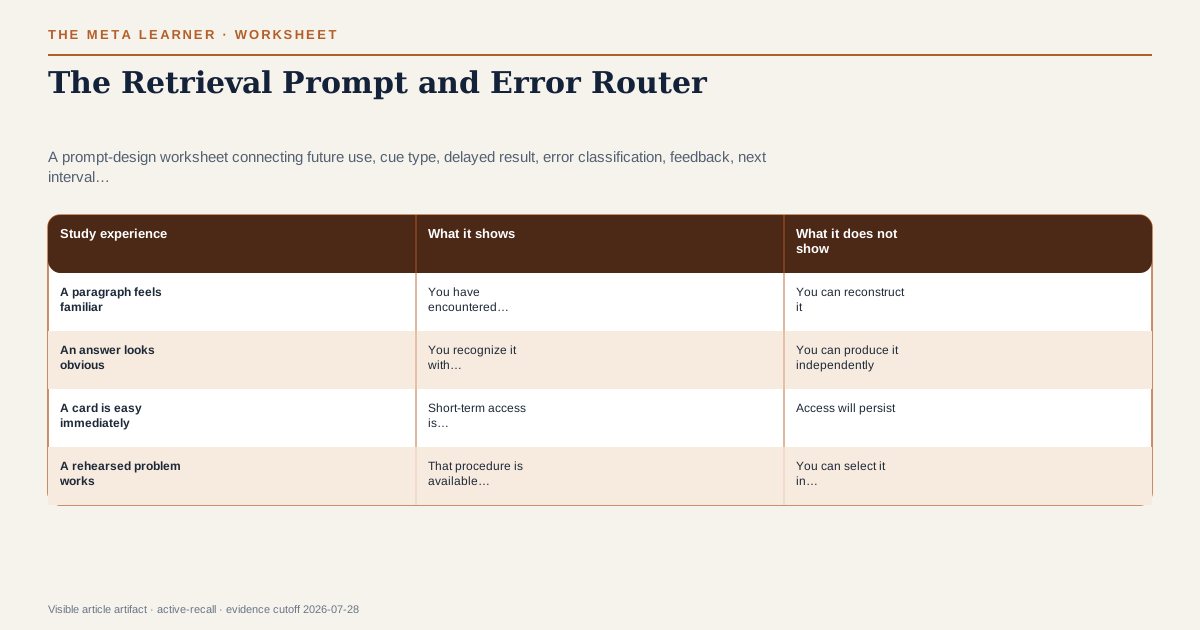
| Study experience | What it shows | What it does not show | |---|---|---| | A paragraph feels familiar | You have encountered it | You can reconstruct it | | An answer looks obvious | You recognize it with cues | You can produce it independently | | A card is easy immediately | Short-term access is strong | Access will persist | | A rehearsed problem works | That procedure is available here | You can select it in a new case |
Retrieval produces evidence about access and can change memory through the act of remembering.
What testing-effect research supports
Laboratory and classroom studies have repeatedly found that retrieval practice can improve later retention compared with additional study, including when rereading creates greater confidence. Benefits depend on task design, feedback, timing, prior knowledge, and the relationship between practice and final assessment.
1, 2, 3Build a good retrieval prompt
A prompt should be specific enough to have a checkable answer and broad enough to require reconstruction. “Review cognitive load” is an instruction, not a retrieval cue. “What are the three kinds of cognitive load in the framework, and how would each change this lesson design?” requires both recall and application.
Use several prompt types:
- Free recall: list everything remembered before opening the source.
- Cued recall: answer a precise question.
- Generation: predict a result or next step.
- Discrimination: choose among similar cases and justify.
- Application: use the idea in a new context.
Check promptly enough to stop errors from becoming rehearsed. Write the correction in a compact form, then retrieve again later.
Case: a familiar mechanism that cannot be reconstructed
A medical learner rereads a mechanism until it feels obvious, then cannot reconstruct the causal chain in a patient case.
Familiarity with the diagram conceals which causal link the learner can actually recover. The diagnostic sequence removes the answer, distinguishes wording from mechanism, and makes correction observable:
| Observed signal | What it may mean | Next response | |---|---|---| | Answer visible | Recognition can mask retrieval failure | Remove the source before responding | | Exact wording recalled | Form may be learned without meaning | Ask for explanation, discrimination, or application | | Wrong answer repeated | Feedback loop is incomplete | Correct promptly and retrieve again later |
The learner draws the mechanism from memory, explains each link, checks the reference, and then applies it to a changed case. Retrieval becomes both a learning event and a diagnostic.
This mechanism exercise demonstrates a retrieval design, not clinical competence or a universal advantage for testing. The changed patient case reveals whether causal relations survived; any medical judgment still belongs to qualified instruction and supervised assessment.
Diagnosis beyond the rehearsed case
Repeat the task with one important support removed and one contextual feature changed. Explain what changed, what stayed constant, and why the method should still apply. Then compare confidence before the test with actual performance. A successful transfer check is not perfect output; it is a defensible choice, visible error correction, and less dependence on the original example. If performance collapses, narrow the claim and return to the part of the method that the error exposes.
Match the retrieval demand to future use
Retrieval is not one activity. Free recall, cued recall, recognition, explanation, and application place different demands on memory. The right form depends on the future task. If the learner must select a diagnosis among close alternatives, practice must include discrimination. If the learner must explain a mechanism, isolated term cards are insufficient. Difficulty should come from recovering the target relation, not from confusing wording.
A practical consequence follows: change the smallest layer that the evidence implicates. Preserve the rest long enough to learn whether the revision helped. This makes adaptation interpretable and prevents a difficult session from triggering a complete, unnecessary system rebuild.
Convert one chapter into retrieval evidence
Convert one chapter into a retrieval cycle:
- Preview headings and define three intended outcomes.
- Read one meaningful section.
- Close it and write the main claim, mechanism, and example.
- Reopen and mark omissions or distortions.
- Create two questions: one direct and one transfer question.
- Answer them tomorrow and again after several days.
- Retire prompts that are consistently easy; repair ambiguous ones.
For complex knowledge, occasionally reconstruct the whole map. Isolated cards can preserve facts while losing relationships.
Read errors before changing prompts
Before changing the learning process, record five fields: the target performance, the present evidence, the change you will make, the result you predict, and the date of review. For this topic, “answer visible” is a signal to investigate, not a conclusion. Write down whether the miss reflects a weak cue, a missing distinction, or absent knowledge, then specify what the next unaided attempt should reveal. After the review, retain the original entry and append the outcome. Comparing that diagnosis with the delayed response shows whether the repair worked or whether the apparent improvement came only from a familiar prompt.
Retrieval designs that reward recognition
A common failure mode is to preserve the visible answer, then count the feeling of familiarity as retrieval. The following designs remove too little support or collect the wrong evidence:
- Revealing the answer before making a genuine attempt.
- Copying sentences instead of creating a cue.
- Testing trivia because it is easy to grade.
- Repeating a card several times in one sitting and calling it mastery.
- Skipping feedback after an incorrect retrieval.
- Using recall alone for a skill that requires performance.
Bring in criterion-based feedback
Self-testing reveals important gaps, but it cannot expose every blind spot. Choose a reviewer who can observe the target performance and ask for evidence tied to a criterion: where did the reasoning break, what was missing, and what would a stronger attempt do differently? Do not outsource the final judgment to an agreeable tool or a single observer. Compare feedback with the stated goal, preserve disagreements, and test the proposed correction in a new case. External feedback is most valuable when it changes the next attempt and leaves a trace that can later be evaluated.
What the evidence does not authorize
The evidence in this article supports a bounded design choice, not a claim that every subject reduces to flashcards or that recall alone guarantees transfer. Retrieval difficulty is productive only within bounds: an impossible prompt, uncorrected error, or test unlike the target performance can rehearse the wrong thing. Keep the original prompt, unaided response, correction, and later test together so confidence cannot replace evidence of what was actually retrieved. Recall practice can strengthen memory, but it cannot validate the truth or safety of the material; consequential content still requires authoritative sources and qualified review.
Move from recall to retention and transfer
Use Spaced Repetition: A Practical Guide to Durable Memory when access fades mainly with delay. Move to the Retrieval-to-Transfer Protocol when recalled knowledge must be selected in an unfamiliar task. If the learner retrieves terms but cannot connect them, compare this method with the Self-Explanation Protocol.
Where active recall stops
Retrieval practice is not universally superior for every outcome or learner, and poorly designed tests can narrow attention toward superficial details. Very low prior knowledge may require worked examples first. Anxiety, accessibility, and stakes also affect how testing should be used.
Active recall is most valuable as a question: what must you be able to produce when the source is gone? Design practice from that answer.
Named sources
Evidence and further reading
Published July 29, 2026. Substantively updated July 29, 2026. Evidence last verified July 28, 2026.
- : Added method entry boundaries, retrieval procedure, adaptations, failure analysis, and a delayed unaided transfer test.