Self-Explanation Protocol: Explain, Expose, Repair
Turn an explanation into a diagnostic learning instrument by committing a model, exposing its gaps, repairing them from evidence, and testing transfer.
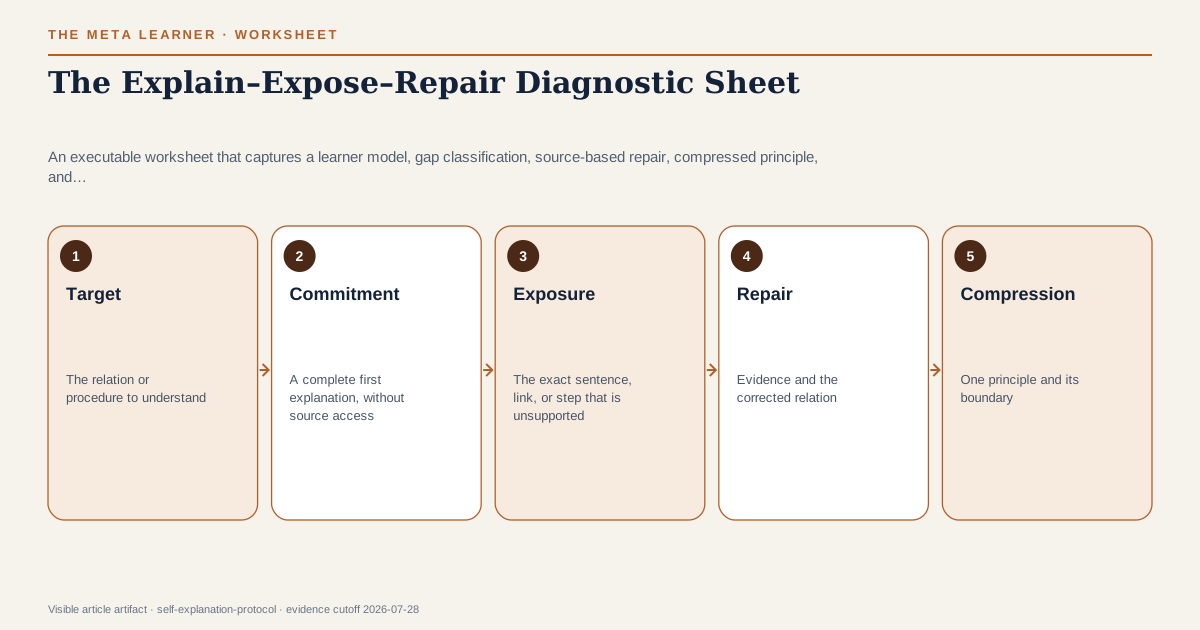
Use self-explanation by first attempting the problem, then explaining why each important step or relation follows, marking every unsupported leap, checking those gaps against a trustworthy source, and rebuilding the explanation from memory. Finish with a new unaided case. The goal is not eloquence; it is an inspectable model that can be corrected.
Use this when a model must become visible
Use this protocol when a learner can recognize an answer but may not understand the causal, logical, or procedural relations underneath it. It fits worked examples, mechanisms, proofs, arguments, code, diagrams, and multi-step decisions with a checkable reference.
Do not use it as the primary method for facts that only need brief recall, an emergency procedure that must follow an authoritative checklist, or a domain where the learner has no source or expert against which to check the explanation. Novices may generate coherent misconceptions; the protocol therefore requires a repair stage rather than treating confidence or length as evidence.
Self-explanation research includes different prompts, subjects, and comparison conditions. A meta-analysis found a positive average association for induced self-explanation, but that does not establish one ideal script or superiority over every equal-time alternative. meta, chi Foundational work examined how learners explained worked examples and connected examples with principles. chi
What survives the comparison: the Explain–Expose–Repair Diagnostic Sheet
Research supports prompted self-explanation as a potentially useful learning intervention and describes constructive inference as distinct from copying an example. Effects vary across task, prompt, comparison, learner, and outcome. The Explain–Expose–Repair sequence is an editorial operationalization, not a universally validated six-step instrument.
meta, chiThe diagnostic sheet
The original asset has six fields:
| Field | Required entry | |---|---| | Target | The relation or procedure to understand | | Commitment | A complete first explanation, without source access | | Exposure | The exact sentence, link, or step that is unsupported | | Repair | Evidence and the corrected relation | | Compression | One principle and its boundary | | Transfer | Result on a changed, unaided task |
An empty exposure column is suspicious. It may mean the task is too easy, the explanation is merely paraphrase, or the learner cannot yet detect what needs evidence.
Run Explain–Expose–Repair
Step 1 — Commit. Close the solution and solve, reconstruct, or predict before explaining. Preserve the first attempt.
Step 2 — Explain. For each consequential step, complete one of three sentences: “This follows because…,” “This evidence changes the claim because…,” or “This action works only when….”
Step 3 — Expose. Underline leaps, undefined terms, missing causes, unexplained selections, and statements supported only by “it seems obvious.” Classify each gap as missing knowledge, weak relation, procedural choice, or boundary.
Step 4 — Repair. Open the primary source, worked solution, test, or qualified feedback. Write the smallest correction that changes the model. Do not replace the whole explanation with polished source language.
Step 5 — Compress. Restate the governing principle, one counterexample, and one condition under which it does not apply.
Step 6 — Retest. After a delay, explain a new case without the sheet.
A worked diagnostic
A learner studies why a price ceiling can create shortage and says: “The legal price is lower, so sellers stop selling.” The exposure stage identifies an unsupported absolute claim. The source model distinguishes movement along supply and demand, time horizon, enforcement, and possible non-price allocation.
The repair becomes: “Holding other conditions fixed, a binding ceiling places the permitted price below the market-clearing price; quantity demanded can exceed quantity supplied. The size and observed form depend on elasticities, time, enforcement, and adaptation.” The counterexample is a ceiling above the equilibrium, which is non-binding.
The value is not the longer paragraph. It is the exposed boundary that changes predictions.
Adaptations by knowledge state
- Novice variant: explain a completed example with three supplied prompts and an expert key.
- Developing variant: explain a partial example, then choose which principle licenses each step.
- Advanced variant: generate a rival mechanism and evidence that discriminates between it and the preferred account.
- Team variant: two people independently explain the same event, then compare the first point at which their models diverge.
- AI-assisted variant: let AI ask questions or identify possible gaps, but require the learner to verify and author the repair.
Adaptation should reduce irrelevant difficulty without removing the target inference.
Failure modes that produce eloquent ignorance
- Paraphrasing the source while it remains visible.
- Rewarding length, vocabulary, or confidence.
- Explaining every sentence instead of the decisive relation.
- Accepting a plausible repair without opening evidence.
- Letting AI generate both the explanation and the critique.
- Rehearsing the repaired wording until the example is memorized.
- Treating one correct explanation as transfer.
If the learner repeatedly invents wrong mechanisms, add a contrasting worked example or expert checkpoint. If time cost exceeds the value of the relation, switch to direct retrieval or guided practice.
Where the Explain–Expose–Repair Diagnostic Sheet travels—and where it does not
Wait until the repaired wording is no longer in working memory. Present a case with different surface features and no prompt naming the principle. The learner must select the relevant relation, explain why it applies, identify a boundary, and solve or predict the outcome. Score selection, causal coherence, boundary accuracy, and correction after feedback.
Use Active Recall to protect the initial commitment, continue through The Retrieval-to-Transfer Protocol, and route persistent gaps into Deliberate Practice.
Explanation is evidence only when it can fail
Self-explanation can increase time on task and may reinforce misconceptions when reference knowledge is weak. A fluent verbal account can conceal procedural failure, and a correct account may not transfer under speed, stress, or different representations. The cited evidence does not validate this exact worksheet for every population or domain. Use authoritative solutions, qualified feedback, and performance tests when errors have serious consequences.
The protocol succeeds when the learner can point to the gap that changed, the evidence that changed it, and the new case in which the repaired model still works.
Named sources
Evidence and further reading
Published July 29, 2026. No substantive revision has been recorded. Evidence last verified July 28, 2026.