How to Use an AI Language Tutor Without Letting Simulation Replace Learning
Use AI for bounded language practice while protecting agency, privacy, linguistic variety, verification, and transfer to uncontrolled human communication.
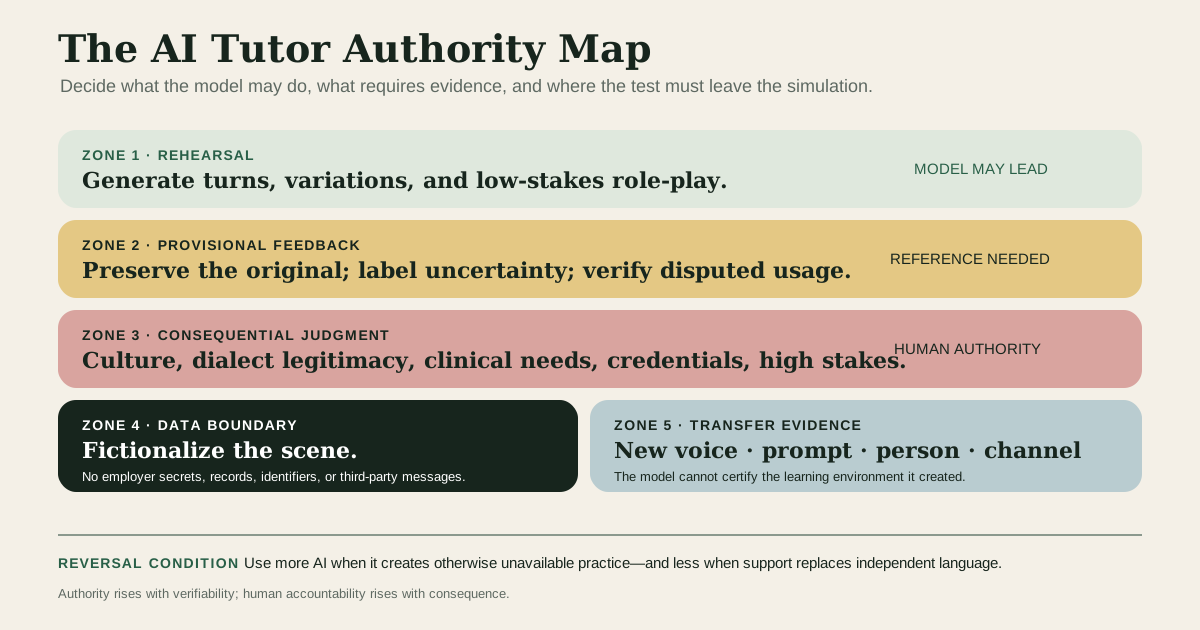
Use an AI language tutor as a bounded rehearsal environment: specify the language variety, level, task, correction policy, privacy boundary, and evidence required outside the model. It can create practice turns, variations, and low-stakes feedback, but it should not be the sole authority on grammar, pronunciation, culture, or proficiency. Verify consequential claims against reliable references or qualified people, and test learning with new voices, prompts, and human interlocutors the AI does not control. unesco-genai, cefr-companion unesco-genai
Fluency inside the machine is an ambiguous success
An AI conversation can feel astonishingly successful. The tutor waits, interprets generously, repairs vague prompts, supplies the missing word, and continues the scene. The learner speaks for twenty minutes and leaves with a transcript full of polished alternatives.
That may be useful practice. It may also be a cooperative illusion.
Real interlocutors do not share the model’s incentive to keep the simulation alive. They bring accents, time pressure, background noise, local conventions, impatience, humor, status differences, and their own reasons for speaking. A tool can therefore increase the volume of language production while concealing how much support it quietly supplied.
The central design problem is not “Which prompt makes the best tutor?” It is which authority the learner is granting the system.
UNESCO’s guidance places human agency, privacy, inclusion, and linguistic and cultural diversity inside the governance of educational generative AI, and calls for validation rather than automatic trust. unesco-genai The concern is not solved by adding a warning beneath a chat box. It must change the workflow: what the model may decide, what must be checked, and what counts as learning.
The sources support preserving human agency, validating multilingual educational AI, treating language ability as multidimensional, and designing feedback choices. Direct comparative evidence for this exact five-zone AI-tutor workflow—and for its proposed transfer test—is limited; the authority map is an editorial synthesis.
Claim sources: unesco-genai, cefr-companion, corrective-feedback
Five zones of authority
1. Rehearsal. The model may generate low-stakes variations, take roles, ask follow-up questions, and keep practice moving.
2. Provisional language feedback. It may suggest a correction or reformulation, provided the learner can preserve the original, request reasons, and verify disputed usage.
3. Consequential judgment. It should not have final authority over cultural acceptability, dialect legitimacy, clinical pronunciation, legal or medical language, or a proficiency credential.
4. Personal data. The learner decides what can enter the system. Real names, employer secrets, student records, medical details, booking references, and third-party messages are not necessary for realistic role-play.
5. Transfer evidence. The model cannot grade the final test when it created the practice, chose the prompts, interpreted the answers, and supplied the corrections. Independence requires another voice, task, person, or setting.
The zones are not a moral ranking of technologies. They separate activities according to how costly an error would be and how independently the output can be checked.
A Mandarin case: the correction that erased a boundary
Jon, an English-speaking beginner, asks an AI tutor to simulate meeting a new colleague in Mandarin. This is a constructed case; the language below has completed model-only review.
Variety: Putonghua / Standard Mandarin.
Transcription: simplified Chinese characters and Hanyu Pinyin with tone marks.
Proficiency boundary: beginner social introduction, not a general claim about workplace pragmatics across Chinese-speaking communities.
Communicative consequence: an unnatural or overfamiliar address can affect social tone even if the sentence is grammatically interpretable.
Jon drafts:
你好,我叫 Jon。很高兴认识你。
Nǐ hǎo, wǒ jiào Jon. Hěn gāoxìng rènshi nǐ.
“Hello, my name is Jon. Nice to meet you.”
The model offers a more elaborate alternative and declares it “more native.” That declaration crosses two boundaries. First, naturalness is not a single grammatical property; it depends on region, relationship, register, and scene. Second, a fluent model response is not evidence that the form is preferred by the relevant speech community.
Jon keeps the simple version, asks the model to label uncertainty and alternatives, and—where the social stakes justify it—takes the disputed question to a reviewer familiar with the named variety. He then tests the sequence with a new interlocutor. The important improvement is not that the AI generated better prose. It is that the workflow prevented stylistic confidence from becoming linguistic authority.
Correction is not one setting
“Correct all my mistakes” sounds rigorous but often produces a transcript the learner cannot act on. Oral corrective-feedback research distinguishes feedback types and reports ongoing debate about timing, uptake, consolidation, and acquisition. corrective-feedback That literature does not establish that automated corrections inherit teacher quality. It does show that feedback is a design choice, not a quantity to maximize.
Choose a policy that fits the session:
| Session purpose | During the task | After the task | |---|---|---| | Fluency and interaction | intervene only when meaning breaks | identify one recurring high-impact pattern | | Accuracy rehearsal | pause on the named target | compare original, correction, and new attempt | | Pragmatic exploration | ask for alternatives and uncertainty | verify with corpus, reference, or qualified person | | Pronunciation | use model feedback as a hypothesis | test with human listeners and new recordings |
A feedback item becomes actionable when it preserves the learner’s utterance, identifies the claimed problem, shows the proposed change, names its evidence status, and appears again in a later task.
A three-session rehearsal contract
Session one: grounded input. Bring a short, trustworthy text or properly sourced recording. Ask questions about meaning and form. Do not ask the model to invent the only evidence it will later explain.
Session two: constrained interaction. State the variety, approximate level, scene, length, and correction policy. Require the tutor to remain in role, avoid completing unfinished learner turns, and mark uncertainty about regional or pragmatic claims.
Session three: escape. Repeat the communicative purpose with no model support. Change the person, channel, voice, topic detail, or time pressure. Preserve the result.
The CEFR describes proficiency as a profile across reception, production, interaction, and mediation rather than as one undifferentiated score. cefr-companion, unesco-genai It does not turn a model’s conversation score into a credential. The transfer test here is therefore a deliberately conservative editorial rule: evaluate what the learner can do when the supportive rehearsal environment is gone.
The strongest case for extensive AI use
For a learner with no affordable teacher, few local speakers, irregular work hours, or anxiety about early interaction, abundant AI conversation may be better than near-total silence. The system can vary topics quickly, tolerate repetition, and give the learner a private place to attempt language before social stakes rise.
That case is strong. It reverses the conservative default when three conditions hold:
- the activity creates practice the learner would otherwise not have;
- its claims can be checked in proportion to consequence;
- support is periodically faded and tested elsewhere.
The boundary is substitution. If AI practice displaces richer human contact, if the learner adopts one model’s dialect as neutral language, or if the tutor’s scores become the only evidence of progress, greater volume may deepen dependence rather than capability.
Signals that the tutor is becoming the curriculum
- The learner cannot begin a sentence until the system suggests one.
- Every conversation uses the same agreeable voice and repair style.
- “More natural” corrections are saved without variety or register labels.
- Cultural rules come from one generated answer.
- personal or third-party data enters role-play for realism.
- transcripts improve, but unaided communication does not.
- the learner asks the model whether the model has taught them successfully.
When these signals appear, reduce authority before increasing prompt sophistication.
What the model cannot certify
Model performance changes across providers, versions, languages, varieties, modalities, and topics. The sources reviewed do not supply accuracy rates for a particular current tutor, and this article does not evaluate one. Voice recognition can confuse language ability with microphone quality or accent familiarity. The Mandarin example received model-only review of its variety, transcription, naturalness, proficiency fit, and communicative consequence; it is not human-specialist certification. High-stakes assessment and clinical, legal, or cultural judgment need accountable human expertise.
The best AI tutor is not the one that makes every exchange feel fluent. It is the one placed inside a learning system that preserves disagreement, keeps evidence visible, and eventually makes itself less necessary.
Use How Corrective Feedback Works to choose a correction policy, How to Improve Listening and Pronunciation for spoken transfer, and How to Verify AI Explanations and Sources for evidence checks.
Named sources
Evidence and further reading
Published July 29, 2026. Substantively updated July 29, 2026. Evidence last verified July 28, 2026.
- : Reconstructed the argument, claim-level evidence, multilingual case, original asset, and prose for the seven-gap editorial program.