How to Improve Listening and Pronunciation: Diagnose the Sound System You Are Actually Learning
Diagnose signal, perception, segmentation, production, and intelligibility with worked Mandarin, Spanish, Japanese, and Arabic examples.
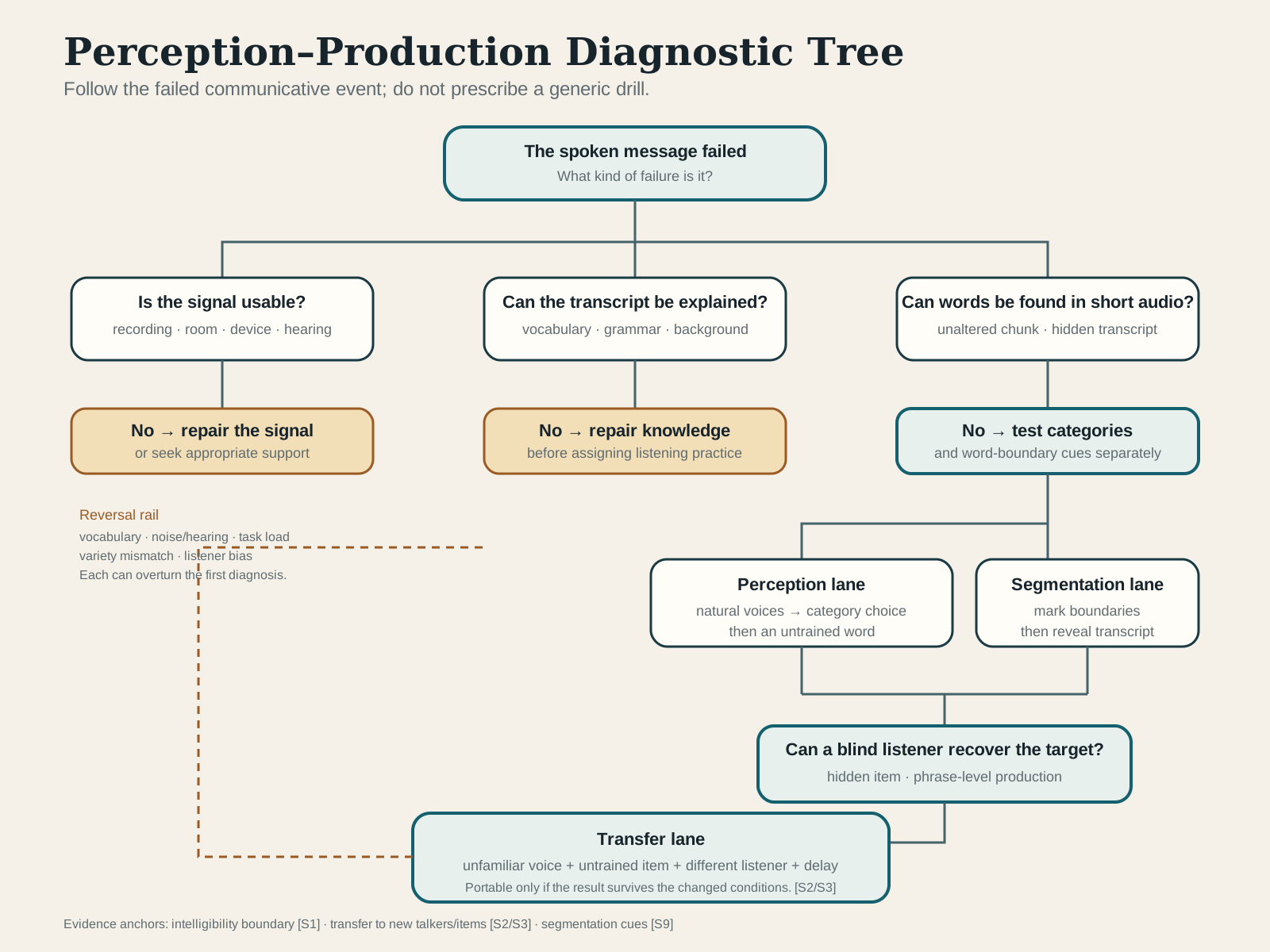
To improve listening and pronunciation, stop treating “sounds bad” as one problem. Diagnose where communication fails: signal, category perception, word segmentation, lexical access, speech planning, or listener intelligibility. Then train one language-pair-specific contrast in meaningful phrases and test it with an unfamiliar voice and listener. Perception and production can reinforce each other, but improvement on one speaker or minimal-pair list is not evidence of general spoken-language ability. s2-wang-mandarin-training, s3-bradlow-rl s3-bradlow-rl
“I know the words” is not a diagnosis
A transcript can make an utterance look obvious because writing supplies boundaries that speech does not. In continuous speech, there is often no pause between written words; listeners combine lexical, acoustic, phonetic, prosodic, semantic, and pragmatic cues to locate boundaries. Which cues receive the greatest weight depends partly on the languages and listening conditions involved. s9-lin-wang-segmentation
That is why one complaint—“native speech is too fast”—can conceal several different failures:
- Signal: the recording, room, device, or hearing condition obscures information.
- Category perception: two meaningful sound patterns are being heard as the same.
- Segmentation: the sounds are audible, but the listener places a boundary in the wrong location.
- Lexical access: the word is known on the page but not retrieved quickly enough from speech.
- Task load: the first phrase is lost while attention is occupied by the next.
- Production: the intended contrast is represented correctly but not expressed clearly.
- Listener fit: the speech works with a familiar teacher but not with the intended audience—or the listener is simply unfamiliar with the speaker’s variety.
These explanations compete. Repeating an entire podcast cannot tell you which one is true. Neither can a single pronunciation score.
The aim is also not accent erasure. The Council of Europe’s revised phonological-control scales explicitly moved away from native-speaker imitation and separate overall phonological control, sound articulation, and prosody, with intelligibility central to progression. s1-cefr-phonology Accent may remain while a message is fully intelligible; conversely, a polished imitation can still fail on a contrast that changes what a listener understands.
Follow the failure, not the exercise
Use the following diagnostic sequence on a five-to-fifteen-second recording with an authorized transcript.
-
Can you explain the message after reading the transcript?
If no, repair vocabulary, grammar, or background knowledge before assigning a listening drill. -
Can you identify the words when the original recording is replayed in short, unaltered chunks?
If yes, but the whole utterance fails, test segmentation and attentional load. Do not slow the file first: slowing may change the very timing cues under investigation. -
Can you distinguish the candidate contrast without producing it?
Use an identification task with several natural speakers. If two categories remain indistinguishable, perception is the leading hypothesis. -
Can you produce the contrast so that an appropriately qualified listener identifies the intended item without seeing it?
If perception succeeds but listener identification fails, production becomes the next target. -
Does the result survive a new word, a new phrase, an unfamiliar voice, and a different listener?
If no, the exercise has taught a token, talker, or task—not yet a portable contrast. In two bounded laboratory lines of work, high-variability perceptual training generalized to new stimuli or talkers and was followed by measurable production gains; those studies support testing cross-modal transfer, not assuming that every pronunciation drill will cause it. s2-wang-mandarin-training s3-bradlow-rl
This tree deliberately separates perception from production. They interact, but they are not interchangeable. In Wang, Jongman, and Sereno’s Mandarin-tone study, American learners’ post-training productions were identified more accurately by native Mandarin listeners, while pitch height and pitch contour did not improve in parallel. s2-wang-mandarin-training A learner can therefore improve one cue or modality without mastering the whole contrast.
The evidence supports intelligibility-centered goals, language-pair-specific diagnosis, and transfer tests using new talkers or items. It does not establish that a single contrast drill, speaker, or laboratory result generalizes to overall conversational ability.
Claim sources: s1-cefr-phonology, s2-wang-mandarin-training, s3-bradlow-rl, s9-lin-wang-segmentation
Four sound systems, four different questions
The following examples are diagnostic specimens, not universal pronunciation rules. Every block names its variety and boundary because “Chinese,” “Spanish,” “Japanese,” and “Arabic” are not single acoustic targets.
English–Mandarin: tone category or word boundary?
- Variety: educated younger-speaker Standard Chinese as described for Beijing
- Transcription system: Hanyu Pinyin with tone marks; source comparison uses phonetic tone descriptions
- Proficiency boundary: beginner recognition of citation-form lexical tones and short phrases; this does not certify connected-speech tone-sandhi control
- Communicative consequence: a tone change can select a different lexical item; a misplaced boundary can prevent recognition even when individual syllables are audible
- languageReviewStatus:
model-review-complete
The source illustration contrasts bā “eight,” bá “pull out,” bǎ “hold,” and bà “father” through the same segmental frame with four citation-form tones. s4-standard-chinese A useful first test is not “Can you sing four shapes?” but “Can you identify the intended item, randomized across unfamiliar natural voices, without seeing the Pinyin?”
Then change levels. The draft phrase Wǒ xiǎng mǎi bā bǎ sǎn (我想买八把伞, “I want to buy eight umbrellas”) places repeated third-tone syllables beside bā and the classifier bǎ. Do not prescribe a surface contour from the written tone marks alone. Ask the learner to mark perceived syllables and word groups before revealing the transcript; have a Beijing-Mandarin reviewer approve the phrase, connected realization, gloss, and pedagogical use before recording. Mandarin tone-training studies with American learners found gains on new stimuli and new voices, but the sample and task were bounded laboratory conditions rather than proof of conversational fluency. s2-wang-mandarin-training
Diagnostic split: strong isolated-tone identification plus weak phrase segmentation points toward boundary/cue integration; weak identification on new voices keeps tone-category perception in play.
English–Spanish: vowel target or stress-and-timing pattern?
- Variety: educated Mexico City Spanish
- Transcription system: standard Spanish orthography plus broad IPA
- Proficiency boundary: A1–B1 control of the five-vowel inventory and lexical stress in short phrases; no claim about all Spanish varieties or regional intonation
- Communicative consequence: stress placement can distinguish lexical or grammatical forms, while imported English-style vowel movement can obscure the intended vowel
- languageReviewStatus:
model-review-complete
Mexico City Spanish is described with five vowel phonemes, /a e i o u/, all available in stressed and unstressed positions; the description also reports that stressed vowels are typically longer and documents running-speech variation rather than an imaginary metronomic language. s5-mexico-city-spanish Its source examples include oso [ˈoso] “bear” versus osó [oˈso] “he dared,” and uso [ˈuso] “I use” versus usó [uˈso] “he/she used.” s5-mexico-city-spanish
This suggests a two-layer test. First, can the learner maintain a recognizable /o/ or /u/ rather than turning it into an English-like glide? Second, can a listener locate the stress and recover the intended word in a short phrase? Avoid declaring Spanish simply “syllable-timed” and asking for equal beats. The learner’s practical target is the variety-specific coordination of vowel quality, stress, syllable structure, and phrase timing—not a slogan about rhythm.
Diagnostic split: a stable vowel with wrong stress calls for a prosodic intervention; correct stress with a drifting vowel calls for a segment target; failure only in longer utterances reopens planning and fluency.
English–Japanese: one mora disappeared
- Variety: educated Tokyo Japanese
- Transcription system: Japanese orthography, modified Hepburn romanization, and broad IPA for the tested contrast
- Proficiency boundary: beginner-to-intermediate lexical length contrasts; pitch accent and fast conversational reduction remain outside this microtest
- Communicative consequence: vowel or consonant length can change lexical identity
- languageReviewStatus:
model-review-complete
The IPA illustration for Tokyo Japanese gives hodo “degree, extent” versus hodō “sidewalk” as a vowel-length contrast and treats the first portion of a geminate obstruent as moraic. s6-tokyo-japanese, s7-japanese-geminates A newer articulatory study lists such singleton–geminate pairs as kata “mold” versus katta “bought,” and haka “grave” versus hakka “ignition”; in its data, durational differences were much larger than the accompanying linguopalatal-contact differences. s7-japanese-geminates
An English-speaking learner may hear katta as emphatic kata, or may create a pause rather than a longer consonantal constriction. The diagnostic task therefore hides the spelling, varies the speaker, and asks for word identification. Production is tested with a blind forced choice by a qualified Tokyo-Japanese listener, followed by the same contrast inside a phrase.
Diagnostic split: success with spelling but failure without it indicates an auditory category/timing problem; success in isolated words but not phrases suggests transfer or planning; consistent identification with an accent is already communicative success.
English–Arabic: first choose which Arabic
- Variety: Gaza City Palestinian Arabic
- Transcription system: broad IPA and English gloss; Arabic orthography is withheld because this release has no human Gaza-Arabic review
- Proficiency boundary: exploratory recognition of vowel-length and pharyngealization cues; not Modern Standard Arabic instruction and not a claim about all Palestinian or Arabic varieties
- Communicative consequence: length and emphasis participate in the variety’s contrast system, while training on the wrong variety can give the learner an inappropriate acoustic target
- languageReviewStatus:
model-review-complete
The Gaza City description reports five long vowels and three short vowels and documents backing effects around pharyngealized /tˤ sˤ dˤ/. It also records features that differ from other Arabic varieties, including dialect-specific consonant realizations. s8-gaza-arabic Its examples include [ˈmɪn] “from,” [fiː] “there is,” [kɐˈmaːn] “also,” and [sˤuːrtɐk] “your image (masculine).” These illustrate environments; they are not presented here as minimal pairs. s8-gaza-arabic
That distinction matters. A learner should not be handed a Modern Standard Arabic recording, a pan-Arabic label, and a Gaza conversational goal as though they were the same system. The first diagnostic question is social and geographic: whom does the learner need to understand and be understood by? Before producing audio or using the material in consequential instruction, a Gaza-Arabic specialist should select lexical contrasts and review orthography, IPA, gloss, register, and speaker eligibility.
Diagnostic split: if several Gaza speakers identify the intended item while the learner still sounds unlike a model, the difference may be accent rather than communicative failure; if only an MSA-trained evaluator rejects it, test variety mismatch before retraining the learner.
A worked case: the tone problem that became a boundary problem
Consider Mara, an English-speaking beginner in Beijing Mandarin. This is a composite diagnostic case; its scores are illustrative, not study data.
She reports, “I know all the words, but tones disappear when people speak.” Her first tutor assigns more tone imitation. The diagnostic tree produces a different provisional account:
| Probe | Illustrative observation | Leading interpretation | |---|---|---| | Read the transcript and paraphrase | Accurate | Meaning and basic vocabulary are available | | Identify four ba citation tones from the familiar tutor | 11/12 | Familiar-token tone perception is not the main failure | | Repeat with two unfamiliar speakers | 7/12 | Category robustness across voices remains weak | | Mark words in six untranscribed phrases | 2/6 | Segmentation is a major candidate | | Produce target items for a blind reviewer | 8/10 intended items recovered | Production is imperfect but often intelligible | | Listen in café noise | Large additional decline | Signal conditions amplify the problem |
The evidence does not justify “tones are solved.” It just makes another week of copying the same tutor a poor experiment. Mara spends four sessions on two tasks: high-variability tone identification across speakers, and boundary marking on short phrases before viewing transcripts. Production occupies the final third of each session: she records a meaning-bearing phrase, and a qualified listener reports what was heard rather than awarding a single accent score.
The diagnosis reverses if new evidence changes the pattern. If boundary accuracy rises when all vocabulary is pre-taught, lexical access moves upward. If unfamiliar-tone identification stays near chance after adequate practice, category perception deserves more weight. If performance collapses only in noise, the plan must address signal conditions and, where appropriate, hearing support. If listeners recover every intended word, further accent modification becomes a personal or social choice—not a communicative necessity.
The unfamiliar-voice transfer test
A good post-test changes only enough to expose memorization:
- Freeze the trained contrast, variety, proficiency level, and scoring rule.
- Use an unfamiliar natural speaker of the same target variety.
- Include untrained words and one short phrase; do not reveal the transcript.
- Score perception by intended-item or boundary identification, not confidence.
- Record a parallel phrase and obtain a blind response from a different qualified listener.
- Repeat after a delay without a warm-up.
Training studies on English /r/–/l/ and Mandarin tones show why new talkers and new items are meaningful tests, while their narrow participant groups and laboratory tasks warn against translating a local gain into “pronunciation mastery.” s2-wang-mandarin-training s3-bradlow-rl
Stop or redesign when the learner cannot understand the source text, the recording lacks reliable variety metadata, the target contrast has no consequence for the learner’s real communication, a listener’s judgment is confounded with prejudice against an accent, or speech/hearing needs require clinical expertise. Practice is justified by a diagnosed failure and a relevant goal—not by the mere existence of a measurable acoustic difference.
The deepest improvement is conceptual: listening and pronunciation are not two generic skills joined by repetition. They are a chain of hypotheses about a particular listener, speaker, sound system, variety, and communicative event. Train the weak link; then change the voice and see whether the chain still holds.
What the experiment cannot establish
The four examples are diagnostic illustrations, not complete pronunciation courses or universal descriptions of Mandarin, Spanish, Japanese, or Arabic. Their variety, transcription, gloss, proficiency, register, and consequence labels completed model review only; no human language specialist or audio reviewer has certified them, and no reviewed audio is claimed. Listener judgments can reflect familiarity or accent prejudice as well as intelligibility. Hearing, speech, or clinical needs require appropriate professional assessment.
Continue with Why Native Speech Sounds So Fast, compare communicative goals in Accent Reduction vs Intelligibility, and place the diagnosis inside How Adults Learn a New Language.
Named sources
Evidence and further reading
- Phonological competence — Common European Framework of Reference for Languages
- Acoustic and perceptual evaluation of Mandarin tone productions before and after perceptual training
- Training Japanese listeners to identify English /r/ and /l/: IV. Some effects of perceptual learning on speech production
- Standard Chinese (Beijing)
- Mexico City Spanish
- Japanese
- Linguopalatal contact differences between Japanese geminates and singletons across different places and manners
- The Arabic dialect of Gaza City
- The Role of Lexical Knowledge and Stress Cues in Segmentation in Second Language Learners of English
Published July 29, 2026. Substantively updated July 29, 2026. Evidence last verified July 28, 2026.
- : Revised for the finite 200-article evidence-led corpus and unpublished release gate.