Accent Reduction or Intelligibility? Choose the Listener Outcome
Separate accent, intelligibility, comprehensibility, and fluency; diagnose a Japanese mora-length consequence; and set pronunciation goals without erasure.
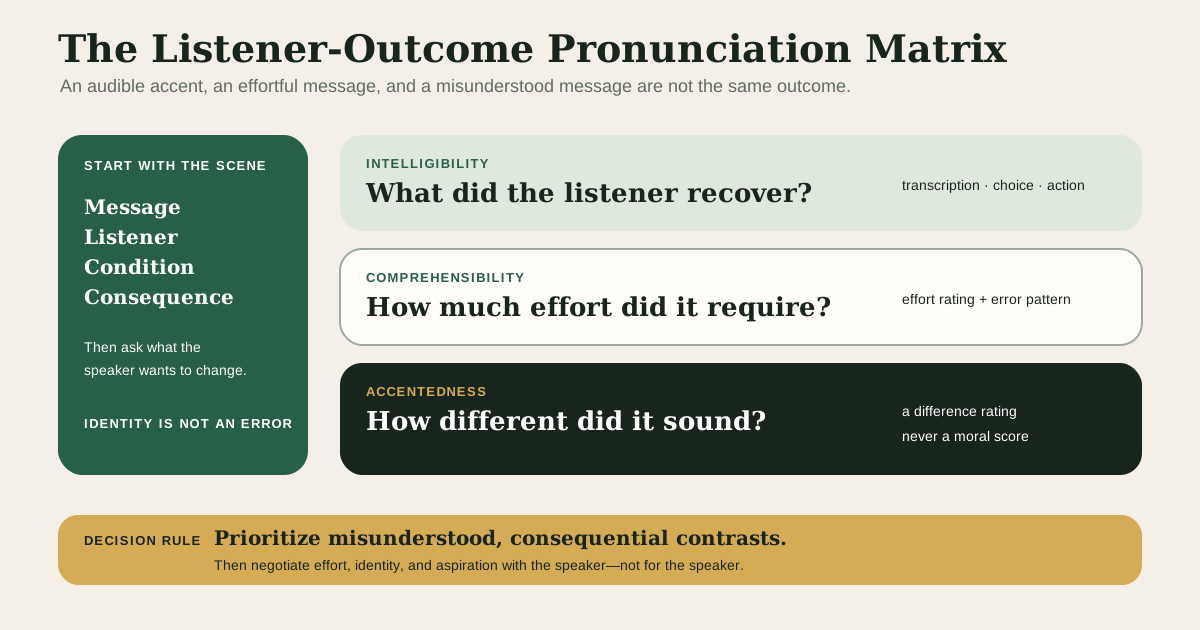
Focus first on intelligibility: whether listeners recover the intended message, especially where an error changes meaning or blocks repair. Treat comprehensibility, fluency, and accentedness as separate outcomes. A speaker may remain clearly accented yet be accurately understood; another may sound locally familiar while one contrast causes consequential misunderstanding. Native-like pronunciation is a legitimate personal preference, not a universal obligation. Set goals for named listeners and situations, test unfamiliar listeners, and preserve the speaker’s identity and agency. fica-meta, intelligibility-review, cefr-companion
Four outcomes hidden inside one accent judgment
“Your accent is strong” can report four different experiences:
- accentedness: the speech differs perceptibly from a listener’s expected reference;
- intelligibility: the listener does or does not recover the intended words or meaning;
- comprehensibility: understanding requires more or less effort;
- fluency: delivery appears more or less continuous and efficient.
The distinctions are not politeness. They change the learning target.
A 2025 meta-analysis of 49 reports found these dimensions related but not interchangeable. Its weakest weighted relationship among the reported pairs was between intelligibility and accentedness; the authors conclude that an accent does not mean unintelligibility and support prioritizing intelligible, comprehensible speech over accent reduction. fica-meta A recent state-of-the-art review likewise emphasizes that intelligibility depends on how it is defined and measured in a context. intelligibility-review
The evidence supports separating accent, intelligibility, comprehensibility, and fluency, and it rejects native-like accent as an automatic proxy for listener understanding. It does not establish one universal intelligibility score or remove the speaker's right to pursue accent-related goals.
Claim sources: fica-meta, intelligibility-review, cefr-companion, japanese-mora
A Japanese contrast where timing carries meaning
Consider a draft contrast often used to illustrate moraic timing:
おばさん — obasan — “aunt / middle-aged woman”
おばあさん — obāsan — “grandmother / elderly woman”
Variety: Tokyo-oriented Standard Japanese as the proposed instructional reference.
Transcription: Japanese kana plus modified Hepburn romanization; the long vowel is shown with a macron.
Proficiency boundary: a beginner-level lexical timing contrast, not a complete model of Japanese prosody.
Communicative consequence: insufficient duration can change which lexical item a listener recovers.
The examples completed model-only English–Japanese review for variety, transcription, meanings, social appropriateness, proficiency fit, and communicative consequence.
Tokyo Japanese provides strong phonological evidence for the mora, including weak moras associated with the second part of a long vowel and the first part of a geminate. japanese-mora If unfamiliar listeners repeatedly recover the wrong item, the duration contrast deserves focused work. The target is not to erase every trace of an English-speaking history. It is to preserve a contrast that carries meaning.
Now consider another feature that listeners notice but that does not alter the message. A learner may choose to work on it because it reduces processing effort, supports belonging, or matters aesthetically. That is also legitimate—provided the preference belongs to the speaker rather than to an institution disguising accent prejudice as communication science.
Build a listener-outcome target
For one recurring situation, record:
- message: what must the listener recover?
- listener: familiar teacher, colleague, customer, multilingual peer, or general public?
- condition: quiet room, telephone, presentation, overlapping conversation?
- consequence: harmless extra effort, repairable delay, social friction, or high-stakes error?
- identity preference: which features does the speaker want to keep, change, or explore?
Test three listener outcomes separately:
| Outcome | Better evidence | |---|---| | intelligibility | accurate transcription, choice, or action | | comprehensibility | listener effort rating plus error pattern | | accentedness | difference rating, never treated as a moral score |
Use more than one listener and include an unfamiliar voice or task. Familiar teachers often understand a learner through experience that a new listener does not possess.
The strongest case for native-like goals
Some speakers want access to acting, broadcasting, covert identity, a particular community practice, or the aesthetic pleasure of close phonetic imitation. Others seek relief from discrimination, even though the burden should not be theirs. Declaring all accent work oppressive can itself override speaker agency.
The reversal condition is ownership. A demanding accent target is defensible when the speaker chooses it with informed awareness of cost, variability, and the absence of guaranteed social acceptance. It is indefensible when a school or employer treats one prestige accent as intelligence, professionalism, or human worth.
The CEFR’s revised phonological approach moved away from native-speaker imitation and foregrounded intelligibility alongside articulation and prosodic control. cefr-companion That shift establishes a sound default, not a ban on personal ambition.
When intelligibility becomes another accent norm
“Be intelligible” can conceal bias if the only listeners are unfamiliar with multilingual speech, if understanding failures are always blamed on the speaker, or if one dominant group defines acceptable effort. Communication is co-produced. Listeners can learn, ask for clarification, and accommodate variation.
Therefore record listener familiarity and task conditions. If one listener fails while others consistently understand, the result may reveal a relationship, not a defective speaker.
What listener evidence cannot decide for you
Listener-based measures vary by task, listener familiarity, bias, recording quality, and language background. The meta-analysis primarily synthesizes second-language speech research with its own first-language-speaker norm overrepresentation. The Japanese example has model review but no human-specialist or natural-audio validation, and this article claims no reviewed audio. Clinical speech or hearing needs require appropriate professional assessment. No intelligibility test can decide how a speaker should sound as a matter of identity.
Pronunciation becomes humane and technically serious when it asks a concrete question: what did this listener understand, how much effort did it require, what consequence followed, and which changes does the speaker actually want?
Use How to Improve Listening and Pronunciation for diagnosis, Why Native Speech Sounds So Fast for connected-speech perception, and Corrective Feedback in Language Learning to prioritize the next repair.
Named sources
Evidence and further reading
Published July 29, 2026. No substantive revision has been recorded. Evidence last verified July 28, 2026.