Corrective Feedback in Language Learning: What to Correct, When, and Why
Match correction to the task, error, learner, and moment so feedback improves intelligibility, accuracy, and independence without destroying interaction.
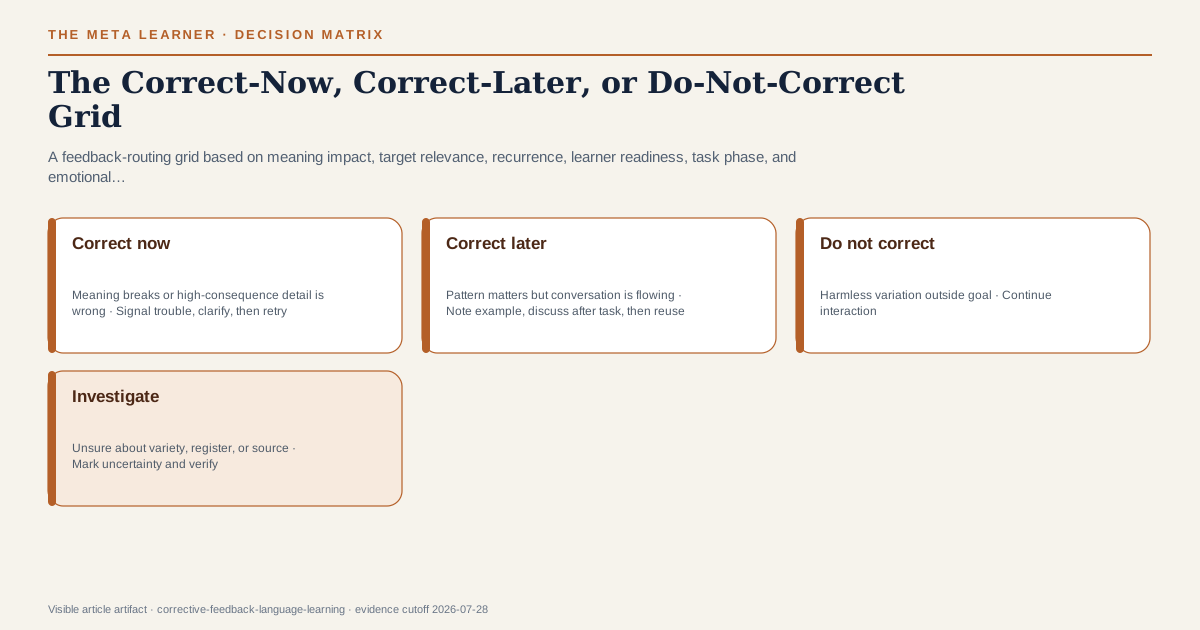
Correct an error now when it blocks meaning, targets the current learning goal, or risks becoming consequential. Correct it later when immediate interruption would damage a fluency or interaction task. Ignore low-value variation when correction adds little. Whatever the timing, require the learner to notice, attempt again, and reuse the feature later.
Correction is a decision not a reflex
An utterance can be grammatically nonstandard and communicatively successful. Another can be polished but pragmatically inappropriate. A third can contain one number error that changes the entire message.
Meta-analysis of classroom studies found beneficial effects of oral corrective feedback under studied conditions, with variation across types and measures. meta, review, cefr A wider research review emphasizes context, learner preferences, interaction, and the complexity of comparing feedback moves. review
The evidence supports feedback as useful; it does not support correcting everything.
The routing grid
Ask six questions:
- Did the error change or obscure meaning?
- Is this feature the current learning target?
- Is it recurring across tasks?
- Is the learner ready to act on the distinction?
- Is the present activity focused on accuracy or fluency?
- What is the likely emotional and interactional cost?
| Route | Typical case | Response | |---|---|---| | Correct now | Meaning breaks or high-consequence detail is wrong | Signal trouble, clarify, then retry | | Correct later | Pattern matters but conversation is flowing | Note example, discuss after task, then reuse | | Do not correct | Harmless variation outside goal | Continue interaction | | Investigate | Unsure about variety, register, or source | Mark uncertainty and verify |
Feedback moves
Recast: reformulate correctly while preserving meaning. It may maintain flow but can pass unnoticed.
Prompt: signal a problem and invite self-correction. It increases retrieval but may frustrate if the form is unknown.
Explicit correction: supply and identify the correction. It is clear but can interrupt.
Metalinguistic clue: point to the rule or category. It helps when the learner understands that language.
Clarification request: respond as a listener who did not understand. It connects form to communicative consequence.
No move is inherently best. Choose based on diagnosis and the task.
A model-reviewed English–Japanese feedback case
Suppose a learner intends “I asked the teacher” and produces 先生を聞きました (sensei o kikimashita). A feedback source might contrast it with 先生に聞きました (sensei ni kikimashita) and then ask the learner to retrieve the relation in a new sentence, such as “I asked my colleague.” The editorial point is the feedback sequence; the Japanese forms received model-only review and are not human-specialist certification.
Variety: Tokyo-oriented Standard Japanese as the proposed reference.
Transcription: Japanese script plus modified Hepburn romanization.
Proficiency boundary: beginner-to-intermediate use of 聞く (kiku) in
the sense “ask”; this does not describe all meanings or particle patterns of
the verb.
Communicative consequence: the particle helps identify the person from
whom information was requested; an unsuitable relation can make the intended
event harder to recover.
Evidence for the diagnosis: the Correct-Now, Correct-Later, or Do-Not-Correct Grid
Complete the feedback loop
Feedback is only information until the learner responds:
- Preserve the original utterance.
- Identify what the listener understood.
- Compare the target form or strategy.
- Have the learner produce a repair.
- Vary the meaning or context.
- Retest after a delay.
If the learner says “yes, I understand” but never retrieves the form, the feedback episode improved explanation, not performance.
Corrective feedback from AI
An AI language tutor can produce plentiful reformulations, but it may over-standardize, mislabel regional usage, invent rules, or miss pragmatic nuance. Ask it to:
- limit feedback to named targets;
- preserve the original and changed text;
- explain whether meaning, grammar, frequency, register, or regionality is at issue;
- mark uncertainty;
- propose a new transfer task.
Verify disputed claims with a reputable grammar, dictionary, corpus, teacher, or community member. Do not let one model define the legitimate variety.
Design a feedback contract for one task
Before speaking or writing practice, agree:
- the communicative goal;
- one or two target features;
- what blocks meaning and must interrupt;
- what will be noted for later;
- preferred feedback move;
- how the learner will retry;
- when delayed transfer will be tested.
Develop the target through How Grammar Becomes Automatic, distinguish communication from conformity through Accent Reduction vs Intelligibility, and configure model feedback with Use AI as a Language Tutor.
Audit whether the correction survives
Select twenty feedback episodes from one target feature. Preserve the original language, feedback move, learner repair, and a delayed new use. Code whether the learner noticed, understood, repaired, and transferred the distinction. A recast that produces no visible response may still help, but the record cannot establish it; an explicit rule that creates an immediate correction may still fail later.
Stratify the small audit by proficiency, modality, and communicative pressure. Beginners may need a clearer cue and bounded choice; advanced learners may benefit from metalinguistic comparison or corpus evidence. Writing allows inspection that fast conversation does not. Language pair and variety determine whether a form is genuinely erroneous, a transfer pattern, or legitimate usage. For pronunciation or audio feedback, verify the recording, transcript, target variety, and listener interpretation. Do not use automatic scores as the sole ground truth. The aim is a feedback route that changes later performance without erasing agency or participation.
Compare uptake with opportunity. A correction cannot reappear if the transfer task never invites the same meaning, register, or sound contrast. Predefine several occasions where the feature is useful but do not announce it; spontaneous selection is stronger evidence than a sentence engineered to force the answer.
Feedback that produces editing without learning
- Rewriting the learner's whole message.
- Correcting forms outside the stated target.
- Interrupting every turn.
- Giving a rule without another attempt.
- Treating one standard variety as the only valid form.
- Praising or correcting without preserving the example.
- Testing the correction only in the original sentence.
Evidence does not select one universal method
Much evidence comes from instructed classroom settings and particular target forms. Feedback preferences, proficiency, literacy, neurodiversity, language pair, identity, and power relations matter. A competent speaker can still be a poor teacher, and automated feedback can be wrong. This article cannot replace language-specific expertise.
Good correction does not maximize the number of visible edits. It creates a better next attempt while keeping the learner able and willing to communicate.
Named sources
Evidence and further reading
Published July 29, 2026. No substantive revision has been recorded. Evidence last verified July 28, 2026.