How Grammar Becomes Automatic: Train Decisions, Not Rule Recitals
Move grammar from explicit explanation to timely use through cue detection, constrained choice, meaningful retrieval, feedback, fluency, and Japanese transfer tests.
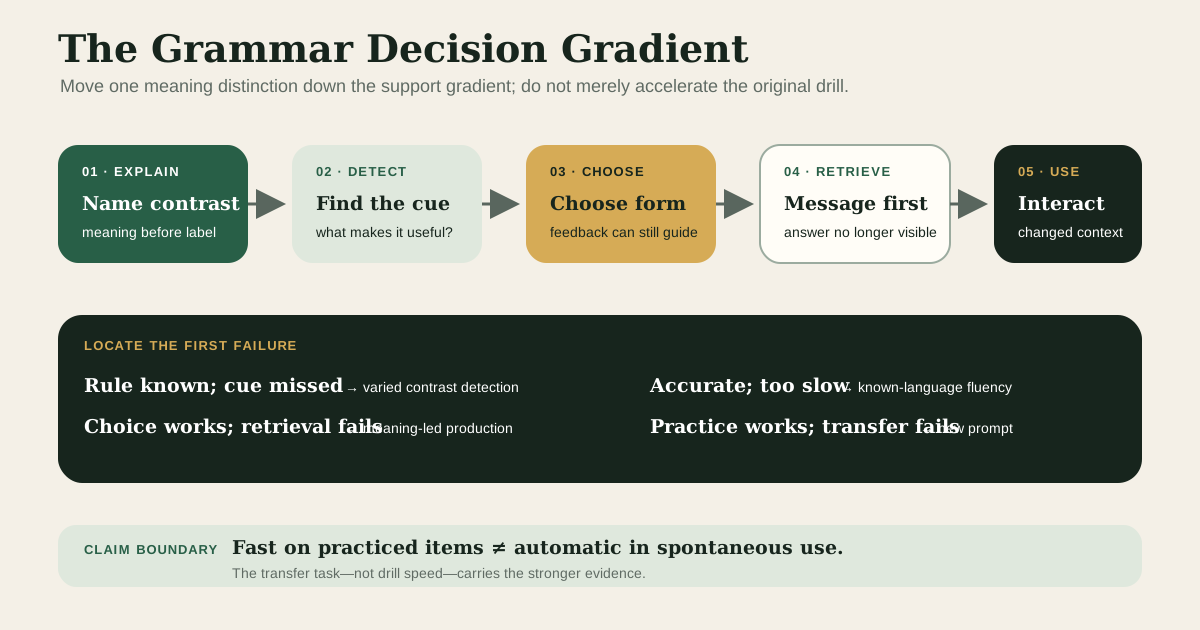
Grammar becomes automatic when learners repeatedly notice the cue that makes a form useful, choose the form for a meaning, retrieve it with progressively less support, and use it under realistic time pressure across changing contexts. Explicit rules can accelerate noticing and repair, but reciting a rule is not fluent control. Move from explanation to constrained choices, then to meaningful production and interaction; measure transfer with a new prompt, not speed on the original drill. Accuracy may temporarily fall as support fades. norris-ortega, focus-form, nation-best-practice, cefr-companion
A correct explanation can coexist with unusable grammar
A learner can explain a rule in elegant English and fail to use it in a three-second Japanese turn. Another can produce the form naturally and give a poor explanation. These are not paradoxes. Explanation and performance place different demands on memory, attention, and time.
Instructional synthesis supports the value of focused second-language instruction, but its conclusions depend on treatments and outcome measures. norris-ortega Research on focus on form asks how attention to linguistic structure can serve acquisition without divorcing the structure from communication. focus-form The practical task is to build a bridge between an explicit distinction and the moment in which a speaker needs it.
The evidence supports focused instruction as one useful component and distinguishes form learning, meaning-focused use, fluency, and grammatical accuracy. The five-stage gradient below is an editorial synthesis; it is not a validated universal sequence for every construction.
Claim sources: norris-ortega, focus-form, nation-best-practice, cefr-companion
The grammar decision gradient
1. Explain the contrast. State what changes in meaning, discourse, or social action.
2. Detect the cue. Given short examples, identify what makes one form appropriate.
3. Choose with constraints. Select or complete the form while the relevant options remain visible.
4. Retrieve for a message. Express an intention without seeing the answer.
5. Use and transfer. Make the choice inside interaction, then repeat the purpose with a changed prompt.
Each stage removes support and adds competing demands. A learner who succeeds at stage two and fails at stage four does not need another beautiful explanation. They need retrieval and assembly. A learner who chooses accurately in writing but fails in conversation may need time-bounded, meaning-preserving practice.
A Japanese case: the particle is not the whole performance
Draft example:
毎朝コーヒーを飲みます。
Maiasa kōhī o nomimasu.
“I drink coffee every morning.”
Variety: Tokyo-oriented Standard Japanese as the proposed reference.
Transcription: Japanese script plus modified Hepburn romanization.
Proficiency boundary: beginner habitual-action description using polite style.
Communicative consequence: the object relation should remain clear, but successful interaction also depends on vocabulary, appropriateness, and the surrounding turn.
The example completed model-only English–Japanese review.
A weak drill asks the learner to insert を into twenty nearly identical sentences. Performance may accelerate because the exercise makes the location and expected answer obvious.
A stronger gradient changes the decision:
- explain the object-marking function in the bounded example;
- identify the object across varied short sentences;
- choose among plausible particles with feedback;
- answer “What do you do every morning?” without a frame;
- discuss a different routine with a new interlocutor.
The final task does not merely remove the blank. It restores intention, lexical choice, sentence planning, and interaction.
Fluency practice should use known material
Nation’s course architecture separates focused learning from meaning-focused output and fluency development. nation-best-practice This matters because learners cannot simultaneously discover a difficult rule, retrieve unfamiliar vocabulary, and become fluent without tradeoffs.
Fluency practice should largely recycle language already understood. Short repeated tasks can reduce planning cost, but the repetition must vary enough to prevent memorizing one answer. Change the day, object, person, or reason while preserving the grammatical decision.
The CEFR also distinguishes grammatical accuracy from fluency. cefr-companion A useful progress record therefore keeps both: did the form carry the intended relation, and did the learner sustain the interaction?
The strongest case for explicit rule study
Adults can use explanation to notice a distinction that input alone has not made salient. A concise rule can compress many examples, reduce confusion, and support self-correction. For low-frequency but consequential forms, explicit attention may be efficient.
The case reverses when explanation becomes the only performance. If each error sends the learner back to a longer lecture, explicit knowledge is functioning as a delay, not a bridge. Stop adding rules when the learner already identifies the cue correctly; move the same distinction down the support gradient.
Drills that automate the exercise
- the blank reveals exactly where the answer belongs;
- only one grammatical form appears in the entire session;
- lexical content never changes;
- speed rises only in a fixed item order;
- every error triggers explanation but no new attempt;
- the final test repeats the training sentences.
Automaticity is task-specific until transfer shows otherwise. The new prompt, not the old drill at double speed, carries the stronger claim.
What automaticity does not mean
Automaticity is gradual, construction-specific, and sensitive to proficiency, task, attention, and context. Instructional meta-analysis does not identify one method for Japanese grammar, and the article does not claim that explicit knowledge simply transforms into implicit knowledge. The Japanese example's variety, transcription, naturalness, proficiency, and consequence fields were checked by a model, not certified by a human specialist. Temporary speed or accuracy gains on practiced items do not establish spontaneous transfer.
Grammar becomes part of fluent action when a learner no longer has to leave the conversation to visit the rule. The route there is not rule versus meaning. It is a disciplined reduction of support until the distinction can serve meaning on time.
Continue with Corrective Feedback in Language Learning, diagnose missing production in Why You Understand More Than You Can Speak, and verify the final step with The Transfer Test.
Named sources
Evidence and further reading
Published July 29, 2026. No substantive revision has been recorded. Evidence last verified July 28, 2026.