Vocabulary That Sticks: From Familiar Words to Available Language
Turn vocabulary recognition into usable language through multidimensional word knowledge, retrieval, spacing, chunks, and Mandarin transfer tests.
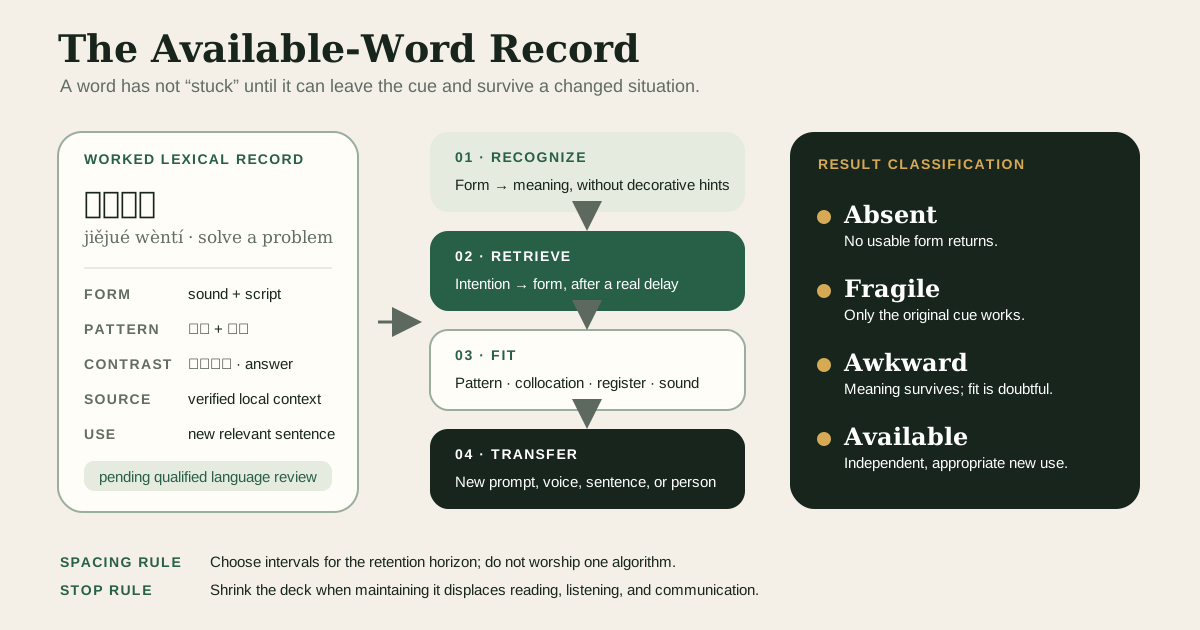
Vocabulary sticks when learners repeatedly reconstruct useful words from meaning, encounter them across time and contexts, learn the forms and combinations that matter, and use them without the original cue. Recognition is useful but insufficient: a word is available only when it can be retrieved, pronounced or written, fitted into an appropriate pattern, and understood by another person. Spacing and retrieval help, but no universal card format or interval fits every word, language, and goal. nation-book, cepeda-spacing, karpicke-retrieval
The illusion produced by a familiar card
A flashcard appears. The answer feels obvious. The learner turns it over, sees the expected word, and awards success.
What has been demonstrated? Perhaps the front of the card cued the back. Perhaps the typography, deck order, or memory of yesterday’s mistake did the work. Perhaps the learner can recognize the form but cannot produce it from an intention, cannot hear it in speech, or puts it into a sentence that no competent speaker would choose.
This is not an argument against flashcards. It is an argument against asking one measurement to stand in for a multidimensional ability.
Nation’s vocabulary framework devotes separate attention to what it means to know a word, deliberate word-card learning, learning from context, multiword units, and testing knowledge and use. nation-book Its scope is a warning against reducing a lexical item to a bilingual pair. A word may involve spoken and written form, one or more meanings, grammatical behavior, collocations, constraints of register, and different degrees of receptive and productive control.
The distinction developed here is between familiarity and availability. Familiarity means that a cue produces a sense of knowing. Availability means that a communicative intention can call up a suitable form, in time, under conditions that differ from the learning event.
The sources support multidimensional vocabulary knowledge, vocabulary’s place inside a balanced language program, retrieval as a consequential learning activity, and spacing that depends on the retention horizon. They do not validate one universal flashcard algorithm or prove that isolated item practice transfers automatically to conversation.
Claim sources: nation-book, nation-excerpt, cepeda-spacing, karpicke-retrieval
Build a record for a word you might actually need
Take the Mandarin expression 解决问题, a common sequence meaning “solve a problem.” This bounded teaching example has completed model-language review.
Variety: Putonghua / Standard Mandarin.
Transcription: simplified Chinese characters plus Hanyu Pinyin with tone marks: jiějué wèntí.
Proficiency boundary: an early-intermediate learner discussing ordinary work or study problems; not evidence of specialized professional register.
Communicative consequence: retrieving only 问题 (wèntí, “problem/question”) lets the learner name the difficulty; retrieving the verb–object sequence lets the learner propose action.
A thin record is:
解决 = solve
A more useful record has layers:
| Layer | What the learner records | What later testing asks | |---|---|---| | Meaning | resolve or solve a problem | Can the intention retrieve the expression? | | Sound | jiějué wèntí | Can it be recognized in a new natural voice? | | Script | 解决问题 | Can it be read without Pinyin and written if required? | | Pattern | 解决 + 问题 | Can the learner preserve the natural combination? | | Source | one verified sentence from real material | Can the learner explain its local meaning? | | Contrast | 解决问题 versus 回答问题 | Can the learner distinguish solving a problem from answering a question? | | Production | a personally relevant new sentence | Can a competent reader understand the intended action? |
The contrast matters because the English word problem tempts a learner to treat every neighboring verb as interchangeable. Draft examples:
我们需要先解决这个问题。
Wǒmen xūyào xiān jiějué zhège wèntí.
“We need to solve this problem first.”
请回答这个问题。
Qǐng huídá zhège wèntí.
“Please answer this question.”
No amount of decorative information makes the record useful unless the learner later has to reconstruct and discriminate the language.
Retrieval should resemble the direction of use
If the goal is speaking, the learner must sometimes move from intention to spoken form. If the goal is reading, rapid form-to-meaning access matters. If the goal is writing characters, an additional production demand appears. A deck can therefore contain several tests, but it should not administer all of them at once.
Use separate cues:
- a short situation that requires the expression;
- audio from a properly sourced natural recording;
- the characters with no Pinyin;
- a sentence with the collocation removed;
- a contrast that requires choosing between two plausible items.
Retrieval research gives good reason to make memory produce an answer rather than merely revisit one. In a controlled comparison, retrieval practice produced stronger later learning than elaborative studying under the tested conditions. karpicke-retrieval That finding does not make every failed recall beneficial. A cue can be so ambiguous that it tests guessing, or so difficult that the learner repeatedly rehearses an error. Retrieval needs an answer check and a repair.
Spacing is a relationship, not a sacred interval
The useful interval depends on the desired horizon. A quantitative synthesis of distributed verbal practice found that spacing effects vary with retention interval and schedule. cepeda-spacing The responsible conclusion is not “review after exactly N days.” It is that review should be distributed, and the schedule should be chosen in relation to how long the learning must remain accessible.
For a phrase needed in tomorrow’s meeting, closely spaced early retrieval may be rational. For language meant to remain available months later, the learner needs returns across a longer period. Errors should affect the schedule, but so should importance: an infrequent specialist term and a common repair phrase do not deserve identical treatment.
A seven-day availability test
Choose twenty items from material you genuinely understand and expect to reuse. For each, create one meaning-to-form cue and one context or contrast cue.
Day 1: interpret the source, record the necessary layers, and retrieve once after a short delay.
Day 2: retrieve from meaning; repair errors with the full source context.
Day 4: use the item in a new sentence, message, or spoken response.
Day 7: test it inside an unfamiliar prompt without the deck interface.
Classify the result:
- absent: no usable form returns;
- fragile: the form returns only with the original cue;
- available but awkward: meaning is expressed, but the pattern or register is doubtful;
- available: the item is retrieved and used appropriately in the new task.
Do not turn these labels into a pseudo-scientific score. Their purpose is to decide what kind of encounter the item needs next.
The strongest counterposition
Explicit vocabulary systems can make language bloodless. A learner may spend months perfecting records while avoiding books, films, conversations, and the accidental richness through which words acquire connotation. Extensive, understandable exposure can supply repetitions, patterns, and meanings that no card author can anticipate.
The objection succeeds when deliberate study displaces language. Nation’s own account places vocabulary within broader language goals and a program containing meaning-focused input, output, focused learning, and fluency. nation-excerpt The appropriate reversal condition is clear: when maintaining the deck consumes more time than reading, listening, and using the language it is supposed to support, shrink the deck.
Explicit study remains valuable where an important item is too infrequent to recur soon, where a script or sound requires focused attention, or where recognition repeatedly fails to become production. The point is not to choose cards or context. It is to make each repair the other’s weakness.
How decks manufacture false progress
- The same cue direction is used for every goal.
- A translation is accepted without form, pattern, or register.
- Cards are reviewed, but words are never sought in new input.
- Correct recognition is recorded as productive mastery.
- the interface supplies hints that ordinary communication will not supply.
- all examples come from generation rather than verified language use.
- review counts rise while the deck consumes the learner’s reading and speaking time.
The cure is not more fields. It is fewer, better chosen records and a transfer task outside the deck.
Where item practice stops
Spacing and retrieval findings come from bounded tasks and do not prescribe one algorithm for second-language acquisition. Word usefulness, segmentation, morphology, script, frequency, and learning burden differ across languages and learners. Model review covered the Mandarin variety label, transcription, gloss, proficiency fit, and stated consequence, but no human language specialist has certified the example. A word used successfully once is not necessarily durable, broadly appropriate, or fluent.
Vocabulary becomes part of a life in the language when it can leave the card: heard in another voice, recalled for a new intention, fitted to an unfolding sentence, and revised when another person understands something different from what the learner meant.
Place this method inside How Adults Learn a New Language, diagnose recognition without production in Why You Understand More Than You Can Say, and examine lexical scale in How Much Vocabulary Do You Need?.
Named sources
Evidence and further reading
Published July 29, 2026. Substantively updated July 29, 2026. Evidence last verified July 28, 2026.
- : Reconstructed the argument, claim-level evidence, multilingual case, original asset, and prose for the seven-gap editorial program.