How Many Words Do You Need to Speak a Language? Frequency, Coverage, and Chunks
Replace one magical vocabulary target with a purpose-specific model of frequency, lexical coverage, depth, formulaic sequences, and productive use.
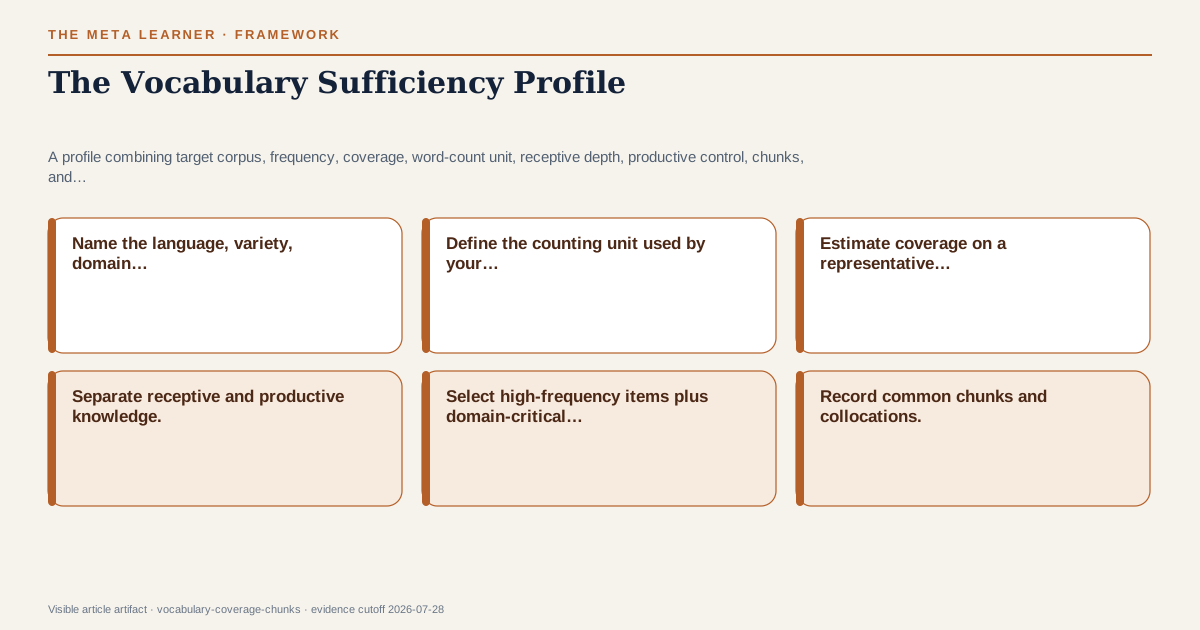
There is no universal number of words required to “speak a language.” The answer depends on the language, how a word is counted, the situations and genres you need, and whether you can recognize or produce each item in context. Prioritize frequent language and useful chunks, then test coverage and performance in your actual domain.
The number changes when the counting rule changes
Does learn, learns, learned, and learning count as one word or four? What about transparent compounds, inflected forms, separable verbs, characters, or multiword expressions? Researchers use lemmas, word families, types, tokens, and other units for different purposes.
English research often estimates the vocabulary needed for a percentage of words in a corpus. Nation summarizes evidence that around 3,000 word families can provide roughly 95 percent coverage of informal spoken English in studied corpora, while higher coverage requires substantially more. nation, replication, cefr Replication work emphasizes that such figures are frequency-profile estimates rather than direct tests of learners who know exactly those counts. replication
These are useful landmarks for English, not a universal passport to conversation.
Coverage is not comprehension
At 95 percent coverage, roughly one token in twenty is unknown. If the unknown word carries the main point, comprehension can fail. Background knowledge, grammar, discourse, speed, pronunciation, and tolerance for ambiguity also matter.
At 98 percent, unknown vocabulary is less dense, but understanding is still not guaranteed. Conversely, an interaction can succeed with much lower lexical coverage because speakers gesture, paraphrase, repair, and share a situation.
Coverage answers: “What proportion of tokens in this corpus come from vocabulary assumed known?” It does not answer: “Can this person communicate?”
Depth changes the usable count
Knowing a word may include:
- recognizing spoken and written forms;
- recalling meaning without a cue;
- producing pronunciation or orthography;
- knowing common combinations;
- controlling grammar and register;
- recognizing related senses;
- using it quickly in interaction.
A thousand deeply controlled, relevant items can enable more real communication than a larger recognition list detached from situations.
Chunks reduce assembly cost
Formulaic sequences such as “Would you mind…,” “the extent to which,” or language-specific interaction routines connect vocabulary, grammar, pragmatics, and fluency. Learn them as analysable units: preserve the whole pattern while noticing what can vary.
Chunks are not a shortcut around grammar. They supply frequent frames from which grammatical knowledge can develop and speaking can proceed with less online assembly.
A model-reviewed English–Japanese example
Consider the request frame 手伝っていただけますか (tetsudatte itadakemasu ka, “Could you help me?”). Learning only 手伝う (tetsudau, “to help”) gives the learner a lexical item; learning the whole frame gives them a way to make a polite request and later substitute another verb. The example is included after model-language review, without a claim of human-specialist certification.
Variety: Tokyo-oriented Standard Japanese as the proposed reference.
Transcription: Japanese script plus modified Hepburn romanization.
Proficiency boundary: beginner-to-intermediate polite requests in ordinary
service or workplace interaction; not a complete account of Japanese
honorific language.
Communicative consequence: the isolated verb identifies the action, while
the frame also manages the request and social relationship.
The Vocabulary Sufficiency Profile: evidence and boundary
Corpus research supports strong frequency effects and interpretable coverage estimates within defined English corpora. CEFR describes lexical range and control as part of broader communicative competence. No source supports a universal vocabulary number that guarantees speaking across languages and contexts.
nation, replication, cefrClaim sources: nation, replication, cefr
A purpose-specific target
Replace “learn 5,000 words” with:
Build enough receptive coverage to follow familiar product meetings, plus productive control of the words and chunks needed to update status, explain risk, disagree, ask for clarification, and negotiate a deadline.
Now collect a small target corpus: meeting transcripts, messages, documents, and recordings you are authorized to use. Identify frequent items, recurring chunks, and high-consequence low-frequency terms. Have a competent speaker or corpus resource verify what is natural in the relevant variety.
Build a vocabulary sufficiency profile
- Name the language, variety, domain, and mode.
- Define the counting unit used by your resource.
- Estimate coverage on a representative corpus.
- Separate receptive and productive knowledge.
- Select high-frequency items plus domain-critical terms.
- Record common chunks and collocations.
- Test a real task and log missing language.
- Update the target from failure, not vanity.
Learn selected items through Vocabulary That Sticks, test productive access through the Receptive–Productive Gap, and apply coverage to Reading Fluency.
Validate the corpus before trusting the percentage
A coverage calculation inherits every choice made in the corpus. Record who produced the language, for whom, in which genre, variety, time period, and modality. A subtitle corpus, academic journal collection, customer-support transcript set, and informal speech archive answer different questions. Remove duplicated boilerplate and inspect whether tokenization handles contractions, compounds, clitics, inflection, proper names, and multiword units appropriately for the target language.
Then sample the learner rather than assuming a list equals knowledge. Test written recognition, audio recognition, meaning-to-form retrieval, and use of high-value chunks in a new task. Verify audio items against accurate transcripts and competent speakers. Keep the proficiency and language-pair boundary explicit: transparent cognates may inflate apparent coverage, while unfamiliar scripts or phonology can depress functional access. Report the counting unit and corpus alongside the number. Without them, “95 percent coverage” is not a portable fact but an orphan statistic.
Vocabulary targets that count the wrong achievement
- Reporting app “words learned” without a counting definition.
- Transferring English word-family numbers to another language.
- Treating recognition as spontaneous production.
- Learning rare synonyms before high-frequency interactional language.
- Memorizing isolated translations without sound, grammar, or collocation.
- Assuming 98 percent coverage guarantees 98 percent comprehension.
- Ignoring names, numbers, and technical terms that carry real consequence.
English coverage figures are not universal constants
The most cited numerical studies are corpus- and English-specific. Morphology, segmentation, script, dialect, genre, and counting method change estimates. Coverage research usually models token knowledge and cannot fully represent depth, pragmatics, or interaction. Use language-specific corpora and qualified advice whenever a numerical target matters.
The vocabulary question is not how many entries you possess. It is which forms you can recognize and mobilize when a particular person, text, and purpose require them.
Named sources
Evidence and further reading
Published July 29, 2026. No substantive revision has been recorded. Evidence last verified July 28, 2026.