How Reading in Another Language Becomes Fluent: Vocabulary, Decoding, and Volume
Build second-language reading fluency by combining lexical coverage, automatic decoding, extensive volume, strategic close reading, and retesting.
Reading becomes more fluent when word recognition and decoding require less attention, allowing you to build meaning across sentences and larger structures. Read a substantial volume of material that is manageable, while using a smaller portion of difficult text for close analysis. Measure comprehension and transfer alongside speed. Effects vary with program design, language, script, proficiency, text choice, accountability, and measurement; English coverage values are not universal.
Fluent reading is efficient meaning construction
Fluency is not racing across a page. It is coordinating print, vocabulary, grammar, discourse, background knowledge, and purpose with enough efficiency that local decoding does not continually erase the larger meaning.
A meta-analysis found positive effects of extensive reading across included second-language studies, while design and context varied. er, vocab, cefr Vocabulary-coverage research illustrates why dense unknown language burdens comprehension, though widely cited numerical thresholds are corpus-specific. vocab
CEFR reading descriptors distinguish tasks such as reading correspondence, orienting, information and argument, and instructions. cefr Read for a purpose, not one universal speed.
The two-speed system
Extensive lane
Read a large amount for story, argument, information, or pleasure. Choose material where unknown language does not constantly break the thread. Look up selectively. The aim is repeated exposure, automaticity, discourse familiarity, and stamina.
Intensive lane
Take a short, consequential passage and inspect vocabulary, syntax, reference, rhetorical structure, and ambiguity. Verify what each sentence contributes. The aim is precision and learning from difficulty.
The lanes support one another. Only intensive reading produces too little volume; only extensive reading can leave persistent blind spots untouched.
Diagnose the slowdown
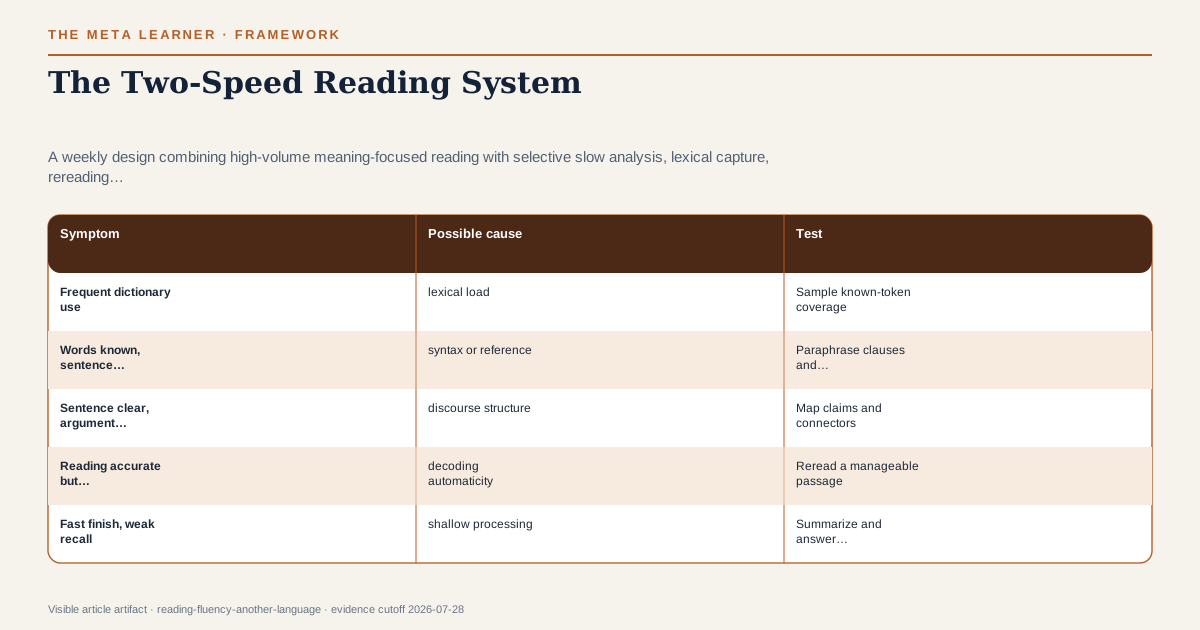
| Symptom | Possible cause | Test | |---|---|---| | Frequent dictionary use | lexical load | Sample known-token coverage | | Words known, sentence unclear | syntax or reference | Paraphrase clauses and pronouns | | Sentence clear, argument lost | discourse structure | Map claims and connectors | | Reading accurate but very slow | decoding automaticity | Reread a manageable passage | | Fast finish, weak recall | shallow processing | Summarize and answer inference questions |
Do not prescribe more speed when the problem is missing language or knowledge.
A model-reviewed English–Arabic reading sample
Use a short Modern Standard Arabic sentence such as أعلنت الوزارة الخطة الجديدة (aʿlanat al-wizāratu al-khuṭṭata al-jadīdata, “The ministry announced the new plan”). On the first pass, read for the event and its participants. On the intensive pass, identify the verb, subject, object, and adjective agreement; then reconstruct the proposition without looking. The Arabic and romanization completed model review; no human Arabic specialist has certified them as teaching material.
Variety: contemporary written Modern Standard Arabic; no claim is made
about spontaneous dialect conversation.
Transcription: Arabic script without full vocalization plus a broad
IJMES-style romanization supplied for review.
Proficiency boundary: intermediate reading of a short, high-frequency news
sentence; not evidence of fluent newspaper reading.
Communicative consequence: misidentifying who announced what reverses the
proposition even when every content word looks familiar.
Evidence inside the case boundary: the Two-Speed Reading System
Evidence supports extensive reading as a useful component and lexical coverage as an important constraint. Functional frameworks distinguish multiple reading purposes. No source supports one optimal words-per-minute target or a universal percentage for all languages, scripts, genres, and learners.
er, vocab, cefrSelect texts with a friction sample
Before committing to a book, sample two pages:
- Can you state the main proposition without translation?
- How often does an unknown item block the sentence?
- Are unknowns repeated and worth learning?
- Does the script or typography slow decoding?
- Is the topic knowledge sufficient?
- Would a graded, annotated, or parallel edition preserve interest?
A text can be “above your level” yet worth intensive study. It is a poor extensive choice if every line becomes analysis.
Rereading with changed purpose
Rereading can build fluency when each pass changes the demand:
- Read for gist.
- Inspect decisive gaps.
- Reread for argument or narrative structure.
- Close the text and reconstruct.
- Return later or read a related text.
Avoid memorizing one passage as a substitute for transfer. New texts must eventually become easier.
Build a two-speed reading week
- Choose one extensive source you genuinely want to continue.
- Set a volume target small enough for continuity.
- Mark but do not immediately chase every unknown.
- Select one short passage for close analysis.
- Capture five high-value words or chunks.
- Write or speak a source-free summary.
- At month's end, compare comprehension and time on an equivalent new passage.
Estimate lexical friction with Vocabulary Coverage and Chunks, preserve meaning through Comprehensible Input, and turn reading into output with Writing Without Translating Every Sentence.
Compare fluency on a matched text set
Create six short texts matched as closely as possible for genre, topic familiarity, lexical coverage, syntax, typography, and length. Use three for baseline and three for later transfer; never retest only the passages you reread. Before timing, define the purpose—scan for a date, follow an argument, enjoy a narrative, or synthesize evidence—because the appropriate pace changes with the job.
Record time together with a source-free proposition, inference question, and confidence rating. Note dictionary use, regressions, and unknown words that altered meaning. A faster reading with weaker reconstruction is not improvement. Compare within the same script and language before borrowing norms from English or another orthography. Beginners may need graded material to make the measurement interpretable; advanced learners can test dense genres and implicit argument. The language-pair boundary also matters because cognates, script familiarity, and prior domain knowledge can accelerate one text set without general reading transfer.
Add an eye-rest and accessibility rule before timing. Font size, contrast, screen glare, line length, and assistive technology change measured pace but are not language proficiency. Use the same humane presentation across comparisons unless accessible adaptation is itself the question. If fatigue explains the decline, redesign the reading condition rather than prescribing more lexical study.
Reading routines that confuse difficulty with depth
- Choosing famous originals that require a dictionary every sentence.
- Reading only graded material after it has become effortless.
- Looking up every unknown before inferring.
- Measuring speed without comprehension.
- Translating line by line.
- Collecting vocabulary while abandoning the argument.
- Rereading one text without testing a new one.
Speed norms depend on language and purpose
Reading processes vary with script, orthographic depth, morphology, direction, genre, disability, and language pair. Research on English learners cannot set universal thresholds. Extensive reading programs also differ in choice, support, duration, and assessment. A visual, reading, or learning difficulty may require accessible formats or qualified support.
Fluent reading grows when the page contains enough known language to carry meaning and enough well-chosen difficulty to keep the system learning.
Named sources
Evidence and further reading
Published July 29, 2026. No substantive revision has been recorded. Evidence last verified July 28, 2026.