How to Write in a New Language Without Translating Every Sentence
Build direct written production from intentions, target-language patterns, drafting, corpus-informed revision, feedback, and delayed independent writing.
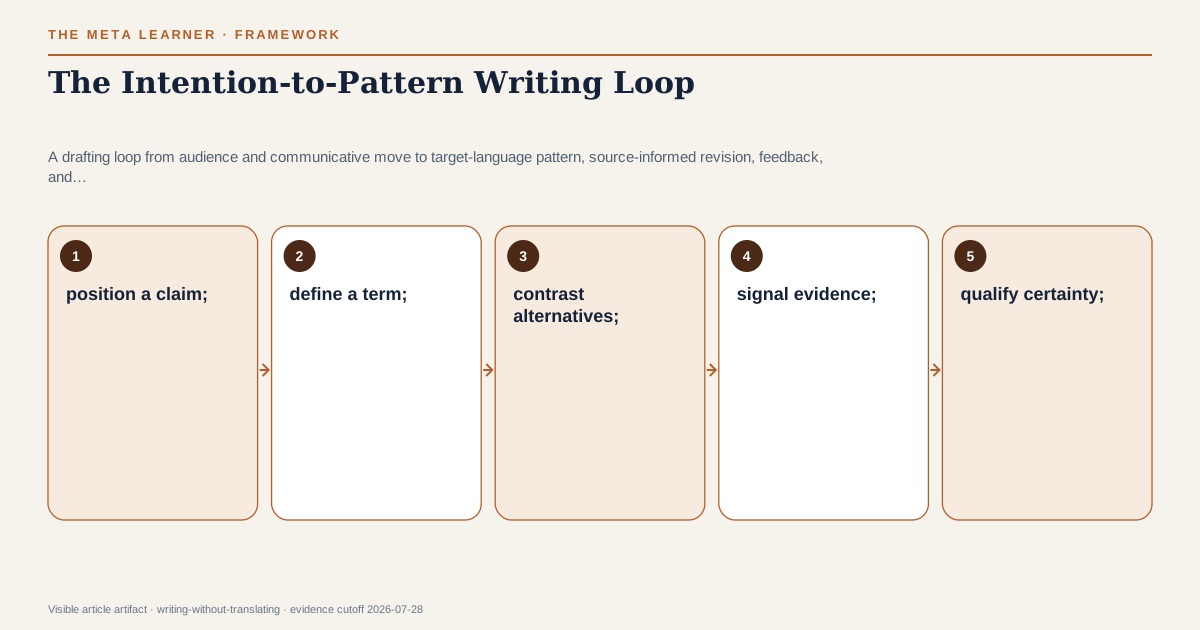
To write without translating every sentence, begin with the communicative move you need—define, contrast, request, qualify, conclude—and retrieve target-language patterns that perform it. Draft within your current range, then compare with reliable examples and feedback. Use your first language for planning when helpful, but avoid using it as the fixed sentence template.
Translation is a tool not a developmental stage to fear
Writers think in images, propositions, fragments, multiple languages, and remembered phrases. Demanding “never think in your first language” is neither realistic nor necessary.
An exploratory study of Chinese learners writing in English found that first-language use served different composing functions and varied with proficiency. composing, formulaic, cefr Formulaic-language research shows how recurring multiword patterns can support fluent language processing and production. formulaic
The goal is not mental purity. It is a growing ability to formulate appropriate text without making every target-language sentence imitate a first-language one.
Start from communicative moves
Before vocabulary, identify what the sentence must do:
- position a claim;
- define a term;
- contrast alternatives;
- signal evidence;
- qualify certainty;
- make a request;
- connect cause and consequence;
- close an argument.
Collect natural patterns for those moves from trustworthy writing in your target genre. Preserve enough context to understand register and grammar.
Instead of translating “On the one hand…,” a learner builds a small repertoire of contrast patterns used in actual reports, messages, or essays.
A model-reviewed English–Arabic pattern
For the move “qualify or clarify a claim,” a writer might collect the frame أودّ أن أوضّح أن… (awaddu an uwaḍḍiḥa anna…, “I would like to clarify that…”). The learner should preserve the source genre, check what normally follows the frame, and later write a parallel sentence without translating a finished English sentence word for word. The form has received model-only language review.
Variety: contemporary written Modern Standard Arabic in a professional
register.
Transcription: Arabic script with a broad IJMES-style romanization for the
review draft.
Proficiency boundary: intermediate professional correspondence; not a
claim about colloquial email, literary prose, or every institutional norm.
Communicative consequence: the frame signals that the writer is refining a
previous interpretation rather than abruptly contradicting the reader.
The intention-to-pattern loop
- Audience: Who will read this and why?
- Move: What must this passage accomplish?
- Pattern: Which target-language frame performs that move?
- Draft: Express the idea within your current range.
- Compare: Inspect corpus or model examples from the same genre.
- Revise: Change only what improves meaning, form, or appropriateness.
- Retrieve: Rewrite a parallel passage later without the model.
The loop creates direct links between intention and target-language form.
The Intention-to-Pattern Writing Loop: evidence and boundary
Research supports strategic L1 use and the importance of formulaic language, while CEFR distinguishes written production and interaction across genres and purposes. The loop is an editorial synthesis; no evidence suggests that all learners suddenly stop translating at one proficiency level.
composing, formulaic, cefrBuild a personal pattern bank
A useful entry contains:
- communicative function;
- full source sentence;
- variable frame;
- register and genre;
- one self-generated example;
- source and date.
For example:
qualify a claim → The evidence supports X under Y conditions, but does not establish Z.
Do not collect ornamental phrases you would never use. Prefer patterns that express intellectual actions in your real work.
Use tools without outsourcing authorship
A dictionary can check sense, valency, and collocation. A corpus can show frequency and context. A teacher can identify unnatural transfer. An AI tool can propose alternatives, but it may flatten voice, over-standardize, or invent usage.
Ask for diagnosis before replacement:
Identify two places where my intended meaning is unclear. Explain whether the issue is vocabulary, grammar, cohesion, or register. Do not rewrite the paragraph. Offer contrasting examples from the stated variety and mark uncertainty.
Then revise yourself and write a new paragraph without the tool.
Write through intention and pattern
Run a four-week project:
- Choose one recurring genre.
- Collect twenty verified patterns by communicative move.
- Write three short texts weekly from new prompts.
- Highlight literal first-language transfers you would not find in target-language examples.
- Get selective feedback on meaning and two recurring patterns.
- Rewrite after a delay without opening the correction.
- Compare range, clarity, and dependence across the month.
Develop the input base through Reading Fluency, interpret transfer with How Your First Language Helps—and Interferes, and structure response through Corrective Feedback.
Run a source-of-sentence audit
After drafting, label each difficult sentence by its origin: target-language pattern retrieved directly, first-language structure translated, dictionary construction, model suggestion, or uncertain invention. The labels are diagnostic, not moral. Select three translated structures and search an appropriate corpus or consult a competent writer to see how the intended move is normally realized in that genre. Preserve legitimate multilingual choices rather than normalizing every difference.
One week later, write a parallel text without the original, translation, or model. Compare whether the communicative moves and verified patterns reappear, whether meaning remains precise, and where dependence returns. Adapt the test by proficiency: a beginner can compose a short message from reliable frames; an advanced writer can test stance, cohesion, and disciplinary register. The specific first-language and second-language pair matters because transfer may be lexical, syntactic, rhetorical, or orthographic. Success in email cannot establish direct composition in an academic article, creative essay, or another script.
Ask a reader to reconstruct the intended claim before correcting the language. If the reader recovers a different proposition, repair meaning first; surface naturalness is secondary to authorship and communicative control.
Revision habits that erase the learner
- Translating polished first-language prose sentence by sentence.
- Asking a model to “make this native.”
- Accepting a correction without explaining the changed meaning.
- Collecting sophisticated connectors outside their genre.
- Revising indefinitely but never drafting anew.
- Measuring error count while ignoring audience and argument.
- Treating every trace of multilingual influence as failure.
Direct writing develops unevenly by genre
The composing study is small and concerns Chinese–English writing; it cannot establish one process for every language pair. Writing-system distance, genre, literacy, proficiency, and identity matter. Translation is itself a skilled practice and may be the correct task. High-stakes professional writing requires qualified review.
Writing “directly” does not mean silencing languages you already know. It means giving the new language enough patterns and practice to shape the sentence from the beginning.
Named sources
Evidence and further reading
Published July 29, 2026. No substantive revision has been recorded. Evidence last verified July 28, 2026.