How Your First Language Helps—and Interferes—with the Next One
Use crosslinguistic influence as a source of hypotheses: exploit verified similarities, contrast costly differences, and test transfer in real tasks.
Your first language helps by supplying concepts, literacy, learning strategies, cognates, and familiar structures. It interferes when those expectations mispredict sounds, meanings, grammar, discourse, or social use in the new language. Treat every similarity or difference as a hypothesis, verify it with target-language evidence, and practise the distinctions that affect communication.
Prior language is an inference engine
A learner never encounters a new language with an empty mind. Existing categories make the signal intelligible. They also make some distinctions hard to perceive.
Crosslinguistic-influence research covers more than surface error; languages can influence conceptualization and patterns of attention as well as form. concepts, book, cefr Contemporary scholarship treats influence as varied across linguistic levels, contexts, and multilingual histories. book
The useful metaphor is prediction. A known language predicts how sounds combine, how events are packaged, where subjects appear, how politeness works, and which words correspond. The next language supplies confirming or disconfirming evidence.
A model-reviewed English–Arabic contrast
English places the adjective before the noun in “the new book.” A proposed Modern Standard Arabic comparison is الكتاب الجديد (al-kitābu al-jadīdu, literally “the book the new”), where the adjective follows the noun and agrees with it in definiteness. The contrast is a hypothesis-building example, not permission to generalize from one phrase to the whole grammar.
Variety: contemporary Modern Standard Arabic for formal reading and
writing; dialect patterns are outside this example.
Transcription: Arabic script plus broad IJMES-style romanization with case
endings shown for the proposed citation form.
Proficiency boundary: beginner noun–adjective phrases; not a full treatment
of case, agreement, word order, or spoken varieties.
Communicative consequence: transferring English order or marking
definiteness only once can make the phrase conspicuously non-target-like and
may blur which property belongs to which noun in a longer message.
Five transfer zones
Sound and script
Known sound categories can help identify familiar contrasts or merge distinctions that matter in the target language. Literacy can transfer direction, decoding, or morphology—or impose misleading letter-to-sound expectations.
Vocabulary
Cognates accelerate recognition, while false friends create confident error. A familiar-looking word still needs pronunciation, collocation, register, and meaning verified.
Grammar
Shared word order or morphology can reduce learning burden. Differences can produce omission, overuse, or avoidance. The learner may also correctly perceive a difference but lack real-time control.
Discourse and pragmatics
Expectations about directness, topic structure, turn-taking, evidence, and politeness can transfer. Calling one style “rude” or “illogical” may confuse difference with deficiency.
Concepts and attention
Languages may routinely require different distinctions. Learning them can make a speaker attend to information that the first language leaves optional. Do not turn this into a deterministic claim that language imprisons thought.
Evidence for the diagnosis: the Transfer Hypothesis Ledger
Positive and negative are outcome labels
The same transfer can help in one task and harm in another. A familiar cognate speeds reading but may cause inaccurate pronunciation. Directness learned in one professional culture may be valued in one setting and misread in another.
Classify the effect, not the language:
- Does it increase accurate comprehension?
- Does it reduce processing load?
- Does it create a recurrent misunderstanding?
- Does it mark a legitimate variety?
- Does it matter for the current goal?
The transfer hypothesis ledger
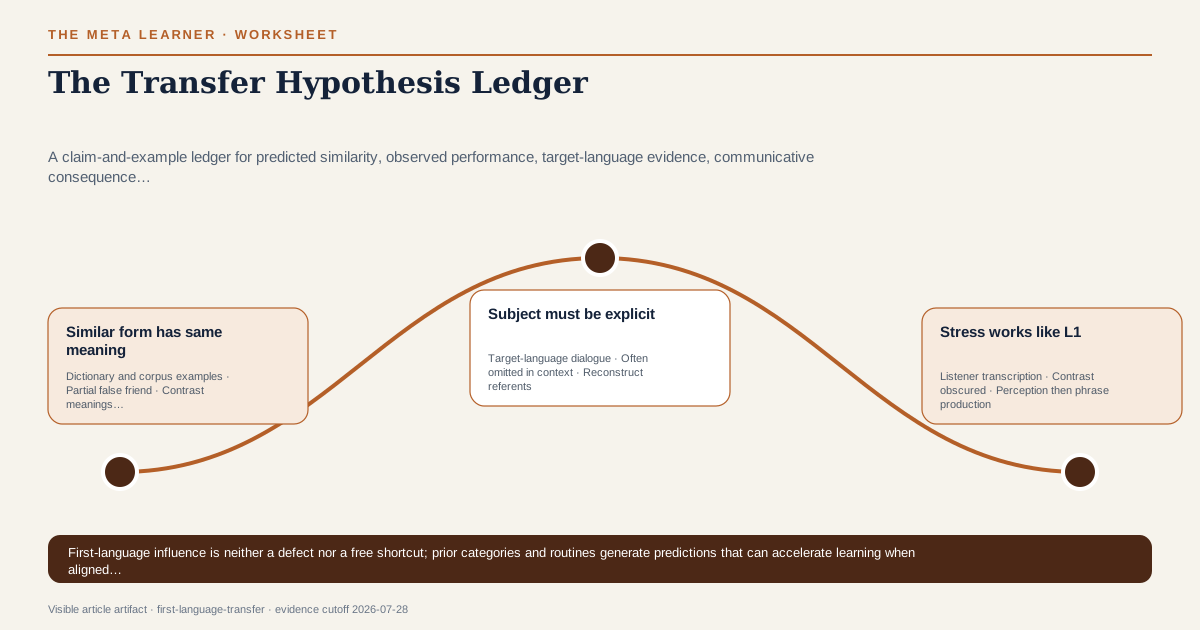
| Prediction | Evidence | Result | Next practice | |---|---|---|---| | Similar form has same meaning | Dictionary and corpus examples | Partial false friend | Contrast meanings in sentences | | Subject must be explicit | Target-language dialogue | Often omitted in context | Reconstruct referents | | Stress works like L1 | Listener transcription | Contrast obscured | Perception then phrase production |
Record an actual example, not a nationality-level stereotype.
Use contrast without translating everything
Contrastive analysis is powerful when narrow:
- Select one recurring target-language feature.
- State the first-language prediction.
- Collect trustworthy target examples and counterexamples.
- Identify the meaning or listener consequence.
- Retrieve the distinction in varied tasks.
- Retest under time pressure and after delay.
Use the ledger when planning two languages at once, keep cognitive claims calibrated through Does Bilingualism Change How You Think?, and proceduralize a form with How Grammar Becomes Automatic.
Triangulate one transfer claim
Choose a repeated production or comprehension event and collect three kinds of evidence. First, compare the learner’s intended form with the first-language pattern. Second, inspect target-language corpus examples or acoustic data in the relevant variety. Third, test a contrasting target-language item that the same transfer hypothesis predicts should behave differently. A plausible story becomes stronger only when it predicts more than the original error.
Repeat after feedback and in a changed task. If the pattern disappears with one cue but returns under time pressure, access rather than conceptual misunderstanding may be central. If it occurs only in a genre copied from first-language schooling, rhetorical transfer may matter more than grammar. Keep proficiency and the complete language repertoire visible: influence can come from a third language, and advanced learners may deliberately use multilingual features for identity or effect. No cross-linguistic claim should be generalized from a single speaker to everyone with the same first language.
For sound claims, add audio QA with matched recordings and listener transcriptions. For lexical or grammatical claims, preserve the corpus query and counterexamples so another reader can inspect the comparison.
Record beneficial transfer with the same care as interference. If a familiar rhetorical structure, cognate, or interactional strategy accelerates performance, test where that help stops; otherwise the ledger becomes a deficit catalog rather than an account of multilingual learning.
Contrastive stories that become stereotypes
- “Speakers of language X always make error Y.”
- Assuming a cognate is identical in register and use.
- Calling every learner error first-language interference.
- Treating target-language variation as incorrect.
- Comparing textbook forms rather than real genres.
- Ignoring influence from a second or third known language.
- Demanding the learner suppress a useful multilingual repertoire.
Transfer is probabilistic not destiny
Crosslinguistic influence varies across speakers and over time. Perceived similarity can matter more than a linguist's classification, and multiple known languages may compete. No general article can specify sound, grammar, or pragmatic transfer for a particular pair. Use language-specific corpora, acoustic evidence, competent speakers, and qualified teaching where needed.
The languages you know do not contaminate the next one. They provide a powerful set of hypotheses—valuable precisely because evidence can refine them.
Named sources
Evidence and further reading
Published July 29, 2026. No substantive revision has been recorded. Evidence last verified July 28, 2026.