Does Bilingualism Change How You Think? Separate Adaptation from Myth
A claim-by-claim examination of bilingual cognition, executive-control controversy, language-use context, sociolinguistic confounding, and real adaptation.
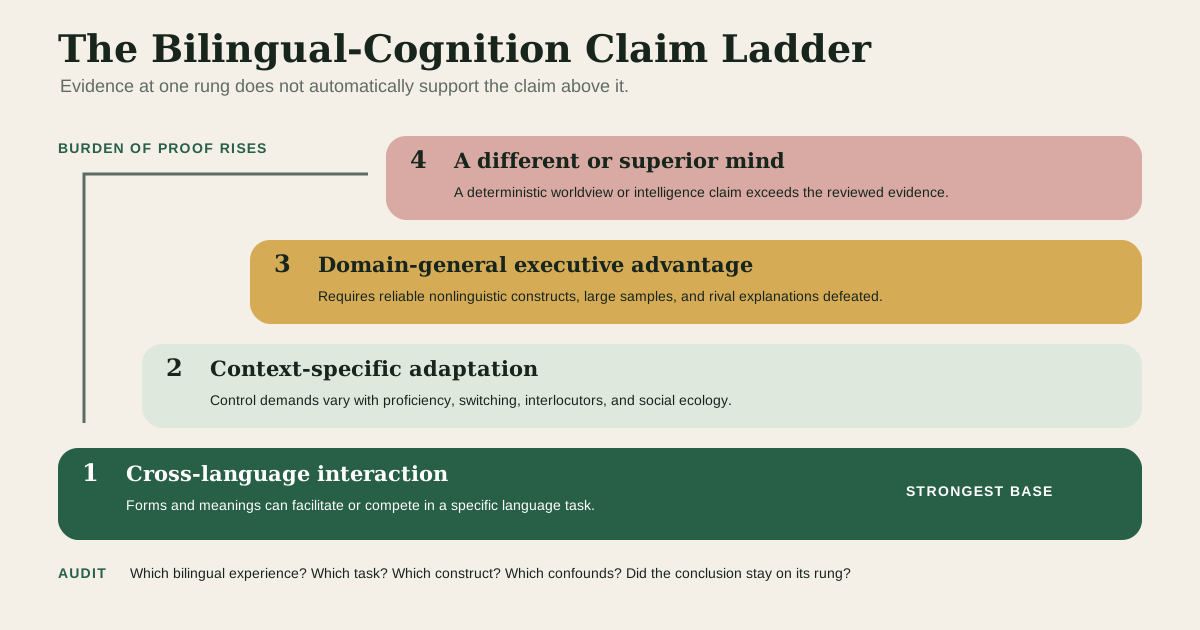
Bilingualism changes how people manage and use language, and those demands can produce adaptations shaped by proficiency, switching patterns, interactional context, and social environment. But “bilingualism makes you smarter” is too broad: adult meta-analytic evidence does not establish a universal executive-function advantage, and two languages do not mechanically create two worldviews. The strongest conclusion is conditional—bilingual experience is heterogeneous, its effects are task- and context-dependent, and language-processing adaptation should not be inflated into a general cognitive upgrade. lehtonen-meta, bilingual-adaptation, systems-framework
One question contains four different claims
“Does bilingualism change how you think?” sounds like one question. It is at least four.
- Are both languages active enough to influence word recognition and production?
- Does repeatedly managing languages adapt processes used for language control?
- Do those adaptations transfer to broad, nonlinguistic executive functions?
- Does speaking another language impose a different worldview?
Evidence for one rung does not automatically support the next. This is the central error in both romantic and dismissive accounts of bilingualism: a measured effect in one task becomes a claim about the whole mind.
Research perspectives describe bilingual language processing as plastic and sensitive to how languages are learned, regulated, and used. bilingual-adaptation Systems accounts go further, placing language use inside social status, identity, intimacy, institutional power, and cultural environment. systems-framework “Bilingual” is therefore not a standardized cognitive treatment. It names people with radically different histories.
The evidence supports cross-language interaction and heterogeneous, context-sensitive adaptation. A major adult meta-analysis and large construct-focused work do not support a simple universal executive-function advantage. The sources do not justify deterministic claims that a language fixes a worldview or that every bilingual experience has the same cognitive outcome.
Claim sources: lehtonen-meta, bilingual-adaptation, systems-framework, ef-structure
Rung one: languages interact
An English–Spanish bilingual does not necessarily close one mental dictionary before opening the other. Similar forms, meanings, and patterns can facilitate or compete depending on the task and the speaker’s history.
Consider the familiar false-friend risk around embarazada.
Variety: broadly shared contemporary Spanish usage, with final wording pending review for the target community.
Transcription: standard Spanish orthography; no phonetic transcription is needed for this semantic example.
Proficiency boundary: an early learner interpreting a common adjective, not a claim about all cognates or advanced bilingual processing.
Communicative consequence: interpreting embarazada as “embarrassed” rather than “pregnant” can radically change the understood message.
Está embarazada.
“She is pregnant.”
The example is pedagogical material checked through model-only English–Spanish review. Its lesson is not that bilinguals are confused. It is that two lexical systems can create useful facilitation and consequential competition. Expertise consists partly in managing that relationship.
Rung two: control adapts to use
The adaptive account asks what bilinguals repeatedly have to control. Someone who uses Spanish at home and English at work faces a different regulatory ecology from someone who switches between languages by interlocutor in the same meeting, or from a community where dense code-switching is ordinary and socially meaningful.
The reviewed literature argues that not all bilinguals or interactional contexts impose the same control demands. bilingual-adaptation, systems-framework This is a better hypothesis than “two languages exercise the brain” because it specifies the experience that might matter.
It also creates reversal conditions. If two groups both know two languages but use them in different contexts, a single bilingual/monolingual comparison can hide the relevant variation. If an observed effect tracks education, migration, occupation, socioeconomic conditions, or testing familiarity, language control may not be the sole explanation.
Rung three: the executive-advantage controversy
The popular claim says that managing two languages improves inhibition, switching, attention, or executive functioning in general.
The adult evidence does not support that sentence without qualification. Lehtonen and colleagues’ meta-analytic review found no systematic overall bilingual advantage after adjustment for publication bias. lehtonen-meta More recent construct-level discussion likewise notes minimal or null effects in large studies and multiple meta-analyses. ef-structure, lehtonen-meta
This does not prove that bilingual experience never matters outside language. A broad average can conceal effects concentrated in particular ages, contexts, tasks, or histories. But that possibility is a research question, not permission to repeat the universal benefit.
The burden of proof rises as the claim climbs:
| Claim | Minimum evidence needed | |---|---| | a lexical competitor affected this task | controlled language-processing evidence | | a usage context adapted language control | measures of actual language experience and the proposed process | | bilingualism improved executive function | reliable nonlinguistic constructs, adequate samples, confound control, preferably longitudinal or causal leverage | | bilingualism changes intelligence | a clear construct, broad convergent evidence, and rival explanations defeated |
“Brain differences” alone do not settle behavioral value. Adaptation can be efficient, compensatory, neutral, or costly depending on what is measured.
Rung four: language and worldview
Languages make distinctions differently. They supply habitual forms, metaphors, categories, and social conventions. Learning another language can expose a person to new communities and make previously invisible distinctions discussable.
That experiential claim is plausible and often personally true. The deterministic version—grammar imprisons thought inside a language-specific world—is much stronger. Bilingual people translate, invent, resist convention, and use multiple repertoires unevenly. Culture, institutions, identity, and biography cannot be reduced to grammar.
The appropriate question is narrower: under which tasks does a linguistic distinction guide attention or memory, how large is the effect, and does it persist when the task or language changes? Without that boundary, “language changes thought” can mean everything and therefore explain nothing.
The strongest counterposition
Even if broad executive advantages are inconsistent, bilingualism may still transform a life in ways laboratory tasks underspecify: access to family, literature, humor, work, migration, political participation, and the ability to mediate between people. These are not consolation prizes for a failed intelligence claim. They are substantive human capabilities.
The counterposition should change what we value, not lower evidential standards. One does not need to promise a cognitive upgrade to justify learning or maintaining a language. Indeed, the upgrade story can devalue bilingual people by measuring their languages only through benefits legible to monolingual institutions.
Audit a bilingual-cognition headline
When a headline claims that bilingualism changes the brain or mind, ask:
- How was bilingual experience defined and measured?
- Which cognitive construct and task produced the effect?
- Was the outcome linguistic or nonlinguistic?
- Were education, migration, socioeconomic status, culture, and publication bias addressed?
- Is the design cross-sectional, longitudinal, experimental, or correlational?
- Does the conclusion remain at the same rung as the evidence?
Then write the strongest permitted sentence. “This sample showed a smaller switching cost on this task” is less viral than “bilinguals have superior executive control,” but it is also a claim that can survive scrutiny.
How the myth survives contrary evidence
- heterogeneous bilinguals are treated as one group;
- a linguistic-control effect is promoted into general intelligence;
- neural difference is equated with behavioral improvement;
- null meta-analytic results are dismissed by inventing unmeasured subgroups;
- social and educational confounds disappear from the story;
- the ordinary value of knowing people through another language is replaced by a productivity benefit.
The opposite myth is equally crude: inconsistent general advantages do not mean bilingual experience changes nothing.
The strongest conclusion the evidence permits
Bilingualism research contains heterogeneous definitions, tasks, populations, and analytic choices. Meta-analytic averages can conceal context-specific effects, while small subgroup findings can be unstable. This article does not adjudicate clinical claims about cognitive reserve or dementia and does not infer causation from cross-sectional differences. The English–Spanish example's variety, transcription, proficiency, and consequence labels were model-reviewed; a human language specialist has not certified them.
Bilingualism changes the conditions under which language is processed and lived. That is already a profound claim. Intellectual seriousness begins by resisting the temptation to turn it into a universal medal for the mind.
Continue with How Your First Language Shapes Your Second, examine planning tradeoffs in Can You Learn Two Languages at Once?, and return to functional value in How Adults Learn a New Language.
Named sources
Evidence and further reading
- Is Bilingualism Associated with Enhanced Executive Functioning in Adults? A Meta-Analytic Review
- The Bilingual Adaptation: How Minds Accommodate Experience
- Rethinking multilingual experience through a Systems Framework of Bilingualism
- Executive function's structure in monolingual and bilingual adults using confirmatory factor analysis
Published July 29, 2026. No substantive revision has been recorded. Evidence last verified July 28, 2026.