How Adults Learn a New Language: Build a System That Survives Real Use
A rigorous adult language-learning system built around target situations, balanced practice, Mandarin transfer diagnosis, and evidence from real use.
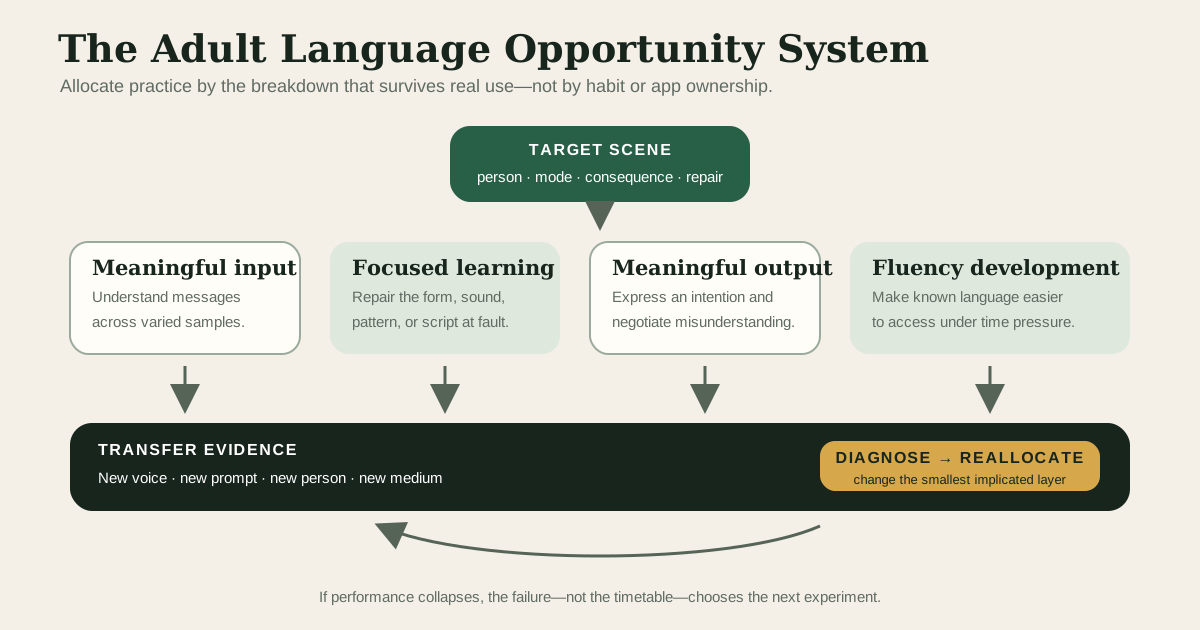
Adults learn a new language by building repeated opportunities to understand, retrieve, produce, repair, and reuse language in situations that matter to them. A strong system balances meaning-focused input, meaning-focused output, focused study, and fluency work, then reallocates effort from evidence of real performance. Adults bring concepts, literacy, and learning experience; those advantages help, but they do not remove language-pair-specific perception, script, grammar, or social demands. cefr-companion, nation-guide
The adult advantage is not a shortcut
Children and adults do not inhabit the same learning conditions. Adults arrive with a conceptual world, a first language, perhaps several additional languages, and a mature ability to plan. They can understand an explanation of aspect, look up a word family, compare two scripts, or choose materials for a professional domain. The same history also creates interference: familiar sound categories absorb unfamiliar contrasts; a known word order feels inevitable; a translation seems equivalent when its social force is not.
The useful question is therefore not whether adults are “good” or “bad” at languages. It is which parts of the task prior knowledge accelerates, which parts it distorts, and what opportunities the learner can repeatedly create.
That last word—opportunity—matters. Twenty minutes of a podcast that remains acoustically opaque is not the same opportunity as twenty minutes of understandable listening with a transcript used after an unaided first pass. A chat in which the learner only nods is not the same opportunity as one in which they must retrieve a phrase, fail, repair it, and try again.
The CEFR treats language use across reception, production, interaction, and mediation rather than collapsing ability into one score. cefr-companion Paul Nation’s practical account proposes four complementary strands: meaning-focused input, meaning-focused output, language-focused learning, and fluency development; a publisher-hosted research chapter similarly frames the strands as the architecture of a balanced course. nation-guide, nation-vocabulary, nation-best-practice These are not four boxes to tick. They are different environments in which a developing language can either become more available or remain inert.
The sources support defining language through functional modes and building a program that includes input, output, focused learning, and fluency. They do not establish one ideal weekly percentage for every learner, one causal sequence, or a guaranteed path to a named proficiency level.
Claim sources: cefr-companion, nation-guide, nation-vocabulary, nation-best-practice
Start with a scene, not a resource
“Learn Mandarin” is too large to organize a Tuesday evening. “Explain why a delivery is late to a supplier in a five-minute video call” is narrow enough to expose its demands.
Write down three scenes you want to enter within the next six months. For each, specify:
- who is present and what relationship you have;
- what you must understand without help;
- what you must say, write, or mediate;
- what would count as a recoverable mistake;
- what failure would have a real consequence.
This converts vague ambition into a provisional ability profile. A learner may need strong reading for technical specifications, modest social conversation, and enough interactional language to ask for clarification. Another may need no handwriting but must distinguish names and numbers on the telephone. Neither profile is a lesser version of an imaginary, uniform fluency.
Needs should guide selection, not imprison the learner. Nation’s guide puts needs and useful language near the beginning of the design problem. nation-guide Yet a language also exceeds our present utility. Broad reading, humor, friendship, and aesthetic curiosity create encounters that no workplace task list can foresee.
One learner, four kinds of work
Consider Elena, an English-speaking operations manager learning Beijing-oriented Standard Mandarin for supplier calls. This is a constructed case, not a report of measured human-subject results.
Variety: Putonghua / Standard Mandarin, with a Beijing-oriented instructional reference.
Transcription: Hanyu Pinyin with tone marks; Chinese characters where useful.
Proficiency boundary: early beginner, rehearsing a narrow repair sequence rather than general business fluency.
Communicative consequence: confusing a date, quantity, or request can alter the transaction; a non-native accent by itself is not failure.
Her first target is not “speak Mandarin.” It is to hear a proposed date, confirm it, and ask the speaker to repeat more slowly. The following micro-sequence received model-only review of its variety, transcription, meaning, proficiency boundary, and communicative consequence:
您可以再说一遍吗?
Nín kěyǐ zài shuō yí biàn ma?
“Could you say that once more?”
The sentence becomes useful only when four kinds of work meet.
- Meaning-focused input: Elena listens to several short, comprehensible scheduling exchanges and tries to identify the proposed date before viewing the transcript.
- Meaning-focused output: she responds with a confirmation or repair request whose message matters inside the role-play.
- Language-focused learning: she deliberately studies a small set of date expressions, the polite pronoun nín, and the sound or tone distinctions that actually caused misunderstanding.
- Fluency development: she repeats already-understood scheduling tasks with changing dates until known language becomes easier to retrieve.
The vocabulary is embedded in a wider program of language, skills, ideas, and discourse; a deck alone cannot supply that program. nation-vocabulary
After two weeks, Elena succeeds with the instructor’s recordings but misses the date when a new speaker talks at an ordinary pace. That result is not discouraging noise. It locates the system’s next design problem: the language is available under familiar acoustic conditions but not yet across voices.
The bottleneck should move the timetable
Many study plans allocate by loyalty: an hour for the app because the subscription exists, a grammar chapter because it comes next, a podcast because serious learners listen to podcasts. A diagnostic system allocates by the strongest current explanation of failure.
Use five possible bottlenecks:
| Breakdown | Evidence to collect | Next experiment | |---|---|---| | The message is mostly incomprehensible | unaided gist across short level-appropriate samples | make input more comprehensible without making it identical | | A known form cannot be retrieved | delayed, uncued production from meaning | retrieve the phrase across days and changing scenes | | A sound or boundary is misheard | forced choice across new natural voices | train that contrast in phrases, then retest | | The sentence is accurate but interaction stalls | recordings of turns and repair | rehearse clarification, turn entry, and recovery | | Practice succeeds but real use collapses | target task with a new person or channel | narrow the transfer gap and fade support gradually |
The table is a set of rival explanations, not a personality test. More input will not repair every retrieval problem; more flashcards will not create turn-taking; pronunciation work will not solve missing domain knowledge.
Build a two-week opportunity system
Choose one scene and run a short cycle:
- Record a baseline attempt without notes.
- Collect six to ten input samples that resemble the scene but are not identical.
- Select a small body of high-utility language from those samples.
- Retrieve it from meaning, not merely by recognizing it.
- Complete three output tasks with changing details.
- Obtain focused feedback on the error that most changes understanding.
- Repeat the task with a new voice, prompt, partner, or medium.
- Reallocate the next cycle from the observed failure.
Keep artifacts: the first recording, the chosen input, a brief error ledger, one later performance, and the transfer attempt. The purpose is not surveillance. It is to stop confidence, frustration, and app completion from becoming the only evidence available.
The strongest counterargument to The Adult Language Opportunity System
A structured system can become managerial theater. Learners may spend so long designing dashboards, coding errors, and optimizing schedules that they avoid the disorderly experience of reading, listening, and talking. They may also turn every conversation into an assessment and lose the human reason for learning.
That objection is correct whenever the system produces more administration than contact. The remedy is not a more elaborate tracker. It is a severe constraint: the plan should fit on one page, and the evidence should come from language use that would be worth doing even if no metric existed.
There is also no requirement that all four strands receive equal time every week. A temporary pronunciation bottleneck may justify concentrated work. An advanced reader entering a new field may need sustained input. Balance is a portfolio property across an appropriate period, not a ritual division of every session.
When the system is busy but inert
Watch for these signals:
- materials change every week, so nothing becomes fluent;
- recognition scores rise, but unaided retrieval does not;
- all listening uses one teacher or synthetic voice;
- correction accumulates faster than it can be retested;
- the learner can perform a script but cannot repair a deviation;
- the plan counts minutes while ignoring what those minutes allowed the learner to do.
When a signal appears, do not rebuild everything. Change the smallest layer implicated by the evidence and preserve the rest long enough to learn from the change.
What this system cannot promise
This article offers a design logic, not a universal acquisition law or a guaranteed timeline. Outcomes vary with prior languages, literacy, age, health, disability, identity, discrimination, access to speakers, instructional quality, and the distance between practice and desired use. The Mandarin example was checked by a model for variety labels, transcription, gloss, proficiency boundary, and communicative consequence; it has not been validated by a human Mandarin specialist. Clinical hearing or speech needs require appropriate professional assessment.
A mature learning system does not make difficulty disappear. It makes difficulty legible. It tells the learner whether the next hour should create more understanding, more retrieval, more interaction, more precision, or more independence—and it demands that improvement eventually survive outside the exercise.
Continue with Vocabulary That Sticks for productive lexical access, How to Improve Listening and Pronunciation for spoken-language diagnosis, and How Long Does It Take to Learn a Language? for scenario-based planning.
Named sources
Evidence and further reading
Published July 29, 2026. Substantively updated July 29, 2026. Evidence last verified July 28, 2026.
- : Reconstructed the argument, claim-level evidence, multilingual case, original asset, and prose for the seven-gap editorial program.