How Long Does It Take to Learn a Language? Replace the Deadline with Scenarios
Estimate language-learning time through target performances, starting conditions, opportunity quality, uncertainty ranges, and repeated real-world evidence.
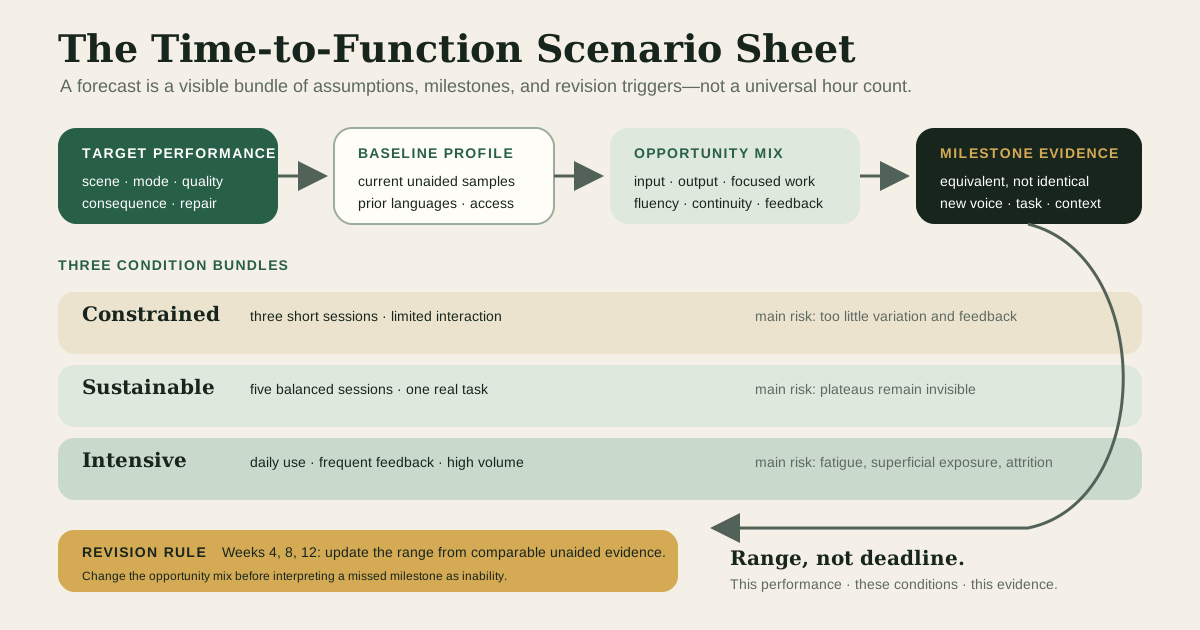
There is no responsible universal number of hours required to learn a language. Define the performances you want, measure your starting profile, describe the quality and composition of weekly practice, and build constrained, sustainable, and intensive scenarios. Then revise the range from comparable, unaided performance samples. Proficiency frameworks can clarify the destination, but they are not clocks; a scenario estimates time to a specified function under stated conditions, not time to an undefined state called fluency. cefr-companion, nation-guide nation-guide
Every precise answer hides a definition
Ask how long it takes to learn Mandarin and the internet will return numbers with reassuring edges. Those numbers appear comparable because the word language is doing too much work.
Does success mean recognizing signs on a trip, conducting a supplier call, following university lectures, reading modern fiction, mediating between colleagues, or writing an argument that survives professional scrutiny? Must performance be rehearsed or spontaneous? With familiar speakers or anyone? Under quiet conditions or on a telephone? At what cost of error?
Until those questions are answered, an hour estimate is not yet wrong. It is uninterpretable.
The CEFR presents language ability across reception, production, interaction, and mediation and supports profiles that need not be uniform. cefr-companion The framework offers no universal conversion from study time to level. It helps clarify what a learner may be able to do; it does not supply a stopwatch.
The sources support functional, multidimensional targets and a program containing several kinds of learning opportunity. The scenario model below is an original planning device, not a validated psychometric forecast or a universal hours-to-proficiency formula.
Claim sources: cefr-companion, nation-guide, nation-best-practice
Replace “language” with a performance portfolio
Write three target performances. Each needs a scene, mode, interlocutor, quality threshold, and repair condition.
A weak target:
Speak business Mandarin.
A more useful draft:
In a scheduled video call with a familiar supplier, explain a two-day delay, understand the proposed alternative date, ask one clarification question, and confirm the next action without a prepared script.
A draft test utterance is 交货要晚两天。我们可以改到星期五吗? (Jiāohuò yào wǎn liǎng tiān. Wǒmen kěyǐ gǎi dào Xīngqīwǔ ma?; “Delivery will be two days late. Can we move it to Friday?”). It is included to make the target observable and has received model-only review for wording, register, pronunciation notation, and supplier-context fit.
Variety: Putonghua / Standard Mandarin for this planning case.
Transcription: Hanyu Pinyin with tone marks for early learning notes, alongside simplified Chinese characters where the work requires them.
Proficiency boundary: a narrow, rehearsed-to-semi-spontaneous operational task; not general professional proficiency.
Communicative consequence: misunderstanding a date or quantity can change a delivery decision, so successful repair matters more than accent imitation.
No human Mandarin specialist has certified this example. Its purpose is to demonstrate target construction, not to prescribe wording.
Now build a profile around the target:
- listening to dates and proposals;
- spoken explanation and repair;
- reading short follow-up messages;
- writing a confirmation;
- mediating the decision for an English-speaking colleague.
A learner may progress rapidly in the repeated call while remaining unable to read a news article. That is not a contradiction. It is the shape of the chosen portfolio.
Four variables that make an hour non-equivalent
Starting repertoire
Prior languages, literacy, familiarity with the script, domain knowledge, and current performance change the starting point. “Beginner” can describe someone who has heard Mandarin at home for years and someone encountering lexical tone and Chinese characters for the first time.
Opportunity composition
Nation’s practical framework distinguishes meaning-focused input, meaning-focused output, language-focused learning, and fluency development; a publisher-hosted research chapter also frames the four strands as a balanced course architecture. nation-guide, nation-best-practice An hour containing understandable messages, retrieval, feedback, and reuse creates a different set of opportunities from an hour of distracted exposure. This does not mean every hour should be divided into equal quarters; it means totals should not hide their contents.
Transfer friction
Shared vocabulary, scripts, discourse conventions, and prior strategies may accelerate some tasks. New sound categories, morphology, writing systems, or social conventions may slow others. “Language difficulty” is not one permanent property; it is a relationship among the learner, the target, and the conditions.
Continuity and access
Work schedules, health, money, disability, discrimination, interaction partners, and material quality shape whether a plan can be sustained. A nominally intensive course that collapses after three weeks may produce less calendar progress than a modest system embedded in everyday life.
Three scenarios, no invented equation
Create scenarios as explicit bundles of conditions:
| Scenario | Weekly opportunity | Main assumption | Main risk | |---|---|---|---| | Constrained | three short sessions, limited interaction | continuity survives a difficult schedule | too little varied input and feedback | | Sustainable | five balanced sessions plus one real task | the plan can continue for months | plateaus remain unnoticed | | Intensive | daily use, frequent feedback, high volume | recovery and quality remain adequate | fatigue, superficial exposure, attrition |
Do not assign a fake numerical “capability gap.” Instead, decompose the destination into milestones: understand the date; request repetition; explain the delay; handle one unexpected alternative; produce a written confirmation.
Estimate a broad calendar range for each scenario. Record why the range might move. The range is valuable precisely because it exposes uncertainty instead of laundering it into one deadline.
Build three scenarios, then earn a forecast
The first twelve weeks should calibrate the model, not prove commitment.
- Record two unaided baseline tasks that resemble the target.
- Run the sustainable scenario long enough to reveal actual weekly continuity.
- Keep a light opportunity ledger: understandable input, independent retrieval, negotiated interaction, focused study, and fluent reuse.
- Repeat equivalent—not identical—tasks at weeks four, eight, and twelve.
- Compare independence, comprehensibility, range, accuracy where consequential, and ability to repair.
- Revise the scenario from the pattern, not from the best or worst day.
Suppose listening accuracy for familiar dates improves, but the learner cannot repair a new proposal from an unfamiliar speaker. The timeline should not simply expand. The opportunity system should change: more varied voices, more clarification sequences, and a transfer test that preserves the consequence.
Only after comparable samples exist does the learner possess an individual rate estimate—and even then, it applies to the current milestone under the current conditions.
The strongest defense of hour estimates
Institutions, learners, and employers must budget. They cannot respond to every planning question with philosophical uncertainty. Course hours, historical cohorts, and proficiency categories can provide useful reference classes.
That argument is right. The mistake is not using a reference class; it is hiding its membership rules. An institutional estimate becomes informative when it names the learners, starting levels, attendance, instructional setting, target assessment, language pair, and outcome distribution. It becomes misleading when a schedule for one population is sold as a biological constant.
Use external hours as an initial prior, if the source is transparent and comparable. Then let the twelve-week evidence update it. The reversal condition is practical: if your target, background, and opportunity structure closely match a well-documented cohort, its range deserves more weight. If they do not, specificity in the number cannot compensate for distance in the comparison.
When timeline arithmetic becomes theater
- “Fluency” remains undefined.
- One level hides radically different listening, reading, and interaction profiles.
- logged exposure is treated as effective practice.
- a rehearsed script is counted as spontaneous proficiency.
- one exceptional week determines the annual forecast.
- the estimate ignores access, interruption, and attrition.
- a missed milestone is read as personal failure rather than evidence about assumptions.
An honest plan makes revision normal. A deadline that cannot survive new evidence is a sales promise, not a model.
A scenario is not a promise
Individual variation is substantial, and proficiency frameworks are descriptive rather than predictive clocks. Practice quality is difficult to quantify, self-reported hours can be unreliable, and progress may change across phases. The Mandarin planning example completed model review for variety, transcription, proficiency fit, and communicative consequence, without human-specialist validation. These scenarios cannot guarantee a test result, native-like attainment, occupational success, or equal access to the social conditions in which language develops.
The point of a timeline is not to domesticate uncertainty. It is to make a promise answerable to evidence: this performance, from this starting point, under these conditions, with these milestones, revised when reality disagrees.
Use CEFR Levels Explained to describe a functional profile, How Adults Learn a New Language to design the weekly opportunity system, and Language-Learning Plateaus to interpret changes in rate.
Named sources
Evidence and further reading
Published July 29, 2026. No substantive revision has been recorded. Evidence last verified July 28, 2026.