CEFR Levels Explained: Use A1–C2 as Coordinates, Not Identities
Understand what CEFR A1–C2 descriptors mean, why real profiles are uneven, how to build a Spanish can-do card, and what a level cannot diagnose.
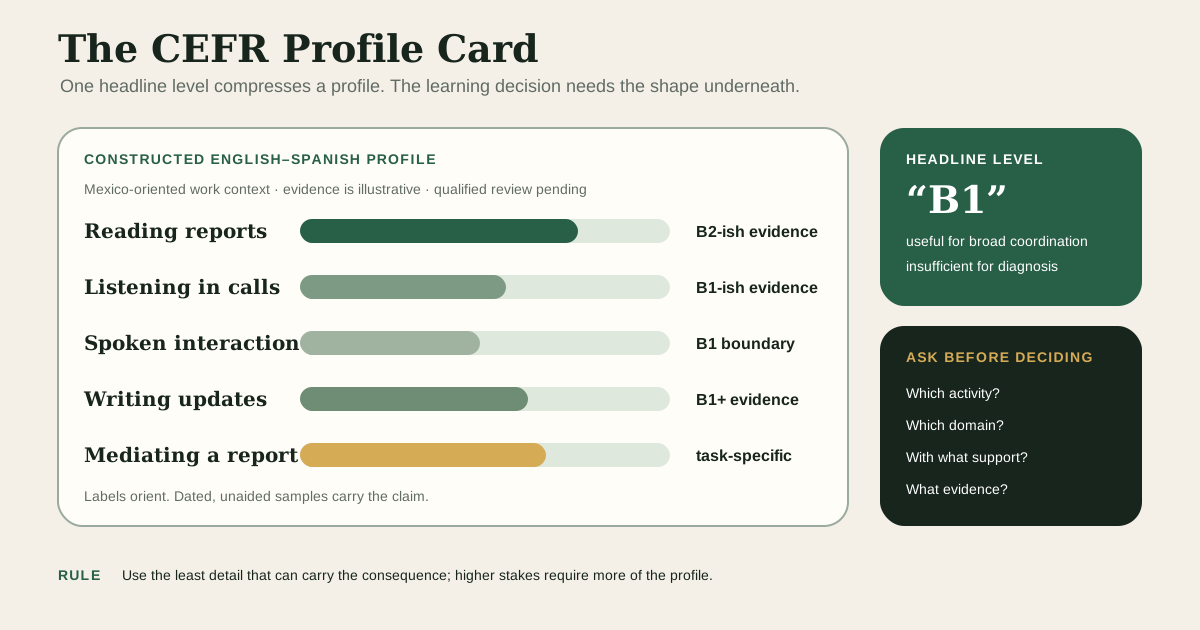
CEFR levels A1–C2 summarize what a language user can do across sets of illustrative descriptors, but the headline level is only a coordinate. Real ability is uneven across listening, reading, spoken and written production, interaction, mediation, domains, and conditions. Use the CEFR to build an evidence-backed profile and choose next performances; do not treat a level as a personality, a universal vocabulary count, a study-hour conversion, or an automatic equivalence to another framework. cefr-companion
A six-step ladder is too simple for a life in language
A1, A2, B1, B2, C1, C2: the sequence invites a seductive picture. The learner climbs. Each rung contains a stable quantity of “language.” At the top, knowledge is complete.
The CEFR itself is more interesting than that picture.
Its common reference levels are expressed through structured sets of illustrative can-do descriptors across communicative activities, strategies, and competences. cefr-companion The Companion Volume discusses profiles that can be uneven and partial: a person may read far beyond their spontaneous speaking, mediate specialist information they understand well, or interact effectively in familiar work while struggling in an unfamiliar social domain. cefr-companion
The headline level compresses this shape. Compression is useful when people need a shared point of reference. It becomes destructive when the compressed label is mistaken for the underlying person.
The sources support descriptor-based levels, uneven profiles, an action-oriented view of language, and extended mediation scales developed through a documented validation process. They do not validate every local exam, self-rating, app score, or direct conversion from CEFR to another framework.
Claim sources: cefr-companion, cefr-validation
What changes from A to C
The levels do not simply count grammar points. Across many scales, progression involves changes such as the range and complexity of texts or tasks a person can handle, how independently they can act, how precisely they can formulate meaning, and how effectively they can adapt, interact, or mediate.
A useful shorthand is:
- A levels: participation remains bounded by familiar needs, simple language, and substantial support.
- B levels: the user gains growing independence across recurring social, educational, or professional situations.
- C levels: the user can handle demanding language with greater flexibility, precision, nuance, and strategic control.
This paraphrase is orientation, not a substitute for the actual scale relevant to a task. “B2” in overall reading does not automatically mean B2 spoken interaction. “C1” in a familiar professional domain does not imply equal ease with literature, humor, accent variation, or every institutional genre.
A Spanish learner whose level depends on the question
Consider Maya, an English-speaking analyst learning Mexico-oriented Spanish. This is a constructed profile, not an assessment result.
Variety: educated Mexico City Spanish as a practical reference, while acknowledging broader Mexican and international variation.
Transcription: standard Spanish orthography; IPA only when a sound question requires it.
Proficiency boundary: an independently functioning intermediate learner in familiar work, not a global B-level certification claim.
Communicative consequence: she must understand a project update, clarify uncertainty, and relay the decision accurately; grammatical elegance is secondary to faithful mediation.
Her target scene includes:
Según el informe, el plazo cambió.
“According to the report, the deadline changed.”
¿Quieres decir que la entrega será el viernes?
“Do you mean the delivery will be on Friday?”
The examples completed model review for variety, register, transcription, proficiency fit, and communicative consequence; they have not been human-specialist validated.
Maya’s evidence may look like this:
| Activity | Current evidence | Boundary | |---|---|---| | Reading | follows familiar reports and identifies reasons | slows sharply in legal or unfamiliar technical prose | | Listening | follows a known colleague in a quiet call | misses reduced speech across overlapping turns | | Spoken interaction | clarifies dates and responsibilities | loses precision when challenged unexpectedly | | Written production | writes concise operational updates | needs review for tone in sensitive messages | | Mediation | relays a short report into English | may omit uncertainty when the source is dense |
Which level is she? The responsible answer depends on why someone is asking. A course placement may need a local decision. A learning plan needs the profile. A high-stakes credential needs a validated assessment with transparent claims.
Mediation changes the picture
Older popular accounts of the CEFR often reduce language to receiving and producing. The Companion Volume gives mediation a larger place: relaying information, explaining data, processing text, collaborating to construct meaning, and facilitating communication. cefr-companion The mediation descriptors were not invented as a casual checklist; the development report documents construct work, consultation, piloting, and validation. cefr-validation, cefr-companion
For Maya, the decisive work skill may not be speaking at length. It may be reading a Spanish update, preserving the author’s uncertainty, and explaining it in English to a colleague who cannot access the source. A general oral score can miss that contribution.
This does not mean “mediation” blesses any summary or translation. A descriptor names a capability to examine. The local task still needs standards for fidelity, consequence, audience, and evidence.
Build a profile card from evidence
- Name three scenes in which language matters.
- Select only the CEFR scales relevant to those scenes.
- Collect one unaided sample for each important activity.
- Match evidence to descriptors cautiously; record uncertainty and conditions.
- Mark the profile’s strongest edge and most consequential weak edge.
- Choose a next task that changes one variable while preserving the purpose.
The card should include dates and samples, not merely self-ratings. It should also distinguish performance under rehearsed conditions from independent ability across changed conditions.
A conversion chart may be administratively convenient, but the CEFR itself does not validate an automatic equivalence between its descriptors and another framework’s scores. cefr-companion Any claimed conversion needs evidence for the specific assessments and populations involved.
The strongest defense of one level
Institutions cannot operate on a portrait of infinite nuance. Employers, universities, teachers, and learners need shared categories. A headline level lowers coordination cost and makes broad expectations discussable.
That defense is valid. The reversal condition is whether the decision truly requires more detail. “Approximately B1” may be enough to select among broad class bands. It is not enough to decide whether someone can safely mediate a medical instruction, teach a seminar, negotiate a contract, or understand a rapidly changing operational call.
Use the least detail that can carry the consequence. The greater the consequence, the less acceptable it is to let one label hide modality, domain, support, and evidence.
Four abuses of a level label
- Identity: “I am B2” becomes a verdict on intelligence or belonging.
- Clock: a descriptor is converted into a guaranteed number of hours.
- Diagnosis: a broad score is expected to explain whether the bottleneck is lexical, acoustic, interactional, or contextual.
- Concordance: labels from different frameworks are declared equivalent without validation.
The CEFR is strongest when it improves the question. It is weakest when it ends inquiry.
What A1–C2 cannot settle
The CEFR is a reference framework, not one test, one curriculum, or a causal theory of acquisition. Local assessments and self-ratings can vary in validity. Descriptors cannot by themselves predict study time, occupational success, cultural knowledge, identity, or performance in every domain. The Spanish examples and constructed profile received model-only language review, not certification for assessment use. Formal placement and credential decisions should use the relevant authorized assessment and its documented interpretation.
A level should open into a profile: what this person can do, with whom, through which mode, under what conditions, and with what evidence. Once those questions are visible, A1–C2 becomes a coordinate system for action rather than a hierarchy of human worth.
Use How Long Does It Take to Learn a Language? to keep descriptors separate from clocks, Language-Learning Plateaus to interpret uneven change, and How Adults Learn a New Language to build the practice system behind the profile.
Named sources
Evidence and further reading
Published July 29, 2026. No substantive revision has been recorded. Evidence last verified July 28, 2026.