Language-Learning Plateaus: Why Progress Stalls and What the Evidence Suggests
Distinguish measurement ceilings, stable routines, narrow input, avoidance, weak feedback, and persistent interlanguage before redesigning practice.
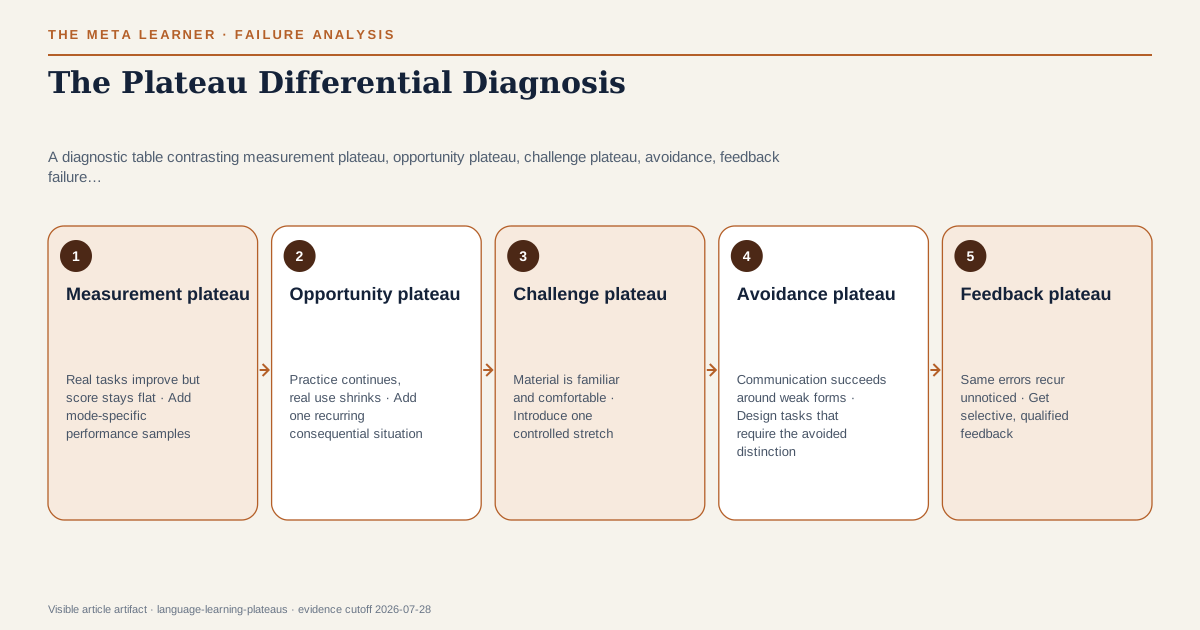
A language plateau can mean progress is harder to see, the current routine no longer challenges the target skill, feedback is missing, real use has narrowed, or a feature has become stable in the learner's developing system. Collect comparable performance evidence, locate the bottleneck, and change one condition at a time before declaring permanent fossilization.
A flat feeling can hide several different curves
Early learning produces visible wins: first sentences, first conversation, first page understood. Later gains are smaller, domain-specific, and harder to notice. Understanding a wider range of accents or choosing a more appropriate register may not move an app score.
Research on fossilization asks why aspects of adult second-language development can become persistently non-target-like despite motivation and exposure. fossil, dynamic, cefr Dynamic-systems accounts emphasize variability, interaction among subsystems, and nonlinear development. dynamic
A few frustrating months are not enough to diagnose an irreversible ceiling.
The differential diagnosis
| Pattern | Evidence | Experiment | |---|---|---| | Measurement plateau | Real tasks improve but score stays flat | Add mode-specific performance samples | | Opportunity plateau | Practice continues, real use shrinks | Add one recurring consequential situation | | Challenge plateau | Material is familiar and comfortable | Introduce one controlled stretch | | Avoidance plateau | Communication succeeds around weak forms | Design tasks that require the avoided distinction | | Feedback plateau | Same errors recur unnoticed | Get selective, qualified feedback | | Load plateau | Life reduces attention and continuity | Shrink scope and protect frequency | | Persistent interlanguage | Feature remains stable across contexts | Run targeted perception, form, feedback, and transfer cycle |
Several patterns can coexist. Start with the cheapest discriminating test.
A model-reviewed English–Arabic plateau probe
An intermediate learner can disagree only with لا أوافق (lā uwāfiq, “I do not agree”). A narrower transfer task adds أتفهّم وجهة نظرك، لكن… (atafahhamu wijhata naẓarika, lākin…, “I understand your point of view, but…,” addressing one man), then varies the addressee, relationship, and stakes. The test asks whether pragmatic range expands on an unseen prompt; it does not treat one phrase as proof that a plateau has ended.
Variety: contemporary Modern Standard Arabic in a formal discussion
register; a spoken community would require a variety-specific alternative.
Transcription: Arabic script plus broad IJMES-style romanization for this
review draft.
Proficiency boundary: intermediate disagreement and qualification in a
narrow formal task.
Communicative consequence: relying on one blunt formula may preserve the
proposition while mismanaging stance, whereas the expanded frame can signal
acknowledgment before disagreement.
Evidence inside the case boundary: the Plateau Differential Diagnosis
SLA research recognizes persistent non-target-like development and nonlinear change. CEFR's multidimensional descriptors make hidden profile shifts visible. Evidence does not support a universal “intermediate plateau” at one time or level, and permanent fossilization is difficult to establish from self-observation.
fossil, dynamic, cefrMeasure the edge, not the comfort zone
If you repeatedly test familiar daily conversation, performance may look stable because the task is mastered. Probe the next edge:
- unfamiliar but relevant topic;
- faster or less familiar speaker;
- longer connected writing;
- mediation for a new audience;
- finer lexical or pragmatic distinction;
- interaction under mild time pressure.
Do not make every dimension harder at once. The result should diagnose, not merely overwhelm.
Break successful avoidance
Intermediate speakers can communicate effectively by using familiar words, simple structures, and repair. That is genuine competence. It can also let a difficult form or genre remain unnecessary.
Create tasks where the target distinction carries meaning. If past-time narration stays vague, compare events whose order matters. If disagreement remains indirect, practise several stakes and relationships. Feedback now has a communicative reason.
Change the evidence loop
A plateau may persist because the learner consumes material, notices difficulty, and returns to the same activity without a feedback cycle. Use:
performance → specific failure → hypothesis → targeted practice → changed task → delayed retest
Keep the original samples. Memory tends to make earlier performance look better than it was.
Run a four-week plateau investigation
- Select one mode and real-world target.
- Collect three comparable baseline samples.
- Classify the likely plateau pattern.
- Choose one intervention with a predicted result.
- Keep other major conditions stable.
- Collect weekly transfer samples.
- Compare with a qualified reviewer or explicit rubric.
- Continue, revise, or reject the hypothesis.
Verify the profile through CEFR Levels Explained, introduce a targeted loop with Corrective Feedback, and update expectations through the Language Timeline Scenario Model.
Use a stop–continue–change decision table
At the end of the investigation, classify the evidence rather than rewarding effort:
| Pattern | Decision | |---|---| | Target performance improves on new tasks | Continue long enough to confirm | | Practice score rises but transfer is flat | Change the task or remove support | | One mode improves while another is flat | Reallocate by profile, not global level | | No measure changes and opportunity is low | Change the environment or pause | | Feedback reveals a stable high-impact form | Run a narrower language-specific cycle |
Interpret the table within proficiency and language-pair boundaries. An advanced learner refining pragmatic register may show smaller, slower changes than a beginner acquiring frequent forms. A new script, limited community access, or first-language transfer can create a local bottleneck without implying a global ceiling. Verify pronunciation conclusions with audio QA and more than one listener; verify lexical or grammatical claims with an appropriate corpus or qualified teacher. The framework cannot establish permanent fossilization, but it can make the next allocation of attention evidence-based.
Keep one stable comparison task across the four weeks as well as the new transfer samples. Without a common anchor, a harder task can make genuine improvement look flat; with only the anchor, familiarity can make a flat capability look improved. The two views constrain each other.
Plateau advice that skips diagnosis
- “Immerse more” without naming the missing performance.
- Starting a new app because the current one feels familiar.
- Increasing difficulty across vocabulary, speed, topic, and accent at once.
- Treating comfortable communication as no progress.
- Correcting every error instead of one persistent pattern.
- Calling a temporary flat score fossilization.
- Comparing an uneven profile with somebody else's strongest mode.
Fossilization is not a self-diagnosis
Researchers debate definitions, causes, and evidence for fossilization, and persistent features differ by linguistic domain and learner. Progress can be constrained by opportunity, discrimination, disability, health, or life conditions rather than practice design. This framework cannot promise continued improvement or identify a biological limit.
A plateau becomes useful when it stops being a verdict and becomes a question: which evidence is flat, which condition is stable, and what change would prove the diagnosis wrong?
Named sources
Evidence and further reading
Published July 29, 2026. No substantive revision has been recorded. Evidence last verified July 28, 2026.