Can You Learn Two Languages at Once? Interference, Transfer, and Time Constraints
Decide whether to study two languages concurrently by testing goals, weekly opportunity, maintenance load, cross-language transfer, and confusion risks.
Adults can learn two languages at once, but each language needs enough meaningful input, retrieval, interaction, feedback, and real use to progress. Expect shared time to slow one or both timelines unless opportunities overlap. Separate contexts where confusion matters, exploit transfer carefully, and consider making one language primary and the other maintenance-only.
The constraint is usually opportunity not brain capacity
Many people live multilingual lives, and research on third-language acquisition shows that previously learned languages can influence additional learning. cenoz, adult, cefr Adult multilingualism research emphasizes diverse histories and practices rather than treating the mind as two sealed language compartments. adult
The practical question is not whether the brain can contain two languages. It is whether your week can sustain two learning systems with enough continuity and feedback.
Four viable configurations
Two equal beginners
This maximizes novelty and coordination cost. Choose it only when both goals are genuine and time is abundant.
Primary plus exploratory
Most effective hours go to an urgent language; the second receives light, curiosity-driven exposure without a promised timeline.
Growth plus maintenance
One language advances while an established language receives enough reading, listening, or interaction to remain available.
Domain separation
Each language has a different life: one for family, another for work; one for reading, another for conversation. Distinct cues can create real opportunity, though profiles will be uneven.
Unevenness is not failure. CEFR treats plurilingual competence as dynamic and potentially uneven. cefr
A model-reviewed English–Arabic planning case
An English-dominant professional gives Arabic one protected domain: scheduling with an Arabic-speaking partner. The target sentence is أحتاج إلى إعادة جدولة الاجتماع (aḥtāju ilā iʿādat jadwalat al-ijtimāʿ, “I need to reschedule the meeting”). A second target language is restricted to recreational reading during the six-week trial. The Arabic example makes opportunity allocation concrete; it has model review but no human-specialist certification.
Variety: contemporary written Modern Standard Arabic as the proposed
cross-regional reference; spoken realization must be chosen for the actual
community.
Transcription: Arabic script plus broad IJMES-style romanization.
Proficiency boundary: beginner-to-intermediate scheduling in a narrow
professional context, not general conversational proficiency.
Communicative consequence: a stable real-world use creates retrieval and
feedback opportunities; confusing the date, meeting, or action can change an
operational commitment.
The feasibility matrix
Score each language:
| Variable | Language A | Language B | |---|---|---| | Consequence and urgency | | | | Current proficiency | | | | Sustainable weekly hours | | | | Access to people and media | | | | Need for maintenance | | | | Transfer from known languages | | | | Cost of confusion | | | | Twelve-week target task | | |
If both are urgent, beginner-level, opportunity-poor, and high-consequence, parallel study may be a bad allocation—not because it is cognitively impossible, but because neither system receives enough evidence-producing use.
Interference is informative
Similar languages can share cognates, grammar, and learning resources, while also increasing competition between close forms. Distant languages may confuse less lexically but require separate scripts, sound categories, or structures.
Keep an interference ledger:
- intended meaning;
- form produced;
- source language suspected;
- target-language evidence;
- repair used later.
Do not treat every borrowed form as a catastrophe. Cross-language activation is part of multilingual use. Focus on errors that recur or change meaning.
Why the evidence supports the Two-Language Feasibility Matrix
Research supports crosslinguistic influence and the legitimacy of uneven plurilingual repertoires. It does not provide a strong universal estimate of how simultaneous self-directed study affects adult time to proficiency. The decision model therefore rests partly on transparent resource-allocation reasoning.
cenoz, adult, cefrProtect contextual separation
Use distinct:
- people or communities;
- recurring situations;
- notebooks or interfaces;
- source voices and varieties;
- weekly performance tasks.
Separation is a retrieval cue, not a ban on comparison. Explicitly comparing a cognate or grammar pattern can improve learning when the relationship is verified.
Run a six-week two-language trial
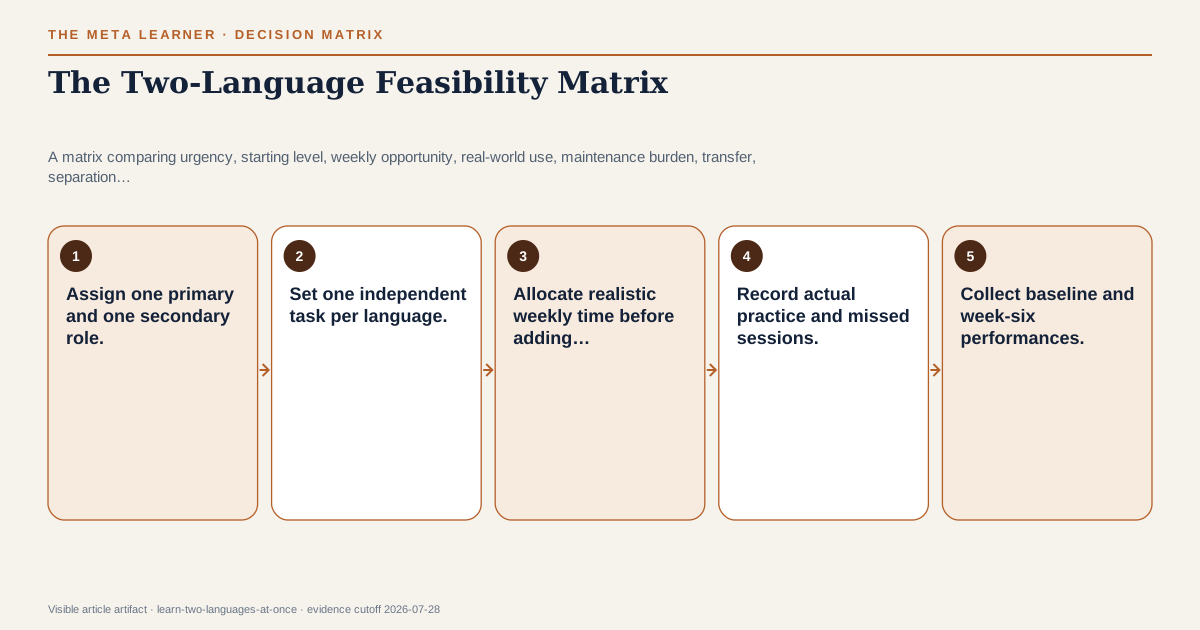
- Assign one primary and one secondary role.
- Set one independent task per language.
- Allocate realistic weekly time before adding resources.
- Record actual practice and missed sessions.
- Collect baseline and week-six performances.
- Log beneficial transfer and harmful confusion.
- Continue, rebalance, sequence, or pause from the evidence.
Interpret influence through How Your First Language Helps—and Interferes, avoid inflated cognitive claims with Does Bilingualism Change How You Think?, and update the calendar using the Scenario Model.
Test opportunity cost with asymmetric evidence
The second language is not free simply because sessions fit on a calendar. Before the trial, write what the same time would buy in the primary language: more interaction, a difficult writing system, pronunciation feedback, or progress toward a near-term credential. At week six, compare both language samples with this counterfactual, not only with the starting point.
Keep the trial asymmetric on purpose. Give each language a distinct job, proficiency target, context, and minimum viable week. A beginner in one and an advanced learner in the other should not share identical metrics. Log cross-linguistic help and interference using actual forms, and verify examples with language-specific dictionaries, corpora, audio, or competent speakers. Closely related language pairs may need stronger contextual separation; distant pairs may compete through time rather than similar words. Continuing both is justified when each produces meaningful independent performance without repeatedly displacing the more important commitment.
Include a pause rule before starting: if either minimum week fails twice or the primary real-world task deteriorates, sequence the languages instead of treating overload as a character test.
At the decision point, count switching overhead and resource maintenance as part of the portfolio. Time spent reorganizing two decks, locating two communities, or repeatedly deciding what to study is not neutral. A simpler one-language system may produce more meaningful use even when nominal study minutes are equal.
Symmetry that makes both languages fragile
- Giving both identical goals despite different needs.
- Starting two large flashcard queues.
- Measuring attention by app streaks.
- Switching resources whenever one language becomes difficult.
- Avoiding all comparison between languages.
- Assuming similar languages are either pure advantage or pure interference.
- Refusing to pause one language when life removes the opportunity.
Research cannot answer your schedule for you
Direct evidence on adults independently beginning two foreign languages at once is sparse and heterogeneous. Findings from bilingual children, institutional programs, or third-language learners do not determine an individual's outcome. Language pair, proficiency, literacy, age, disability, identity, and real-world opportunity all alter the decision.
Two languages at once is not a test of talent. It is a portfolio decision: which capabilities deserve scarce time, and what evidence will justify continuing each investment?
Named sources
Evidence and further reading
Published July 29, 2026. No substantive revision has been recorded. Evidence last verified July 28, 2026.