Comprehensible Input: Understanding Is the Gate, Not the Whole Journey
Learn what comprehensible input contributes, why understood messages do not automatically become usable language, and how to run an input-to-use Spanish cycle.
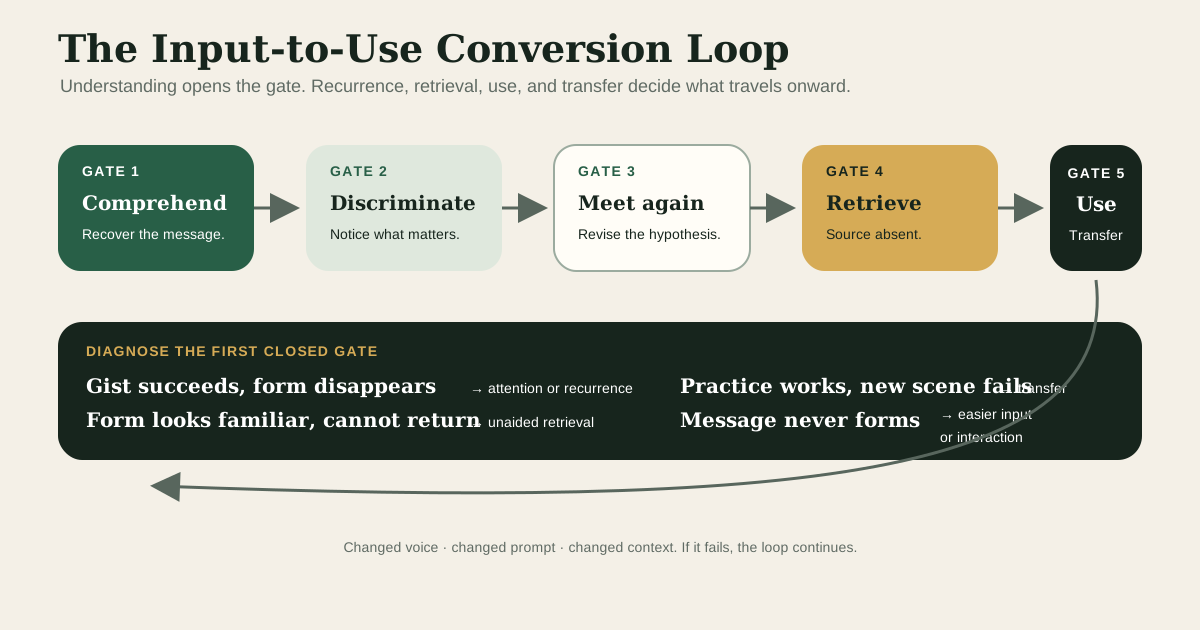
Comprehensible input is language whose message a learner can substantially understand through known language, context, prior knowledge, and interaction. It is indispensable because opaque noise offers little usable meaning, but comprehension is a gate rather than proof of acquisition. Understood language must recur, attract attention where needed, become retrievable, enter communication, and survive a changed context. Interaction can improve immediate comprehension; even then, what was understood may not become vocabulary, grammar, or independent production. loschky-study, nation-best-practice, cefr-companion
Comprehension can be real while learning remains fragile
You follow a video. The scene is obvious, the speaker is expressive, and subtitles rescue the difficult line. At the end, you can explain what happened. Tomorrow, none of the language returns.
Nothing fraudulent occurred. You understood the message. The mistake is concluding that message comprehension and durable command of its forms are the same event.
Loschky’s experiment made this distinction unusually visible. Learners of Japanese received different input and interaction conditions. Negotiated interaction produced the highest moment-to-moment comprehension, yet differences in immediate comprehension did not correlate with gains on the study’s vocabulary-recognition and locative-structure measures. loschky-study All groups showed gains, but the result resists a simple equation: more understood now equals more acquired later.
The evidence supports comprehensible messages as a central learning condition, negotiated interaction as a route to better immediate understanding in one experiment, and a curriculum broader than input alone. It does not support an exact comprehension percentage, one universal difficulty formula, or the claim that understood content automatically becomes productive language.
Claim sources: loschky-study, nation-best-practice, cefr-companion
Five gates between input and use
Gate one: recover the message. The learner can follow enough meaning to form a coherent interpretation.
Gate two: discriminate what matters. A sound, boundary, word, or pattern becomes perceptible rather than dissolving into the message.
Gate three: meet it again. The form recurs across time and contexts, allowing the learner to revise an incomplete hypothesis.
Gate four: retrieve it without the source. Meaning or intention calls the language back after a delay.
Gate five: use and transfer it. The learner interprets or produces the language in a new scene, voice, or text.
Input can fail at any gate. A text may be so difficult that no stable message forms. It may be so easy that nothing new is processed. A vivid story may carry meaning while a useful phrase remains unnoticed. A highlighted phrase may be noticed but never retrieved. A memorized sentence may return only when the original video supplies its rhythm.
The gates are not a rigid acquisition sequence. They are diagnostic questions.
A Spanish example: understanding the story, missing the mechanism
An English-speaking learner watches a short Mexico-oriented Spanish clip about a missed appointment. Draft line:
No llegué a tiempo porque se descompuso el coche.
“I didn’t arrive on time because the car broke down.”
Variety: contemporary Mexican Spanish as the intended reference.
Transcription: standard Spanish orthography; no IPA is claimed.
Proficiency boundary: an early-intermediate learner following a familiar narrative.
Communicative consequence: the learner needs to explain a delay and its cause, not merely identify that something went wrong.
The scene, gesture, and cognates may make the event comprehensible. Yet the learner may not later retrieve a tiempo, may mis-segment se descompuso, or may avoid the causal structure entirely. The example completed model review for variety, wording, register, proficiency fit, and consequence.
The right response is not to make every viewing a grammar lecture. First preserve the message. Afterward, test one useful layer: hide the transcript and ask the learner to explain a different delay. If the causal relation survives but the phrase does not, the input created conceptual understanding without yet creating productive availability.
Interaction makes input adjustable
Comprehensibility is not a property of a file alone. In interaction, a learner can request repetition, confirm an interpretation, or ask what a word refers to. The other person can rephrase, point, slow selectively, or supply an example.
That negotiation can make a message more accessible, as it did in Loschky’s tested condition. loschky-study It can also teach interactional survival: the learner does not wait passively for perfectly graded speech but learns to repair understanding.
Still, a helpful interlocutor can conceal dependence. The transfer test must eventually remove the exact supports that made the first exchange successful.
Run a five-gate input cycle
Choose a two- to four-minute source with a message worth understanding.
- Listen or read once without a transcript or dictionary; record the gist and uncertainties.
- Revisit with bounded support; resolve only the uncertainties that block the message.
- Select one to three high-value forms whose function you can explain from context.
- Return after a delay and reconstruct the message without the source.
- Use one selected form in a changed but related situation.
- Meet a new sample containing the same form or function.
- Record which gate failed.
The cycle prevents two opposite errors: turning input into a decoding exam, and allowing entertainment-level understanding to masquerade as language learning.
The strongest input-only argument
Output produced too early can become anxious, inaccurate rehearsal. Explicit correction can interrupt attention to meaning. Rich, compelling input supplies vocabulary, syntax, discourse, pragmatics, and cultural knowledge in their natural relationships. For many beginners, more understandable listening and reading is exactly the neglected intervention.
All of that can be true. The reversal condition is the learner’s goal. If the desired capability is receptive—reading a field or enjoying stories—input may dominate the portfolio. If the learner must explain, negotiate, write, or speak, output and retrieval are not ideological additions; they are parts of the target performance.
Nation’s course account places meaning-focused input beside meaning-focused output, focused learning, and fluency development. nation-best-practice The CEFR likewise distinguishes reception, production, interaction, and mediation. cefr-companion A balanced system does not diminish input. It stops input from being held responsible for every missing operation.
When input becomes beautiful avoidance
- material is selected for prestige rather than recoverable meaning;
- subtitles remain visible before an unaided attempt;
- hours rise while delayed reconstruction remains impossible;
- the learner never checks whether a useful phrase can be retrieved;
- one familiar narrator becomes the entire listening world;
- “silent period” has no exit condition despite a productive goal.
The correction is not forced conversation at all costs. It is one small, diagnostic act outside the source.
What comprehension cannot prove
The Loschky study used Japanese, specific participants, input conditions, and acquisition measures; it cannot prescribe one Spanish curriculum. Comprehension is difficult to measure, and a correct gist can coexist with serious local misunderstanding. The Spanish exchange is labeled for variety, transcription, proficiency boundary, and communicative consequence after model-only review; human English–Spanish validation was not performed. Clinical language, hearing, or literacy needs require appropriate expertise.
Input is where another language first becomes inhabitable. Learning continues when forms emerge from the scene, return after it has vanished, and help the learner understand or do something the source never rehearsed.
Place the loop inside How Adults Learn a New Language, diagnose missing production in Why You Understand More Than You Can Speak, and calibrate lexical load with How Much Vocabulary Do You Need?.
Named sources
Evidence and further reading
Published July 29, 2026. No substantive revision has been recorded. Evidence last verified July 28, 2026.