Why You Understand More Than You Can Speak: Diagnose the Missing Operation
Diagnose why language recognition outpaces speaking, distinguish lexical access from planning and anxiety, and run a Spanish recognition-to-production bridge.
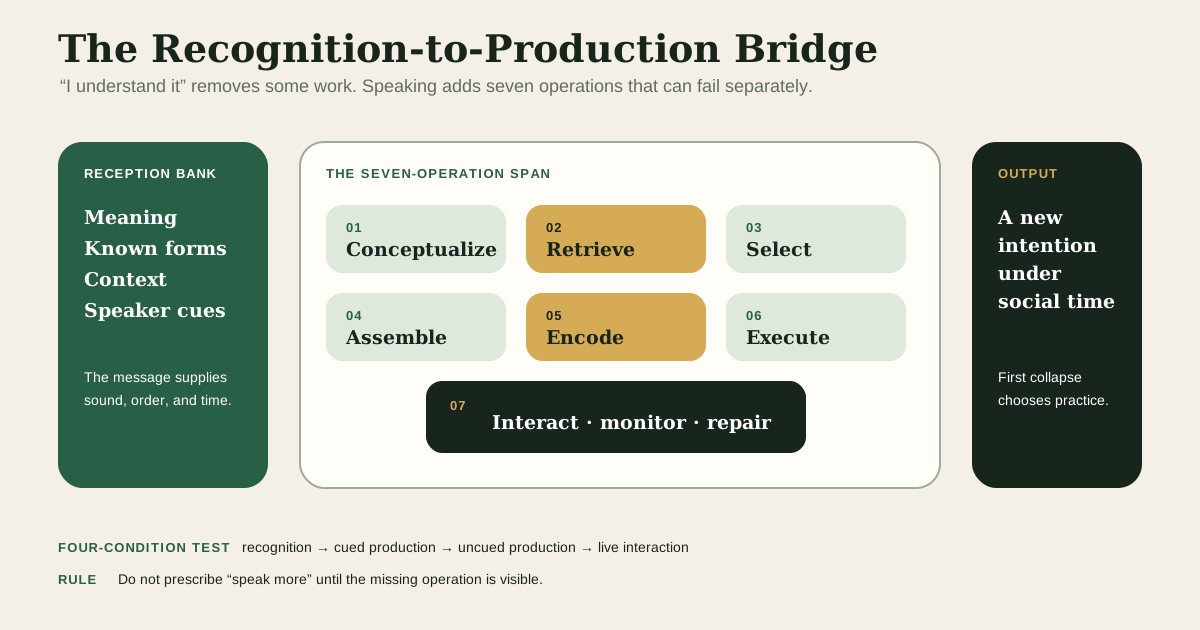
You can understand more than you can speak because recognition supplies the language, while production must retrieve words, select among competitors, assemble grammar, encode sound, articulate, monitor, and manage another person in real time. The gap is normal but not self-explanatory. Test whether the failure is lexical access, sentence planning, pronunciation, time pressure, anxiety, or interactional timing; then practise that operation and require transfer to a new prompt. More input helps only when missing knowledge is the bottleneck. gap-study, nation-book, cefr-companion
Understanding removes only some of the work
When another person speaks, much of the message is already present. Sounds, words, order, and context constrain interpretation. When you speak, an intention must become language before time and attention run out.
That asymmetry makes the receptive–productive gap unsurprising. It does not make every gap identical.
A study of young second-language learners reported a robust receptive–expressive vocabulary gap across its measures and investigated possible mechanisms. gap-study The finding is relevant but bounded: children retrieving tested words are not adults conducting spontaneous conversations. Nation’s vocabulary framework separately considers knowing a word, receptive and productive use, multiword units, and testing. nation-book The CEFR distinguishes reception, production, interaction, and mediation. cefr-companion
Together, these sources support a distinction. They do not supply a universal cause.
The evidence supports measurable separation between receptive and expressive vocabulary and distinguishes receptive from productive language activities. The seven-operation bridge below is a diagnostic synthesis. It has not been validated as a clinical instrument or a universal sequence.
Claim sources: gap-study, nation-book, cefr-companion
Seven operations hidden inside “say it”
- Conceptualize: decide what you mean.
- Retrieve: summon suitable words or chunks.
- Select: suppress plausible but wrong alternatives.
- Assemble: fit forms into an intelligible sequence.
- Encode: prepare the sound pattern.
- Execute and monitor: speak while detecting consequential errors.
- Interact: time the turn, read the listener, and repair misunderstanding.
Reading or listening exercises may support several of these operations indirectly. They do not require the learner to perform all of them under social time.
A Spanish case: one phrase, four different failures
An English-speaking learner understands this draft Mexico-oriented Spanish sentence in a message:
Me quedé sin batería.
“My battery ran out / I was left without battery.”
Variety: contemporary Mexican Spanish as the intended reference.
Transcription: standard orthography; pronunciation evidence is not claimed.
Proficiency boundary: early-intermediate everyday problem reporting.
Communicative consequence: the learner needs to explain why communication stopped.
Later, asked why they disappeared from a call, the learner says nothing. The example has received model-language review. At least four explanations compete:
- the meaning is recognized only when the phrase is visible;
- quedarse sin cannot be retrieved as a unit;
- the learner retrieves words but cannot assemble the past form quickly;
- the sentence is ready internally, but social time pressure blocks execution.
Each explanation predicts a different pattern. A translation card tests the first two poorly. Another hour of passive listening may not solve the fourth.
Run a four-condition bridge test
Use one message the learner can already understand.
Condition A: recognition. Present the original sentence and ask for its local meaning.
Condition B: cued production. Remove the key phrase but preserve the sentence frame or first sound.
Condition C: uncued production. Give only the communicative intention in a changed scene.
Condition D: interaction. Ask an unexpected follow-up and require repair.
Record where performance first collapses.
| Pattern | Stronger current explanation | Practice | |---|---|---| | A fails | knowledge or segmentation | return to understandable input and form–meaning mapping | | A succeeds, B fails | weak lexical access | meaning-to-form retrieval across delays | | B succeeds, C fails | cue dependence or assembly | varied sentence generation from intentions | | C succeeds, D fails | timing, monitoring, affect, or interaction | bounded live turns and repair routines |
This is not a diagnosis of the person. It is a hypothesis about one language operation in one task.
Chunks reduce assembly without eliminating thought
Multiword units such as me quedé sin… can give production a larger retrievable unit. That reduces the number of decisions required in the moment. It does not mean memorizing an entire conversation or using formulas without understanding.
A useful chunk is generative: it keeps a stable relationship while accepting meaningful variation. The learner might later report losing signal, time, money, or another resource—only after a reviewer confirms which completions are natural in the target variety and scene.
The transfer test changes both content and interlocutor. If the expression appears only inside the original prompt, the bridge remains cue-bound.
The strongest argument for simply speaking more
Production becomes easier through production. Conversation creates time pressure, feedback, repair, emotional salience, and the need to select. No private diagnostic can fully reproduce it.
That is correct when lack of production opportunity is the bottleneck. It reverses when conversation repeatedly rehearses avoidance, when the partner supplies every missing word, or when failure is caused by an unperceived contrast or unknown construction. “Speak more” names a dose, not the active ingredient.
The better rule is to increase the smallest form of output that exposes the missing operation while keeping the message worth expressing.
Why more conversation can miss the cause
- a generous partner guesses the intended meaning;
- the learner repeats familiar stories and never varies the demand;
- feedback targets grammar while retrieval is failing;
- anxiety is interpreted as missing knowledge;
- unknown language is treated as a confidence problem;
- successful cued production is mistaken for free availability.
Every intervention needs a reversal condition. If targeted retrieval improves private production but live interaction still collapses, move the investigation to timing, listener response, and affect.
What the gap does not reveal
The receptive–expressive study reviewed young learners and vocabulary tasks; it does not quantify an adult conversational gap. Production failures can involve language knowledge, working conditions, anxiety, speech or hearing needs, discrimination, or interactional context. Model review checked the example’s variety, transcription, naturalness, proficiency fit, and communicative consequence, but this is not human English–Spanish certification. Clinical concerns require appropriate professional assessment.
The gap is not evidence that your “real level” is low. It is evidence that a performance contains operations your current practice has not yet made sufficiently available. Once the first failing operation is visible, frustration can become an experiment.
Start with Comprehensible Input, distinguish word quantity from usable combinations in Vocabulary Coverage and Chunks, and investigate real-time collapse in Why You Freeze When Speaking.
Named sources
Evidence and further reading
Published July 29, 2026. No substantive revision has been recorded. Evidence last verified July 28, 2026.