Why You Freeze When Speaking a Second Language—and How Fluency Develops
Diagnose freezing as the interaction of retrieval, formulation, attention, anxiety, task demands, and repair—then train fluency without demanding speed.
You may freeze because word retrieval, grammar, pronunciation, monitoring, interaction, and anxiety compete for limited attention. Diagnose the bottleneck by changing one condition at a time. Build fluency through familiar content, repeated tasks with variation, useful chunks, repair strategies, and progressively less preparation—not by forcing maximum speed. Speech patterns vary across individuals and languages, and persistent freezing may involve clinical, hearing, speech, or mental-health factors.
A pause is an observation not a diagnosis
Silence can mean searching for a word, reorganizing an idea, monitoring accuracy, fear of evaluation, failure to hear the partner, or simply a thoughtful speaking style. Treating every pause as “low fluency” hides the intervention.
Research separates utterance fluency from underlying cognitive fluency and from a speaker's first-language patterns. fluency, anxiety, cefr Studies also find relationships among speaking anxiety, task complexity, and breakdown fluency under specific conditions. anxiety
The first move is comparison, not self-judgment.
The demand stack
During spontaneous speech, a learner must:
- formulate the message;
- retrieve words and chunks;
- encode grammar;
- articulate intelligibly;
- understand the other person;
- monitor their response;
- manage the turn and social stakes.
Preparation removes some demands. A familiar topic reduces conceptual work. A supportive partner reduces threat. A phrase such as “Give me a moment to think” buys interactional time.
An English–Japanese interactional example
A learner who goes silent while planning a longer answer can rehearse 少し考えさせてください (sukoshi kangae sasete kudasai, “Please let me think for a moment”). The phrase is not evidence that anxiety or retrieval caused the pause. It is an interactional tool that preserves the turn while the learner tests the diagnosis.
Variety: Tokyo-oriented Standard Japanese as the proposed reference.
Transcription: Japanese script plus modified Hepburn romanization.
Proficiency boundary: intermediate conversation in a polite register; the
form is not presented as appropriate for every relationship or region.
Communicative consequence: the listener receives an explicit request for
planning time instead of having to interpret silence as completion,
confusion, or withdrawal.
The diagnostic contrasts
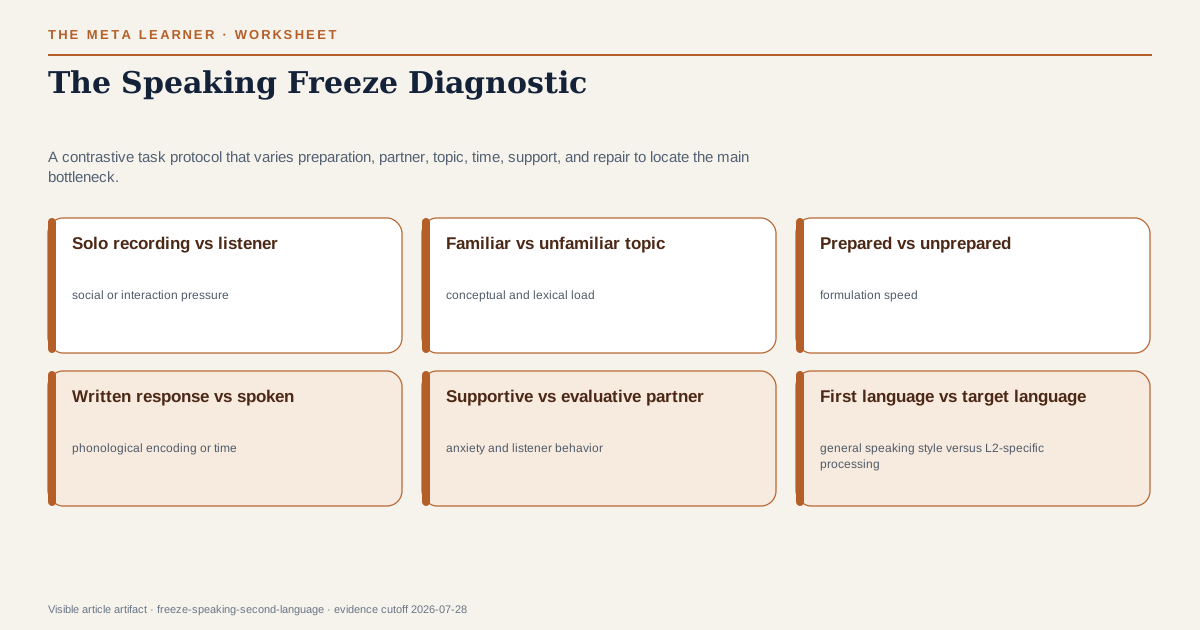
Perform the same communicative function under paired conditions:
| Contrast | If performance changes, investigate | |---|---| | Solo recording vs listener | social or interaction pressure | | Familiar vs unfamiliar topic | conceptual and lexical load | | Prepared vs unprepared | formulation speed | | Written response vs spoken | phonological encoding or time | | Supportive vs evaluative partner | anxiety and listener behavior | | First language vs target language | general speaking style versus L2-specific processing |
No single contrast proves a cause. It tells you what to test next.
Why the evidence supports the Speaking Freeze Diagnostic
Fluency research supports multidimensional analysis and influence from task, cognition, and speaker characteristics. CEFR describes fluency as one qualitative feature among range, accuracy, interaction, coherence, and phonology. Evidence does not justify equating fast speech with high proficiency.
fluency, anxiety, cefrRepetition without memorized captivity
Use a 4–3–2 variation:
- Explain a familiar idea in four minutes.
- Repeat it to a new listener in three minutes.
- Explain it again in two minutes.
- Change the audience or conclusion so that wording must adapt.
The familiar message frees attention for formulation; the changed condition prevents pure recitation. Do not compress time until meaning and intelligibility remain.
Build a repair repertoire
Fluent interaction includes managing trouble:
- “Let me say that another way.”
- “The word I need means…”
- “Do you mean X or Y?”
- “Could you repeat the last part?”
- “I have not finished the thought yet.”
Translate these functions into natural forms for your target language and variety with a competent source. Repair is not evidence of failure; it is communicative skill.
Reduce evaluative threat
Separate practice phases. In fluency work, a partner notes only errors that block meaning. Later, review one repeated pattern. Allow planning, then gradually remove it. Use predictable formats before high-stakes improvisation.
If anxiety is severe, generalized, or distressing, more exposure is not automatically the answer. A qualified mental-health professional or supportive teacher may help design an appropriate path.
Run a speaking freeze experiment
- Record a two-minute baseline in a target situation.
- Mark pauses without judging them.
- Run two diagnostic contrasts.
- Select one bottleneck and one support.
- Repeat the task across three days with varied content.
- Add one listener and explicit repair phrases.
- Compare message completeness, repair, and comfort—not words per minute alone.
Build retrieval with the Receptive–Productive Gap, develop interaction through How Adults Learn a New Language, and choose humane sound goals through Accent Reduction vs Intelligibility.
Compare the pause across controlled conditions
Record the same communicative function under four conditions: rehearsed alone, unrehearsed alone, with a supportive familiar partner, and with a new partner. Keep topic difficulty roughly stable. Mark silent pauses, filled pauses, abandoned messages, repair, and whether the listener understood. Do not interpret speed alone: an advanced learner may pause to formulate a precise qualification while a beginner speaks quickly through a memorized sequence.
Add one linguistic probe. Supply the needed vocabulary, then the grammar frame, then planning time on separate attempts. The support that changes performance suggests a bottleneck worth testing. Verify any model-generated phrases with a competent speaker and an appropriate corpus; an unnatural “repair phrase” can increase pressure. Language-pair, proficiency, turn-taking conventions, personality, and listener behavior set the boundary. A pattern limited to evaluative settings is different from a retrieval failure across private practice, and neither establishes a medical or psychological diagnosis.
Include the listener as part of the observation. Did they interrupt, finish sentences, change topic rapidly, leave repair time, or signal understanding? A learner may appear more fluent with a cooperative partner because interaction is jointly constructed. The intervention can therefore target turn-entry phrases and repair practice, but it may also target a safer speaking environment. Do not reduce every social breakdown to speed inside the learner.
Fluency practice that increases the threat
- Interrupting every error.
- Demanding native-like speed.
- Recording only unfamiliar topics.
- Comparing yourself with edited media.
- Memorizing one speech and calling it spontaneous fluency.
- Avoiding all pauses, fillers, and repair.
- Increasing social exposure without diagnosing distress.
Fluency is personal and context bound
Fluency measures are task- and language-sensitive, and listener bias can affect judgments. Speaking anxiety is not the sole explanation for freezing, and this article cannot diagnose a speech, hearing, neurological, or mental-health condition. Proficiency, language pair, cultural turn-taking norms, and individual speaking style must shape interpretation.
Fluency is not the absence of hesitation. It is increasing capacity to construct, sustain, and repair meaning while time and other people keep moving.
Named sources
Evidence and further reading
Published July 29, 2026. No substantive revision has been recorded. Evidence last verified July 28, 2026.