Why Native Speech Sounds So Fast: Perform a Ten-Second Listening Autopsy
Diagnose fast-speech difficulty through segmentation, reduction, lexical access, prediction, and a Mexico City Spanish ten-second listening autopsy.
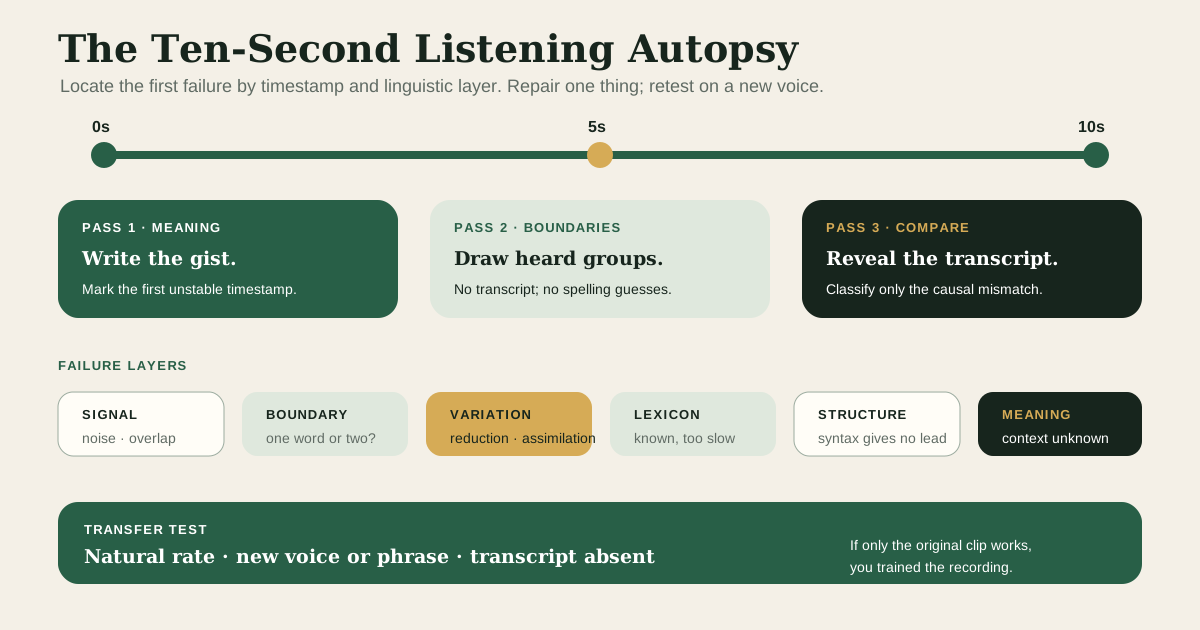
Native speech often sounds too fast because learners cannot yet locate word boundaries, recognize context-shaped pronunciations, retrieve words quickly enough, or use syntax and meaning to predict what comes next. Actual rate matters, but slowing everything can hide the cause. Take a difficult ten-second clip, mark the first lost timestamp, compare sound with the transcript only after an unaided pass, classify the breakdown, and retest with a new speaker. Train the failed layer, then return immediately to meaning. cutler-book, field-book, mexico-spanish mexico-spanish
The speed reading is often a symptom
“They speak too fast” is an honest perception and a weak diagnosis.
Written language has spaces. Careful teaching speech protects boundaries. Familiar words appear in their citation forms. Connected speech obeys different pressures: articulators move continuously, sounds adapt to neighbors, unstressed material may weaken, and listeners predict likely words before every acoustic detail has arrived.
Cutler’s account of native listening argues that spoken-word recognition is exquisitely tuned to the requirements of a listener’s known language. cutler-book The learner is not simply a native listener running at half speed. They may be applying boundary cues and sound categories that worked in another language.
The sources support language-specific spoken-word recognition, the pedagogical value of separating decoding from broader comprehension, and documented connected-speech variation in Mexico City Spanish. They do not establish that one reduction process or playback-speed setting explains every learner's difficulty.
Claim sources: cutler-book, field-book, mexico-spanish, cefr-companion
Five rival explanations for “too fast”
- Signal: the recording, device, noise, or overlap obscures information.
- Segmentation: the learner cannot locate likely word boundaries.
- Variation: familiar words appear in reduced, assimilated, or context-shaped forms.
- Lexical access: the word is known on paper but not retrieved at conversational speed.
- Prediction and structure: the listener cannot use grammar, discourse, or situation to narrow what comes next.
Rate amplifies all five. It is rarely the only variable.
Mexico City Spanish does not sound like spaced orthography
Consider the draft question:
¿De dónde eres?
“Where are you from?”
Variety: Mexico City Spanish as the phonetic reference, not all Spanish.
Transcription: standard orthography here; no narrow connected-speech transcription is supplied or claimed because this release has no human phonetic review.
Proficiency boundary: beginner social listening across natural voices.
Communicative consequence: failure to segment the question blocks an ordinary introduction even if each written word is familiar.
The phonetic illustration of Mexico City Spanish documents several reasons why connected speech cannot be reconstructed by reading one careful sound per letter. It reports approximant realizations associated with informal and faster speech, cross-word place assimilation when no pause intervenes, and final unstressed-vowel lenition ranging toward devoicing or deletion. mexico-spanish Those findings describe bounded data from a named variety; they are not a recipe for reducing every word.
The question completed model-language review. Its function is to establish a test scene, not to invent a single “native” pronunciation.
Perform the ten-second autopsy
Choose one natural, licensed or properly sourced clip with a transcript. Use no more than ten seconds.
Pass one: meaning without text. Listen once. Write the gist and mark the first timestamp at which the message becomes unstable.
Pass two: boundary hypothesis. Listen again and draw slashes where you believe meaningful groups begin and end. Do not guess the spelling yet.
Pass three: transcript comparison. Reveal the transcript. Mark only the mismatch that explains the failure:
- a word was unknown;
- a known word was not recognized acoustically;
- two words were heard as one or one as two;
- a sound differed from the expected citation form;
- syntax did not predict the continuation;
- the signal itself was inadequate.
Then create one repair and one transfer test.
| Failure | Repair | Transfer | |---|---|---| | unknown word | learn it in the local phrase | new sentence with the same function | | missed boundary | alternate audio and chunked transcript | unfamiliar voice, no transcript | | reduced realization | compare careful and connected natural tokens | new phrase with the same process | | slow lexical access | rapid meaning recognition in short phrases | changed topic at natural rate | | weak prediction | pause before the phrase and predict possibilities | parallel discourse with new content |
The autopsy ends after one explanatory layer. A clip annotated with twenty colored phenomena may look scholarly while teaching nothing portable.
Why slowing helps—and when it harms
Slower playback can reveal acoustic detail and lower working pressure. For an early pass, that can be useful. It becomes harmful when the altered signal removes the very transitions, rhythm, or reductions the learner must eventually recognize.
Use speed as a microscope, not a habitat:
- attempt natural rate;
- slow only enough to inspect the disputed span;
- return to natural rate;
- test a new voice or phrase.
If the learner succeeds only with the original slowed clip, the method has trained a recording.
The strongest exposure argument
Experienced listeners became experienced through enormous contact with speech. A ten-second analysis cannot replace extensive, meaningful listening. Excessive autopsy can make every sentence a crime scene and destroy attention to ideas.
Correct. The protocol reverses when the learner can recover the message and the same local failure no longer recurs. At that point, stop dissecting and listen. Field’s pedagogical account treats listening as more than a global comprehension score, but diagnosis remains in service of language use. field-book, cefr-companion
The ideal ratio is asymmetrical: much more meaningful listening than forensic analysis, with analysis reserved for recurring, high-value breakdowns.
Training that teaches the transcript
- reading subtitles before the first listen;
- replaying one voice until memory predicts every word;
- treating orthographic spaces as acoustic boundaries;
- slowing audio without returning to natural rate;
- imitating reductions without variety or register evidence;
- measuring success on the same clip used for diagnosis.
The transfer test must change the voice or item. Otherwise familiarity, not listening, can produce the score.
What a short clip cannot establish
The Mexico City Spanish source describes a bounded metropolitan variety and speaker sample; Spanish connected speech varies across region, community, style, and individual. A ten-second success cannot establish broad listening proficiency. Model-only review covered the example's variety, transcription boundary, naturalness, proficiency fit, and communicative consequence; no reviewed recording is included, and any future audio must be licensed or human-recorded and separately checked. Hearing concerns require appropriate professional assessment.
Fast speech becomes less mysterious when the learner stops asking where the speaker “deleted the words” and starts asking which cues an experienced listener used to find them.
Use How to Improve Listening and Pronunciation for the full diagnostic tree, compare goals in Accent Reduction vs Intelligibility, and return the repaired clip to Comprehensible Input.
Named sources
Evidence and further reading
Published July 29, 2026. No substantive revision has been recorded. Evidence last verified July 28, 2026.