Critical Thinking: How to Evaluate Claims and Evidence
A practical method for separating claims, evidence, assumptions, inference, and uncertainty before deciding what to believe or do.
Critical thinking is the disciplined evaluation of what a claim means, what evidence supports it, which assumptions connect evidence to conclusion, what alternatives remain, and how confident a decision should be. It is not reflexive skepticism; it is calibrated judgment. No checklist supplies missing domain knowledge, eliminates motivated reasoning, or resolves values when evidence remains incomplete.
Start with the exact claim
Critical thinking begins before search. A reader confronting a contested claim must decide what the sentence actually asserts: description, cause, forecast, value judgment, recommendation, or several of these joined together. Until that object is precise, more sources may simply accumulate around different questions.
The method here is for people who cannot become specialists in every field but still need calibrated judgment. It is not automatic skepticism, debate performance, or certainty where evidence remains incomplete.
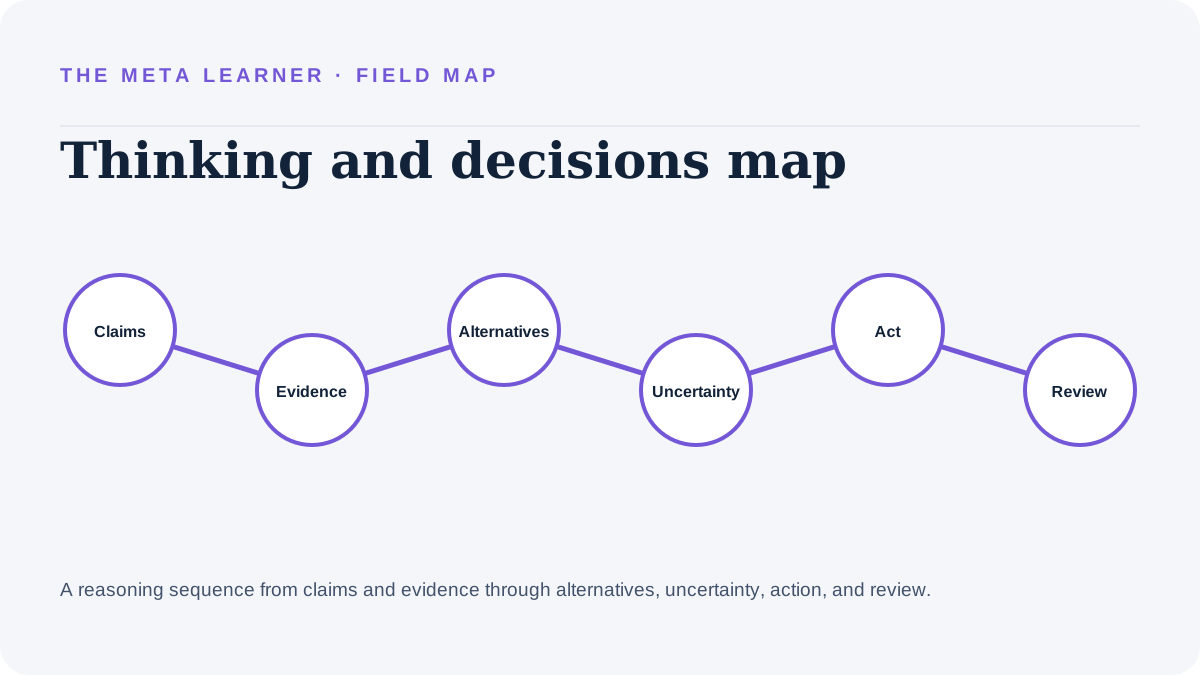
The method begins before fact-checking. A sentence may combine description, prediction, cause, and recommendation. Unless these claims are separated, one strong fact can lend unearned credibility to a weak conclusion.
The CLAIM check
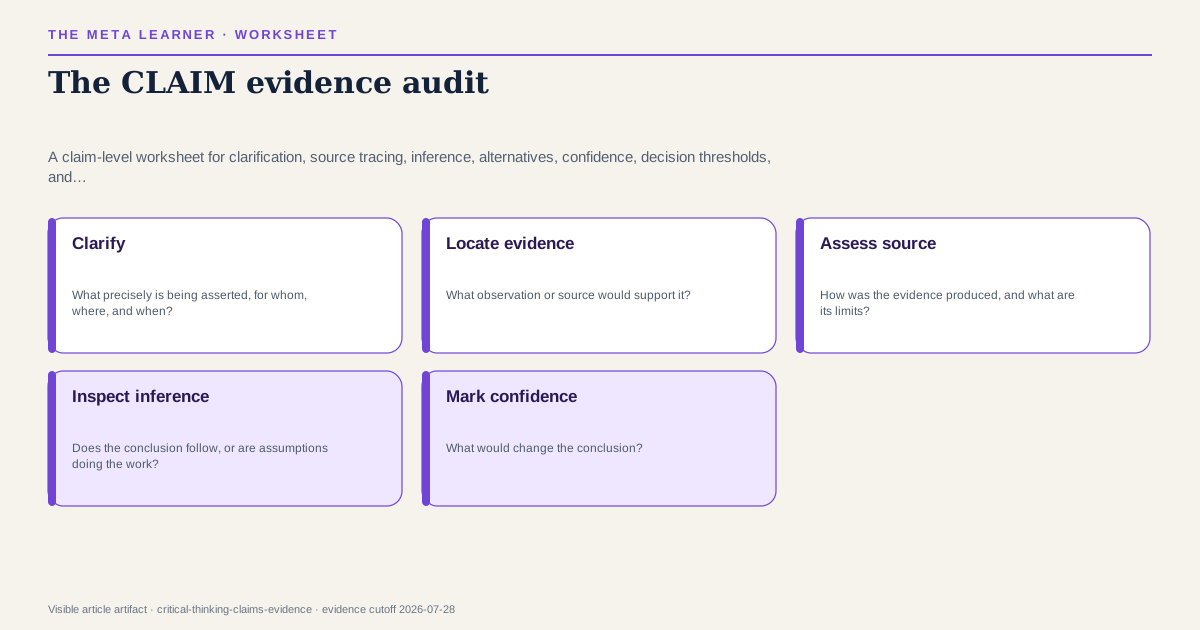
| Move | Question | |---|---| | Clarify | What precisely is being asserted, for whom, where, and when? | | Locate evidence | What observation or source would support it? | | Assess source | How was the evidence produced, and what are its limits? | | Inspect inference | Does the conclusion follow, or are assumptions doing the work? | | Mark confidence | What would change the conclusion? |
Apply the check to your preferred conclusion as carefully as to one you dislike.
The CLAIM evidence audit: evidence and boundary
Expert frameworks describe critical thinking as purposeful, self-regulatory judgment involving interpretation, analysis, evaluation, inference, and explanation. Research also shows that reasoning skills depend partly on domain knowledge and may not transfer automatically. Practice should therefore use real content and explicit transfer across contexts.
1, 2, 3Separate evidence from inference
Suppose a report says, “Seventy percent of surveyed firms plan to use AI, so most jobs will soon be automated.” The survey result, if valid, describes stated plans among a sample. The conclusion adds definitions of “use,” a causal model, a time horizon, and an assumption about jobs rather than tasks.
Write each bridge as a premise. Search for evidence about the weakest premise. This often turns a polarized debate into a tractable research question.
Evaluate the source in context
Authority is relevant but insufficient. Check who produced the evidence, how participants or cases were selected, what was measured, whether the comparison is appropriate, and whether newer evidence changes the picture. For web claims, leave the page and investigate the publisher; find independent coverage and trace quotations to their origin.
Ask what evidence is missing. Absence is not automatically proof of suppression, but selective presentation can change an interpretation.
Case: the 40-percent productivity headline
A report claims that an AI tool increased productivity by 40 percent, but the comparison group, task mix, and measurement window are unclear.
The audit must separate what the report measured from what the headline asks the reader to conclude:
| Observed signal | What it may mean | Next response | |---|---|---| | Large effect | Potentially important but underspecified | Ask what was measured against what | | Many citations | Quantity does not establish relevance | Trace each source to the exact claim | | Single explanation | Alternatives may be hidden | Generate rival causes and discriminating evidence |
The reviewer rewrites the claim with population, task, comparator, and time; separates measured output from inferred productivity; and lowers confidence until the design is known.
This reconstruction neither dismisses the reported increase nor accepts the automation conclusion. It identifies the missing comparison and the observation that would discriminate output acceleration from durable productivity.
Stress-test CLAIM in another domain
Apply CLAIM to a different domain without the table. First reconstruct a health, education, or labor claim; then let a knowledgeable reviewer identify the step where your inference becomes too strong. Transfer is present when you can locate the claim type, evidential warrant, live rival, and decision boundary without copying the wording of the AI-productivity example.
Construction before adversarial pressure
Critical thinking has a constructive phase and an adversarial phase. The constructive phase represents the strongest plausible version of the claim and identifies what would make it useful. The adversarial phase searches for missing assumptions, rival explanations, and disconfirming evidence. Starting only with attack encourages shallow dismissal; starting only with coherence encourages motivated acceptance. Good judgment needs both.
The practical consequence is symmetric burden. If a favored claim depends on an uncontrolled comparison, lower confidence by the same amount you would for an opposing claim. If a rival explains the evidence but predicts something different, seek that discriminator rather than accumulating sources that repeat the same design.
Run the CLAIM audit
Choose one consequential article or AI answer:
- Underline its three most important claims.
- Label each descriptive, causal, predictive, evaluative, or prescriptive.
- Write the strongest supporting evidence beside each.
- State the hidden assumption required for the inference.
- Generate one serious alternative explanation.
- Assign a confidence range and name the evidence that would move it.
- Write the most defensible decision, which may be “wait” or “test.”
Then seek a knowledgeable critic, not merely another source that agrees.
Preserve the mind-change threshold
For a consequential claim, retain its exact wording, population, measure, comparator, source chain, rival explanations, confidence range, and action threshold. “Large effect” is not a conclusion until magnitude, uncertainty, and practical importance are reconstructed. The record should expose later updates without erasing the reasoning that changed.
Ways a claim escapes scrutiny
- Treating rhetorical confidence as evidence quality.
- Demanding perfect evidence only from opposing claims.
- Using one anecdote to settle a population claim.
- Confusing correlation with cause.
- Assuming a credential makes every claim authoritative.
- Ending with “it is complicated” instead of a calibrated decision.
Route the weakest warrant to the right critic
Choose a reviewer whose knowledge matches the weakest warrant: a statistician for design, a domain specialist for mechanism, or an affected stakeholder for the values hidden in the recommendation. Ask the reviewer to mark the exact inferential bridge, not merely approve the conclusion. Preserve disagreement when experts apply different models; consensus manufactured by averaging can erase the most decision-relevant objection.
What CLAIM can and cannot establish
The evidence in this article supports a bounded design choice, not automatic skepticism, debate performance, or certainty in domains where evidence remains incomplete. The force of an argument depends on the kind of claim, the quality of its warrant, the relevant alternatives, and the consequence of being wrong. Preserve the route from evidence to conclusion, including the assumptions that carry the inference and the rival account that would explain the same facts. Where a conclusion can materially affect another person, critical scrutiny should include the governing standard and an accountable expert, not merely a sharper argument.
Limitations
No checklist eliminates motivated reasoning, missing data, or time pressure. Expertise can improve evaluation while also creating commitments and blind spots. Some decisions must be made before uncertainty resolves; in those cases, reversibility and monitoring matter alongside belief.
Critical thinking earns its name when it changes action: a claim is narrowed, evidence is sought, confidence is revised, or a safer experiment replaces premature certainty. Compare first principles and analogy, turn errors into deliberate practice, and extend linear claims with systems thinking.
Named sources
Evidence and further reading
Published July 29, 2026. Substantively updated July 29, 2026. Evidence last verified July 28, 2026.
- : Rebuilt the article around claim anatomy, rival explanations, symmetric source standards, and decision reversal.