First Principles vs Analogy: When to Use Each
First-principles reasoning rebuilds from constraints; analogy transfers patterns from prior cases. Strong problem solvers alternate between them.
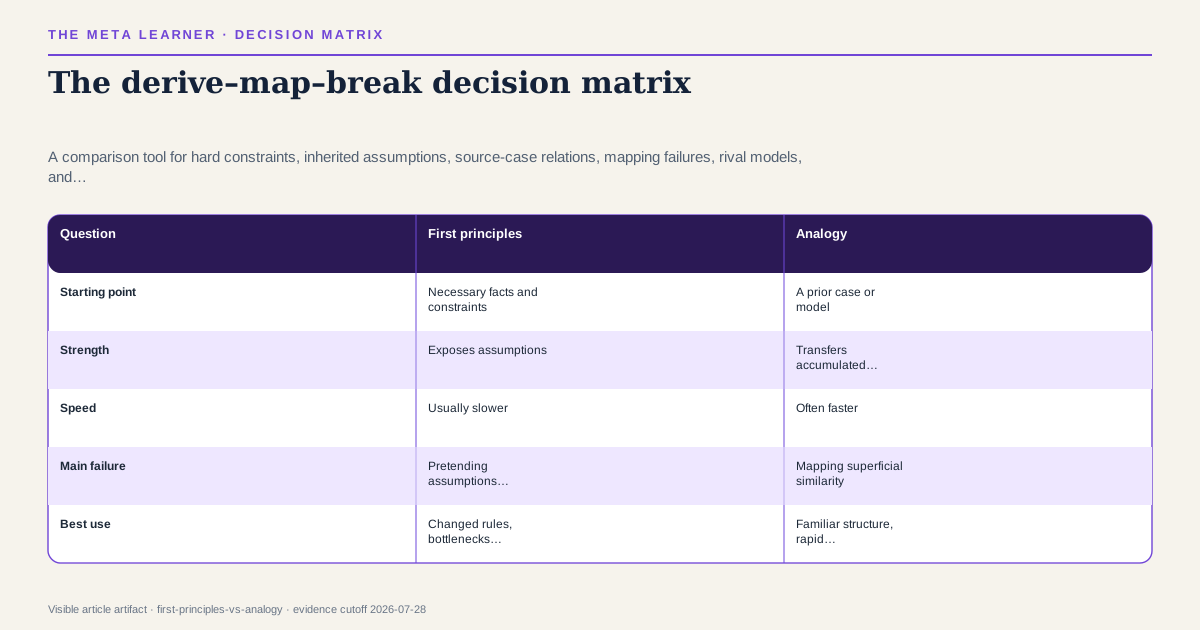
Use first-principles reasoning when inherited assumptions may be wrong, constraints have changed, or a novel design must be rebuilt from fundamentals. Use analogy when a structurally similar case offers tested patterns, speed, or a useful hypothesis. Alternate between them and test where the mapping breaks. Complex social problems rarely permit complete derivation, and every analogy omits features whose importance may appear only after action.
Two engines of invention
Problem-solvers rarely choose between pure derivation and pure imitation. First-principles reasoning strips a design back to defended constraints; analogy imports relational structure from a prior case. The productive tension is that each exposes the other’s hidden assumptions.
The comparison covers decomposition, invariants, reference classes, structural similarity, and switching between modes. It rejects both myths: that first principles are assumption-free and that analogy is merely a shortcut.
The methods are sometimes presented as opposites: original thinkers derive, ordinary thinkers copy. In practice, reasoning from fundamentals still depends on concepts learned from prior cases, while a good analogy requires abstracting underlying relations rather than copying surface features.
Constraint-building and structure-transfer
| Question | First principles | Analogy | |---|---|---| | Starting point | Necessary facts and constraints | A prior case or model | | Strength | Exposes assumptions | Transfers accumulated experience | | Speed | Usually slower | Often faster | | Main failure | Pretending assumptions are fundamentals | Mapping superficial similarity | | Best use | Changed rules, bottlenecks, redesign | Familiar structure, rapid hypotheses |
The output of either method should be a testable model, not a slogan.
What survives the comparison: the derive–map–break decision matrix
Cognitive research on analogy emphasizes mapping relationships between source and target, not simply matching visible features. Transfer is difficult when learners do not notice the relevant structure. This supports explicit comparison and boundary testing whenever an analogy guides a decision.
1, 2, 3Reason from constraints
Start by defining the objective and separating:
- physical, logical, legal, or mathematical constraints;
- current costs and conventions;
- assumptions inherited from the existing solution;
- values or tradeoffs that require a choice.
“Customers require a weekly report” may be a convention; “a regulated decision needs an auditable record” may be a harder constraint. Reframing can reveal solutions that preserve the need while changing the form.
First-principles language is easy to abuse. If a statement cannot be defended with evidence or a transparent derivation, it may simply be another assumption wearing a prestigious label.
Transfer an analogy carefully
Choose more than one source case. Describe the causal or relational structure: actors, incentives, resources, feedback, and failure modes. Map each element to the target and write where correspondence fails.
For example, calling a knowledge system a “garden” highlights cultivation and gradual development, but plants do not evaluate sources or pursue projects. The metaphor suggests maintenance; it cannot determine information architecture.
Case: a subscription model crosses markets
A founder copies a successful subscription model from another market without checking whether usage frequency and switching costs are comparable.
The comparison becomes useful only when each route exposes a different assumption and therefore recommends a discriminating observation:
| Observed signal | What it may mean | Next response | |---|---|---| | Famous precedent | Availability may substitute for similarity | Name the shared causal structure | | Blank-slate claim | Hidden assumptions remain | List physical, legal, and behavioral constraints | | Modes disagree | A useful diagnostic opportunity | Find which assumption creates the divergence |
The founder uses analogy to generate a candidate model, first principles to test demand frequency and economics, and a small experiment to resolve the most consequential uncertainty.
The small experiment does not establish that the borrowed model scales. It asks whether the relation that made the source case work—usage frequency, recurring value, and switching behavior—exists in the target market.
Break the analogy on purpose
Transfer the same source analogy to a second target whose surface features are similar but incentive structure differs. Then derive both targets from their constraints without naming the source case. If the recommendations diverge, identify the relation responsible. Successful transfer is not loyalty to one method; it is knowing which mapping or “fundamental” failed.
Run the constraint-analogy sequence
Take one problem and run both routes:
- Write the desired outcome and hard constraints.
- List three assumptions that could be removed.
- Derive one design from the remaining constraints.
- Find two structurally related cases from different domains.
- Map relations, not visual features.
- Identify one break point in each analogy.
- Design a small test that distinguishes the competing proposals.
The exercise is successful if it produces clearer uncertainty and a better experiment, not if one method “wins.”
Keep model provenance
Record the target, claimed hard constraints, removable conventions, source case, relational mapping, break points, and the smallest test that distinguishes the competing designs. A famous precedent raises the value of inspection; it does not establish transfer. A “fundamental” earns its name only when evidence or derivation makes it harder to remove than a familiar assumption.
When decomposition and analogy distort
- Calling preferences or current prices fundamental.
- Rejecting precedent in the name of originality.
- Choosing an analogy because the story is memorable.
- Transferring a tactic without matching incentives.
- Using only successful comparison cases.
- Ending with conceptual elegance instead of testing.
Limitations
Complex social systems rarely yield to complete derivation, and analogies inevitably omit features. Time and evidence constraints may force a provisional choice. Use multiple models, state assumptions, prefer reversible moves, and monitor whether predicted mechanisms appear.
First principles clear the ground; analogy carries useful structures across it. Skilled reasoning knows when each movement has gone too far. Inspect wider system feedback, apply the CLAIM audit, and carry the rival models into decisions under uncertainty. When both routes support the same action for different reasons, retain both predictions: their later divergence may reveal which model was actually doing the explanatory work.
Named sources
Evidence and further reading
Published July 29, 2026. Substantively updated July 29, 2026. Evidence last verified July 28, 2026.
- : Replaced templated sections with a dual-model test for constraints, structural analogy, mapping failure, and transfer.