How to Make Decisions Under Uncertainty
Make better uncertain decisions by defining options, using base rates and ranges, separating value from information, and favoring reversible tests.
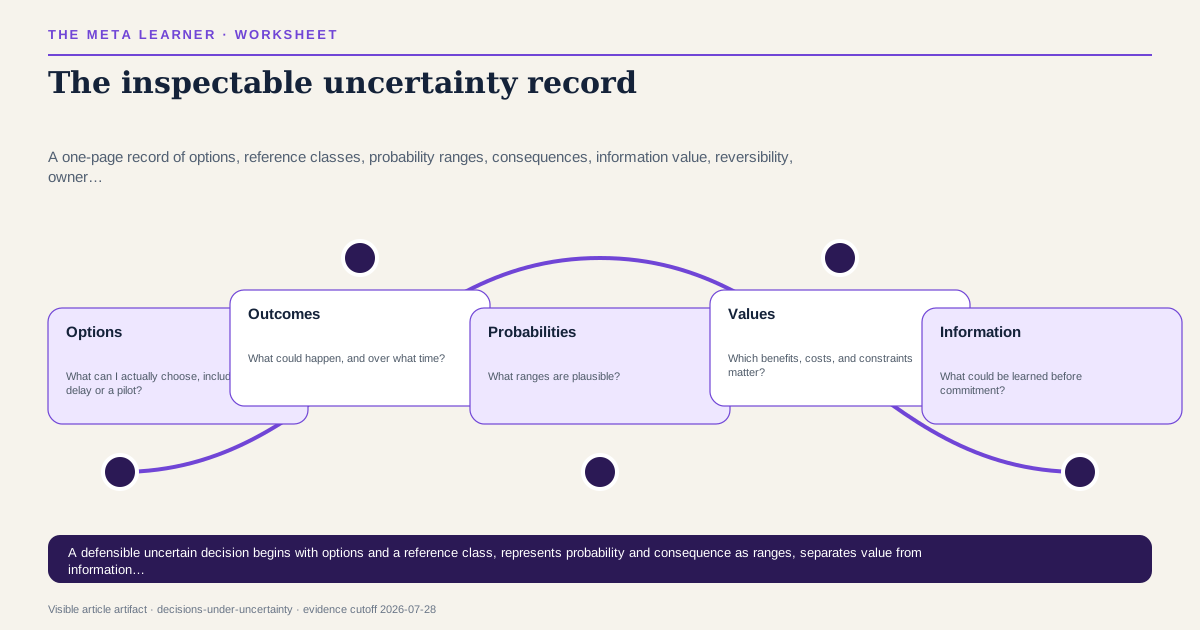
Decide under uncertainty by defining the choice and time horizon, starting from relevant base rates, representing outcomes as ranges, comparing expected consequences, and asking what information is worth acquiring. When possible, choose reversible tests that produce evidence before larger commitment. Reference classes may be contestable, probabilities deeply uncertain, and stakeholder values impossible to combine in one score.
Decisions begin where certainty ends
A consequential choice usually arrives before all relevant information can be known. Waiting is still an option with costs, and numerical confidence does not remove value conflict. The task is to make options, ranges, consequences, thresholds, and update rules inspectable before luck reveals the outcome.
This article covers base rates, scenarios, value of information, reversibility, and decision records. It does not manufacture precise probability from weak evidence or compress accountability into one score.
Uncertainty is not the absence of a decision. Waiting is also an option with costs and effects. The goal is not to feel certain but to make the reasoning inspectable and update it when new evidence arrives.
A compact decision frame
| Component | Question | |---|---| | Options | What can I actually choose, including delay or a pilot? | | Outcomes | What could happen, and over what time? | | Probabilities | What ranges are plausible? | | Values | Which benefits, costs, and constraints matter? | | Information | What could be learned before commitment? | | Reversibility | Which choices preserve future options? |
Do not let the most vivid outcome become the only one modeled.
The inspectable uncertainty record: evidence and boundary
Research on judgment documents systematic errors involving representativeness, availability, anchoring, and base-rate neglect. Forecasting research suggests that decomposition, probabilistic estimates, active updating, and feedback can improve calibration. These practices reduce some errors; they do not eliminate uncertainty or value conflict.
1, 2, 3Start outside, then come inside
The outside view asks what happened in a relevant reference class. If considering a twelve-week learning project, examine completion rates and time demands for comparable projects, not only your best-case schedule.
Then use the inside view: what is genuinely different about this case? Update from the base rate rather than ignoring it. Express uncertainty as a range and write which evidence justifies moving away from the reference class.
Separate probability and value
A likely outcome is not automatically desirable, and a low-probability outcome may deserve attention if its consequence is catastrophic. For each option, list material upsides and downsides. Use rough expected-value calculations when the numbers are meaningful, but do not hide ethical constraints or distributional effects inside one score.
Ask about asymmetry. A small pilot may cap downside while preserving learning. A public irreversible claim may carry reputational cost far beyond its immediate benefit.
Case: a stable role versus an uncertain AI company
A professional considers leaving a stable role for a young AI company with uncertain funding and learning potential.
The decision record separates narrative attraction from the uncertainties that can change the choice:
| Observed signal | What it may mean | Next response | |---|---|---| | Compelling story | Inside-view detail may dominate | Add base rates and failure modes | | More research | Information may not change the choice | Estimate its decision value | | Irreversible commitment | Downside deserves more scrutiny | Create a staged option where possible |
She writes scenarios, identifies a runway threshold, negotiates a staged start, and records what evidence would reverse the choice. Uncertainty is managed through structure and options, not denied.
The staged start has value only if it tests the pivotal uncertainties before the professional gives up the recovery path. It cannot simulate every cultural or career consequence, and it should not be described as risk-free.
Change the owner and downside
Rebuild the record for an organizational investment rather than a career move. Change the distribution of downside and the person who can reverse the choice. If the same worksheet produces the same recommendation despite those changes, it is being completed mechanically. Transfer means preserving the logic while allowing values, reference classes, and thresholds to change the action.
Build the uncertainty table
Write a one-page decision record:
- Decision, owner, deadline, and objective.
- Three real options.
- Reference class and base-rate evidence.
- Best, expected, and worst plausible outcomes for each.
- Probability ranges and confidence.
- Key assumptions and one disconfirming indicator.
- Reversibility and cost of delay.
- Decision, reason, and review date.
After the outcome, score the process separately from luck. A good decision can have a bad result; review whether evidence was used well given what was knowable then.
Freeze the forecast before the outcome
Freeze the options, evidence, ranges, value judgments, decision owner, and reversal conditions at choice time. Append new evidence rather than rewriting the original rationale. A compelling story is a prompt to seek a reference class; a base rate is a starting distribution, not permission to ignore genuine local mechanism evidence.
Decision traps under uncertainty
- Creating precise probabilities from no evidence.
- Treating one confident expert as a distribution.
- Ignoring the option to run a smaller test.
- Counting sunk cost as a future benefit.
- Evaluating decisions only by outcome.
- Updating selectively when news supports the preferred option.
Limitations
Probabilities may be deeply uncertain, reference classes contestable, and values incomparable. Models can exclude people who bear the consequences. High-stakes decisions need domain expertise, stakeholder input, and governance beyond a personal worksheet.
The discipline is to replace a story of certainty with a record of options, ranges, trade-offs, and update rules. Audit the underlying claim evidence, trace downstream effects through systems thinking, and use difficult reading when the decision depends on a demanding source. The record should remain understandable to someone who disagrees with the choice. Inspectability does not guarantee agreement; it makes the live factual, probabilistic, and value disputes available for challenge.
Named sources
Evidence and further reading
Published July 29, 2026. Substantively updated July 29, 2026. Evidence last verified July 28, 2026.
- : Rebuilt the guide around reference classes, ranges, information value, reversibility, and explicit update thresholds.