How to Read a Difficult Book
Read a difficult book by mapping its problem and structure, adjusting speed, retrieving the argument, tracing evidence, and testing application.
Read a difficult book by first identifying the problem it addresses and the route of its argument, then reading important sections slowly enough to reconstruct claims and evidence. Use retrieval, questions, and application to distinguish temporary comprehension from knowledge you can use. Genre, prior knowledge, language proficiency, and purpose determine which passes and external aids are appropriate.
Name the kind of difficulty
This guide is for adult readers tackling important books that exceed their current vocabulary, background knowledge, or conceptual map. It covers purpose, inspection, question-led reading, slow passages, reconstruction, external aids, and synthesis. It is not a requirement to finish every page, a speed-reading method, or a substitute for prerequisite study. Choose one difficult chapter and reconstruct its argument with the book closed. The reading has become usable when you can recover the claims, tensions, and evidence—not when every page is highlighted.
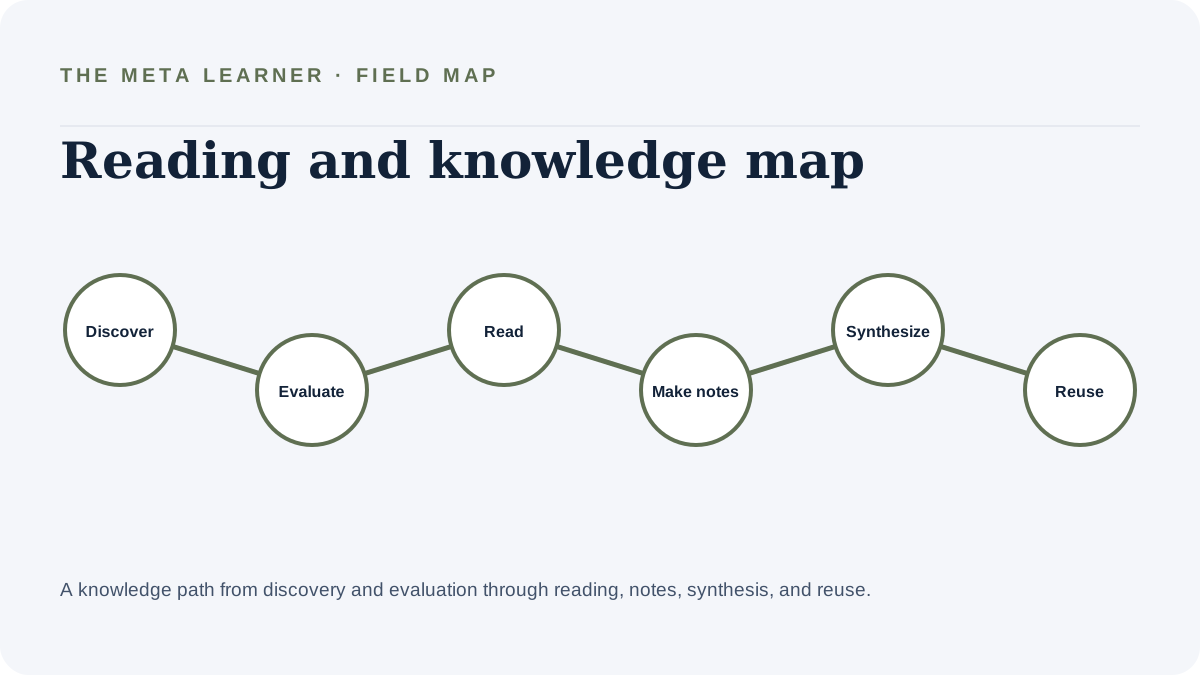
Difficulty can come from unfamiliar vocabulary, dense sentences, missing background, an unusual structure, abstract ideas, or a genuinely weak argument. Diagnosis matters because slowing down does not fix every kind of difficulty.
Four passes, unequal attention
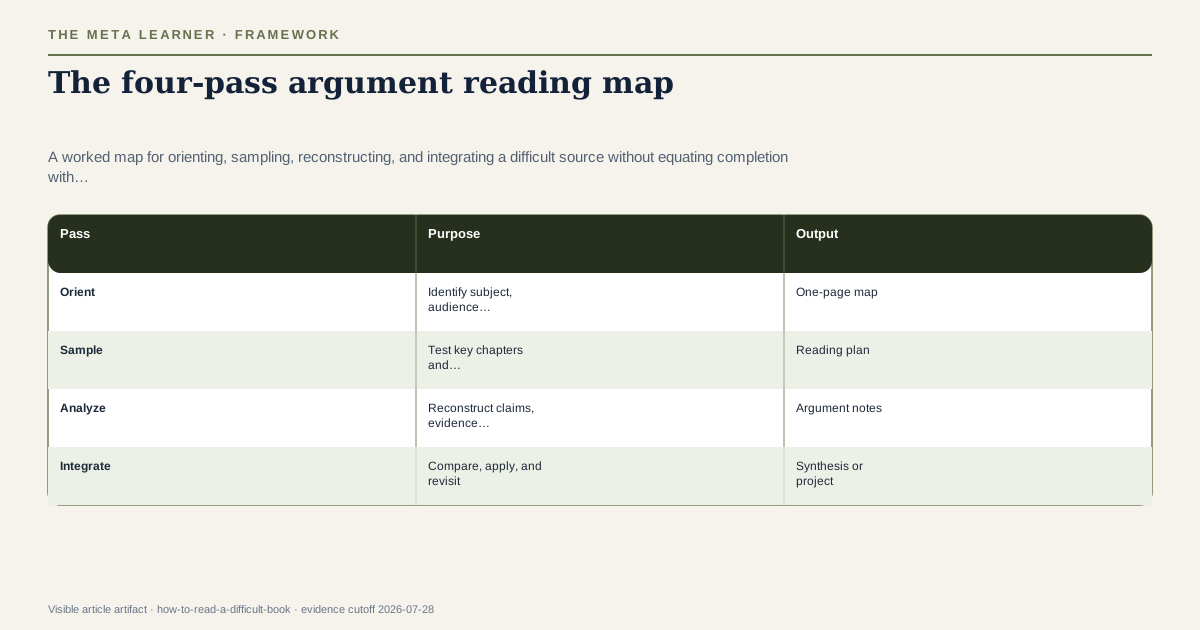
| Pass | Purpose | Output | |---|---|---| | Orient | Identify subject, audience, problem, and structure | One-page map | | Sample | Test key chapters and prerequisite needs | Reading plan | | Analyze | Reconstruct claims, evidence, and objections | Argument notes | | Integrate | Compare, apply, and revisit | Synthesis or project |
Not every page deserves the same attention. Difficult reading is selective attention guided by the author’s structure and your question.
Evidence for the closed-book move
Research on learning emphasizes prior knowledge, active construction, retrieval, and transfer. Retrieval studies show that attempting to reconstruct material can produce stronger later learning than additional exposure. These findings support closing the book periodically and rebuilding the argument rather than highlighting continuously.
1, 2, 3Pass one: build the map before the interpretation
Inspect the table of contents, introduction, conclusion, headings, index, diagrams, and notes. Write:
- What question does the book appear to answer?
- What kind of book is it: argument, synthesis, method, history, or reference?
- Which chapters seem load-bearing?
- What prior concepts may be assumed?
Read a central section and the conclusion before committing to a linear march. This reveals whether a prerequisite source or companion text would reduce avoidable confusion.
Passes two and three: reconstruct the load-bearing argument
For each important section, capture four things in your own words:
- The claim.
- The reason or mechanism.
- The evidence or example.
- The limitation, objection, or unanswered question.
Mark terms the author uses technically. Define them from context before reaching for a dictionary, then confirm. If a sentence remains opaque, identify its grammatical skeleton and rewrite it plainly without changing the claim.
Diagnostic case: page-one overload
A reader begins a dense economics book at page one, looks up every unfamiliar term, and loses the argument before chapter two.
The reader separates three different problems—orientation, prerequisite knowledge, and local reasoning—because each demands a different intervention:
| Observed signal | What it may mean | Next response | |---|---|---| | Every sentence is slow | Missing map or prerequisite | Inspect structure and identify the central question | | Heavy highlighting | Selection occurs without reconstruction | Close the book and state the argument | | Local clarity | Global relation is missing | Place the passage in the chapter’s role |
The reader inspects contents and conclusion, writes three questions, reads one argumentative chapter, diagrams its claims, and consults a secondary source only for a named gap.
This is a diagnosis for one argumentative work, not a universal reading ritual. A novel, reference manual, mathematical monograph, or sacred text may demand a different relation between sequence, language, and interpretation.
The closed-book argument trial
Close the book for a day, then draw the author’s problem, main claim, three load-bearing premises, strongest evidence, and best objection. Reopen the source and mark omissions or invented connections. Next, use the reconstructed argument to interpret a case the author did not discuss. That pair of tests distinguishes local familiarity from an argument model that can travel.
Match the aid to the obstacle
Difficult reading has at least three causes: unfamiliar language, compressed background knowledge, and genuinely complex reasoning. They require different responses. Vocabulary can be previewed; missing prerequisites may require a detour; complex reasoning needs reconstruction and examples. Treating every difficulty as a reason to slow down creates fatigue without diagnosis. The reader should name the obstacle before choosing the aid.
Match the aid to the diagnosed obstacle. Preview a glossary for technical language, study a prerequisite for compressed background, diagram the inference for complex reasoning, and challenge the evidence when the prose is clear but the argument is weak. “Read more slowly” is useful only when speed is the actual bottleneck.
A ninety-minute difficult-reading lab
Use a ninety-minute difficult-reading session:
- Ten minutes: orient and write one question.
- Twenty-five minutes: read the first selected section.
- Five minutes: close the book and reconstruct.
- Ten minutes: check gaps and trace one source.
- Twenty-five minutes: read a connected section.
- Ten minutes: draw the argument and strongest objection.
- Five minutes: schedule the next retrieval and application.
At the end of a chapter, write a 150-word explanation for an intelligent reader who has not opened the book. Avoid copying the author’s phrasing.
Preserve the evolving argument
For each load-bearing chapter, keep the question, reconstructed claim, premise, evidence, objection, and location in the source. Mark your interpretation separately. When a later chapter revises an earlier premise, amend the ledger instead of silently overwriting it. This produces a book-level argument that can be challenged without reducing the text to quotations.
Failure patterns that feel like seriousness
- Reading every page at one speed.
- Highlighting before knowing the argument.
- Looking up every unfamiliar term and losing the thread.
- Confusing difficulty with profundity.
- Summarizing chapters without evaluating evidence.
- Finishing the book but never retrieving or using it.
Invite disagreement only after reconstruction
Compare your reconstruction with a scholarly review, qualified reader, or competing interpretation only after writing your own. Ask where the two maps disagree: the author’s problem, a premise, the role of evidence, or the conclusion’s scope. Return to the original source to adjudicate what the text supports, and preserve unresolved disagreements rather than averaging them into false consensus.
Use How to Annotate for Argument, Not Highlighting for the ledger, compare empirical reading with How to Read a Research Paper, and use When Experts Disagree when the book enters a contested field.
What the method’s evidence does not license
The evidence in this article supports a bounded design choice, not a requirement to finish every page, a speed-reading method, or a substitute for prerequisite study. Difficulty can come from missing background, unfamiliar vocabulary, compressed argument, or genuine disagreement; each calls for a different reading move. Keep the author’s claim, your reconstruction, and your objection visibly separate so later notes do not turn interpretation into quotation. When a book is being used to guide clinical, legal, financial, or technical action, return to the governing evidence and involve qualified expertise rather than treating interpretation as authority.
Genre and expertise limits
Some books require specialized training, translation support, or a community of interpretation. A selective strategy can miss cumulative literary effects or intentionally nonlinear structures. The method should adapt to genre and purpose rather than forcing every book into an argument outline.
A difficult book becomes learnable when you stop treating completion as the objective. The aim is a defensible model of what the author claims, why, and what the idea lets you see or do.
Named sources
Evidence and further reading
Published July 29, 2026. Substantively updated July 29, 2026. Evidence last verified July 28, 2026.
- : Rebuilt as an argument-reconstruction protocol with diagnostic reading passes and transfer evidence.