When Experts Disagree: How to Weigh Competing Claims
Weigh expert disagreement by separating factual premises, models, values, forecasts, evidence quality, track records, and conditions for updating.
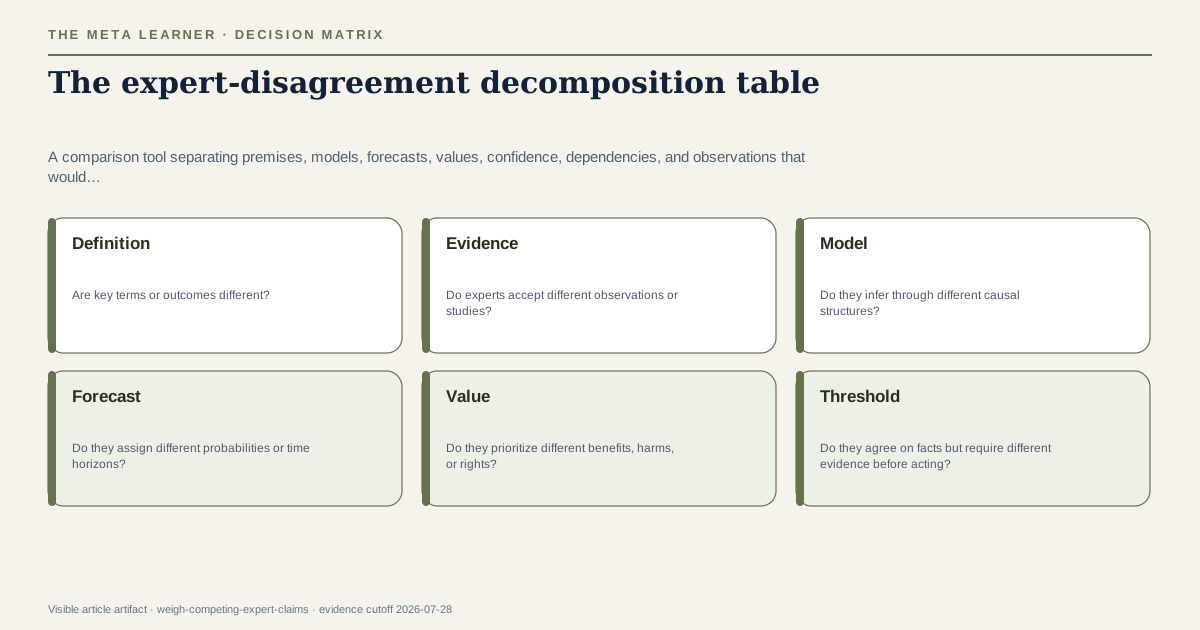
When experts disagree, do not begin by choosing a personality. Rewrite each position as explicit claims, then compare domain relevance, evidence, assumptions, uncertainty, independence, forecasting record, and conditions for updating. Separate disputes about facts from disputes about models, values, or action thresholds. Act using the downside and reversibility of the decision, not the fantasy that uncertainty must disappear first.
Why expert disagreement feels paralyzing
Expertise is indispensable precisely where independent verification is difficult. That creates a dilemma: the less you know, the harder it is to judge people who know more—and public disagreement can make every view look equally optional.
Two corrections help. First, “experts disagree” rarely means all qualified specialists are divided evenly. A mature consensus can coexist with disagreement about magnitude, mechanism, subgroup, policy, or future trajectory. Second, experts may agree on evidence while choosing different actions because values and risk tolerances differ.
Your task is not to become the expert overnight. It is to map the disagreement well enough to decide what confidence and action are justified.
Classify the disagreement
Use six categories:
| Type | Question | |---|---| | Definition | Are key terms or outcomes different? | | Evidence | Do experts accept different observations or studies? | | Model | Do they infer through different causal structures? | | Forecast | Do they assign different probabilities or time horizons? | | Value | Do they prioritize different benefits, harms, or rights? | | Threshold | Do they agree on facts but require different evidence before acting? |
Many debates contain several types. Labeling them prevents empirical evidence from being asked to settle a moral priority, or values from being disguised as a technical inevitability.
Establish the reference class
Ask who counts as an expert for this precise claim. A Nobel Prize in one discipline does not create expertise in another. A practitioner may know implementation constraints that a researcher has not studied; that experience does not automatically estimate population effects. An institution may possess relevant data while also holding material interests.
Evaluate:
- training and work directly related to the claim;
- access to relevant evidence;
- standing among domain peers;
- transparency of method and uncertainty;
- independence and conflicts;
- history of corrections and calibrated forecasts.
Authority is contextual, as the ACRL framework emphasizes.acrl-authority, cochrane-heterogeneity, ipcc-uncertainty Contextual does not mean arbitrary; it means the credential must fit the evidential job.
Evidence-synthesis and uncertainty guidance support examining heterogeneity, strength of evidence, agreement, likelihood, and confidence rather than reducing uncertainty to one number. IPCC terminology is designed for assessment reports and should not be copied mechanically into every field, but its separation of confidence and quantified likelihood is instructive.
Claim sources: cochrane-heterogeneity, ipcc-uncertainty, acrl-authority
Turn a dispute into a disagreement ledger
Give each position a column and complete these rows:
- exact claim;
- population, setting, and time horizon;
- strongest supporting evidence;
- strongest counterevidence acknowledged;
- causal model or mechanism;
- important assumptions;
- confidence and probability, if stated;
- financial, institutional, or ideological dependencies;
- prior forecast or relevant track record;
- observation that would change the view.
If an expert cannot state an update condition, the position may function as identity rather than inquiry. If you cannot state it on their behalf, read more before evaluating.
Treat heterogeneity as information
Conflicting study results need not mean one side is fraudulent. Populations, interventions, measurements, and biases may differ. Cochrane’s meta-analysis guidance warns that an average can mislead when effects vary and that heterogeneity should be investigated rather than ignored.cochrane-heterogeneity
Ask:
- Do effects change direction or only magnitude?
- Were analyses specified before results were seen?
- Could small-study or publication bias matter?
- Are apparently conflicting results compatible within their intervals?
- Does one contextual feature plausibly modify the effect?
Sometimes the right synthesis is conditional: X tends to help under A and B, may not under C, and remains unknown under D.
Separate confidence from action
The IPCC guidance distinguishes confidence in a finding from probabilistic likelihood language and asks assessment authors to consider evidence and agreement.ipcc-uncertainty Outside climate assessment, use plain language, but keep the conceptual separation.
Action also depends on:
- consequence of delay;
- consequence of a false positive;
- reversibility;
- option value of a small experiment;
- distribution of harms;
- ability to monitor and correct.
You may act at moderate confidence when delay is dangerous and action reversible. You may demand stronger evidence when action is irreversible or concentrates harm.
A worked disagreement
Experts disagree about whether generative AI will eliminate a profession.
The ledger reveals different claims:
- a capabilities researcher forecasts task performance on benchmarks;
- a labour economist estimates occupational exposure and adoption;
- a manager describes workflow redesign inside one firm;
- a worker organization emphasizes job quality and bargaining power;
- a vendor predicts rapid transformation while selling the tool.
These perspectives are not votes on one proposition. Capability is not adoption; exposure is not displacement; a firm case is not a labour-market estimate; aggregate growth does not settle distribution. The decision should move from “Who is right?” to “Which tasks, adoption constraints, institutional choices, and indicators would distinguish these scenarios?”
Build the disagreement ledger
For one consequential dispute:
- Select three strong, non-identical positions.
- Define the expert reference class.
- Complete all ten ledger rows with source links.
- Mark the disagreement type for each row.
- Identify shared premises and true cruxes.
- Assign a provisional confidence range, not a theatrical decimal.
- Choose a reversible action and monitoring signal.
- State what would make you update.
Use How to Make Decisions Under Uncertainty for action, Critical Thinking: A Practical System for Claims and Evidence for decomposition, and Systems Thinking for multi-level effects.
Ways readers manufacture false balance
- Selecting one famous dissenter and one consensus representative as equal camps.
- Counting credentials instead of checking domain fit.
- Averaging probabilities that answer different questions.
- Treating conflict of interest as automatic disproof—or ignoring it.
- Confusing confident delivery with calibrated judgment.
- Demanding complete agreement before low-risk action.
- Hiding value conflict inside arguments about “the science.”
- Updating only when the opposing side is wrong.
What the ledger cannot adjudicate
The ledger depends on visible evidence and honest representation. It can miss proprietary data, tacit knowledge, coordinated influence, publication bias, or unknown unknowns. Forecast track records may be too sparse to compare. In urgent clinical, legal, security, or safety decisions, use current authoritative guidance and accountable specialist advice rather than an independent scoring exercise.
Expert disagreement is not permission to believe anything. It is an invitation to identify the exact crux on which better evidence—or clearer values—could move the decision.
Named sources
Evidence and further reading
Published July 29, 2026. No substantive revision has been recorded. Evidence last verified July 28, 2026.